Sign in. It’s quick, free and it’s up to you.
An account is an optional way to support the work we do. Find out more.
Sign in. It’s quick, free and it’s up to you.
An account is an optional way to support the work we do. Find out more.
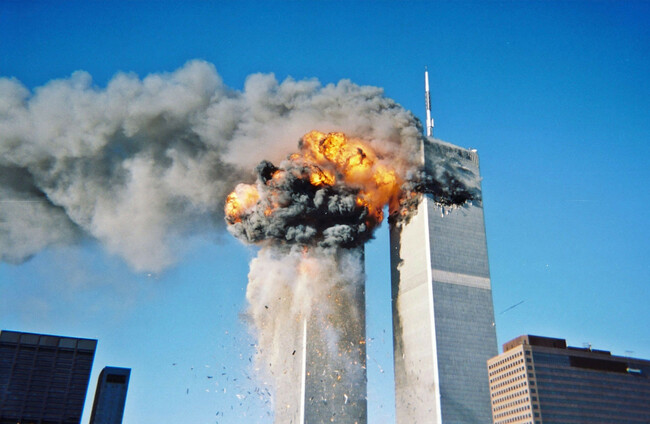

AT SOME POINT over the next few days, many 40-somethings and upwards will do one or all of these things: they’ll emit some class of profanity, possibly affixed to the word “holy”, shake their head in sorrowful disbelief, refuse aloud to believe that it’s been twentyeffingfive years, and bustle onto social media to share this chagrin to their score of followers #neverforget.
Which would be a daft hashtag. It may be a whole quarter of a century on, but September 11, 2001 isn’t in any danger of slipping anyone’s minds. Every witness will have a story about where they were when the immolation of the twin towers happened – shocking, cinematic, reality-distorting, world-tilting, the very first time a revolution was globally televised.
And the least likely to forget were those who experienced the madness of it all close-up, in person, with their own two eyes. Including my own two eyes. Yeah, I was living there, a denizen of Manhattan, a journalist who, when the second plane and horrified realisation both struck, headed to where the story was.
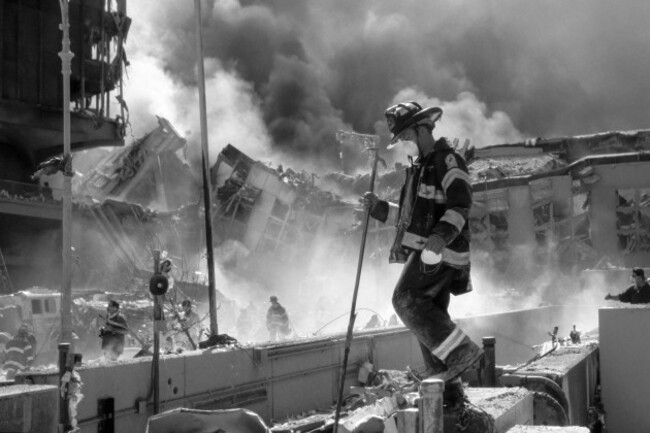
But here’s the thing. I have no photos to prove it. None taken by me, none of me at work. What I had with me that day was a notebook, pen and a set of eyeballs. Yet 25 years on, the vividness of the day, the assault on all senses, remains undimmed, all of it – the sights, the sounds, the hurricane of emotions swirling through the city, the molten heat underfoot, the choking metallic stench rising from the murdered buildings.
Obviously, obviously, there is a profusion of photographs and video footage and post-event reconstructions, reportage, books and documentaries to act as any numbers of aides-mémoire; also, it was a cataclysm of such significance and without any precedent, that events were burned indelibly into the minds of anyone in situ as they unfolded.
But I think perhaps that there was another factor at work. I didn’t have a camera. In fact, I’m not sure I owned a camera. In 2001, there was still a year to go before the first commercial camera phone was launched in the US, so taking photos wasn’t a part of your daily routine.
Cameras came out for occasions – family stuff, parties, weddings, holidays, big sporting days out. Selfies didn’t exist, of course. You could set a timer and scuttle back into shot, ask a passing randomer to do the honours, or chance your arm and reverse the camera and click, but the resulting picture more often than not fell somewhere between hilarious and crap.
No filters, obviously, so you just hoped for the best or to be slightly out of focus. Or else you really weren’t that bothered – after all, who would see the photos, bar a small circle of family and friends? And as for lugging a camera to something like a gig… well, most of the time that was more trouble than it was worth. Chances are that the camera would get robbed or get lost. And after enjoying a clatter of pints, focusing could be an issue, and it wouldn’t be the fault of the device.
Anyway, the whole point of going to a concert was to take it all in, soak up the atmosphere, get lost in the music. Wasn’t it? That’s the thing about cameras. Once you place a lens between yourself and a subject, or in front of yourself and a subject, everything changes. In the former, you’re forcing a shape and a story on what you’re seeing.
You choose what to include and what to leave out; you choose what to focus or zoom in on, and what to dismiss. In the latter, you turn the lens towards yourself, and now you’re the star of the show and the backdrop merely serves as a prop to your personal drama, as proof that you were there.
Except, of course, that you weren’t all there. Because after framing, focusing, zooming, you’ve already moved on to the next stage. Crop, filter, caption, hashtag, post. #BestLife #LifeGoals #Blessed. Facebook, Snap, Insta, TikTok. It might be great for clout, but it’s a diminished way of being. At Reading Festival recently, singer Florence Welch – not for the first time – urged the crowd to “put your phones the fuck away”, because “filming this song will stop you from experiencing this song.”
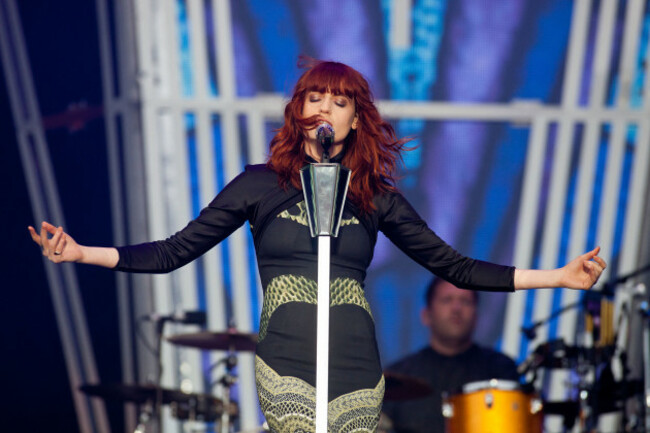
Likewise, a video clip (irony noted) captioned ‘Ibiza 2000 v. Ibiza 2024 has clocked up millions of hits across social media recently, contrasting the pulsating hands-in-the-air dancing mass of energetic ravers with the same gig over two decades later, which shows a similar-sized crowd all standing eerily still, all with arms aloft holding camera phones and each filming exactly the same thing.
Florence Welch was absolutely right. The phone screen is exactly that – it blocks that experience of emotions, energy, presentness, connection and communion from flowing between the artist and the audience, and between audience members themselves. Having fun with your mates? Nope, you and your camera are a thing apart; you’ve stepped out of the flow, you’re busy curating an image while missing the big picture.
Of course, when it comes to news, cameraphones have been a game-changer; they have made it possible for witnesses to document events which would otherwise have taken place unseen – just look at the terrifying videos recorded on phones of the roaring wall of water demolishing a path through a remote Nepalese valley last month.
But so many parts of ordinary life don’t need to be obsessively and minutely recorded and documented. Enjoy the view, the scenery, the company, the craic, the music. Make the pictures in your head. Stop taking poxy selfies, you know what you look like. Or if you’re chronically online and unable to help it, then snap off a few shots and clips to add to your reel/feed at the outset – yes, yes you were there – then put your phones the fuck away.
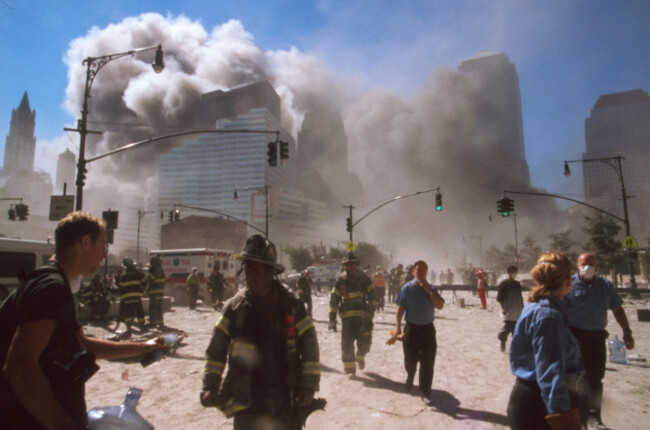
In retrospect, am I sorry that I didn’t have a camera with me on September 11? Truthfully, no. Some vivid images still drift into view from time to time, such as running onto a small side street angled towards the fallen towers, only to come to a bewildered stop. I looked up at the rectangle of clear blue sky between the tall blocks and wondered how snow was falling from it, fluttering endlessly onto the sidewalk. But the flakes were soot and dust and detritus, but mostly countless shredded fragments of paper, some bearing the logos and titles of companies which until a short time ago had been ensconced among the clouds on the skyscrapers’ top floors.
No camera could have captured the gut-wrenching understanding that the men and women who had written on these papers were most likely also ashes on the late summer breeze. Imagine September 11 2001 v September 11 2026. Just imagine how social media would be inundated with videos and images, how those fleeing the chaos and carnage in desolation and horror would be instantly identified, turned into memes, added to stories that aren’t their own.
Imagine the snatched selfies in front of the tangles of melted steel and mountains of rubble. Imagine that for every GoFundMe for victims’ families and firefighters, there’d be an immediate flood of conspiracy theories, hateful hashtags, AI slop, deepfakes, disinformation.
On 9/11/2001 the revolution was televised. Now, it would be photographed, filmed, packaged and curated for social media by all the cameraphones who were there or who hurried there. Not to help, but for kudos. In the thick of it, but not present. Filming, but not seeing the big picture.
This would be perfectly normal. And that’s the greatest horror of all.
Lise Hand is a journalist and writer. This column runs every Wednesday.
To embed this post, copy the code below on your site








have your say