Sign in. It’s quick, free and it’s up to you.
An account is an optional way to support the work we do. Find out more.
Sign in. It’s quick, free and it’s up to you.
An account is an optional way to support the work we do. Find out more.

THE TUESDAY MORNING of 11 September 2001, was shaping up to be a relatively slow news day, following an even slower news month.
The New York Mayoral primaries were scheduled to take place. Mike Bloomberg’s victory was a given and, aside from his press conference and celebration that evening, there wasn’t much to do, other than hit up a few polling stations.
I received a call from the Sunday Tribune at the same time as the first report on NPR about a plane crashing into one of the Twin Towers at the World Trade Centre. I grabbed a notebook, a fistful of pens and my flip phone and ran out onto the street.
Within seconds, I was in a taxi, speeding down the FDR Highway.
There was almost no traffic. The driver and I listened as New York’s local station, 1010 WINS, reported flames were shooting out of the North Tower. To our west, a cloud of black-grey smoke rose into the brilliant blue sky. We speculated it was likely an accident involving one of the biplanes that swarmed Lower Manhattan.
We had just come off the FDR at Exit 2, about a mile east of the Twin Towers when the news broke that a second plane had hit the South Tower. The driver was blessing himself and muttering ‘Jesus Christ’ over and over as the panicked voice of the announcer filled the cab.
He dropped me near City Hall. The sky had darkened but much of Manhattan’s financial district is a claustrophobic warren of narrow streets and skyscrapers that block the sky.
The towers weren’t visible from where I stood but the air had filled with a rising cacophony of shouts and sirens. I looked down Broadway to see hundreds of first responders – ambulances, firetrucks and police cars – flooding the streets.
As I walked south towards St Paul’s Chapel, crowds of dazed, terrified-looking workers were surging in the opposite direction.
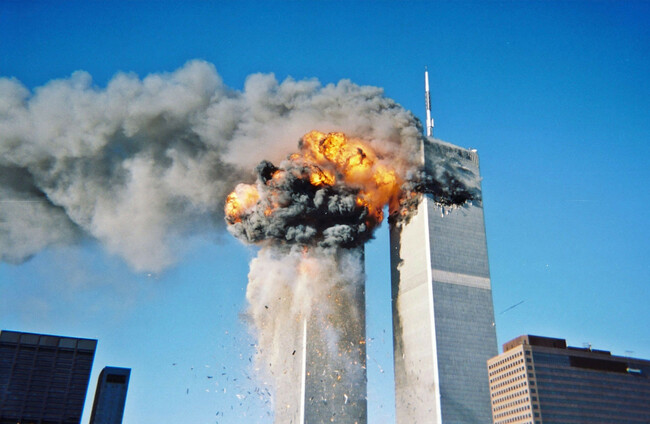
Police were simultaneously redirecting traffic and exhorting them to keep moving amid a rising sense of chaos. At the corner of Fulton and Broadway, the towers suddenly came into view in a heart-stopping assault on the senses. Only the bottom halves were visible.
The rest was engulfed by flames and dense black smoke.
Even as police pushed them northwards, dazed locals huddled at coffee stands, listening to radio relays of events. Other stopped outside cafes or stores where televisions were tuned to CNN, watching in disbelief as the horror that was unfolding a few blocks west semaphored around the world.
Then suddenly, without warning, at 10.29 the South Tower came crashing down; 110 floors of metal, concrete and glass imploded in around ten seconds in a great whooshing, sucking, all-consuming roar that filled the narrow streets and flooded them with flying debris, smoke and ash.
A sea of people emerged, sobbing and shrieking, covered in yellowish-grey dust. First responders yelled to clear the area. NYPD officers funnelled the survivors across Fulton Street and onto Park Row, then corralled them onto the Brooklyn Bridge.
Shellshocked
I watched as shellshocked and stunned into silence, they moved like sleepwalkers, their gazes fixed ahead, the dust that covered their faces streaked with tears and bloody scratches. Some clutched briefcases, others were missing jackets or shoes.
They stumbled across the Brooklyn Bridge, a ghostly exodus punctuated by the sound of sirens.
I turned and headed home. I spent the next several hours juggling radio interviews and news meetings with the editor and news editor at the Sunday Tribune. In the two hours since I’d left the world had changed. We didn’t know how much.
Outside, windows rattled and buildings juddered at the 150-decibel roar of fighter jets racing down the East River.
How to make sense of it all? Six seismic events had slammed into each other in less than two hours. Seventeen minutes after the first plane hit the North Tower at 8.46 am, a second slammed into the South Tower.
Thirty-four minutes later, a Boeing 757 punched through Pentagon’s outer perimeter and through three of its five reinforced concentric rings.
Barely two minutes after that, the South Tower collapsed. Within four minutes of its fiery implosion, Flight 93 exploded in flames as it crash-landed in a field in rural Pennsylvania.
Thirty minutes later, at 10.28 am, the North Tower collapsed.
We grappled with a sense of freefall, not knowing if more attacks would follow, whether we had entered a rapid-onset Armageddon. Even then, we knew the chaos and carnage that would roil the world was only beginning.
When 7 World Trade Centre collapsed around 5.30pm that evening, it felt like an aftershock following an earthquake. The global tectonic plates had already shifted.
America was at war. The 47-story building had blazed for seven hours while firefighters watched helplessly, their hoses rendered useless by the rupturing of the massive water mains beneath the World Trade Center complex.
When I returned later that afternoon, the police had closed off the entire downtown area so that rescuers and first responders could work unimpeded.
I made my way over to St Vincent’s Hospital on West 12th Street. The ER entrance bay was filled with medical staff. They stood waiting to treat those rescued from the flames.
An administrator told me they had carried out a trial run involving a mass casualty scenario three months earlier.
They were prepared and ready, she said, rattling off their inventory; 7,500 burn packs, hundreds of oxygen tanks and ventilators and a comprehensive ICU surge plan. Already, 500 staff members and volunteers had given blood.
They stood waiting, but nobody came. Around 300 walking wounded had been treated earlier for cuts, bruises and injuries sustained as they fled the blast of debris caused by the towers’ collapse.
But those who had been trapped inside the towers perished, along with the first responders who rushed into save them.
There would be no survivors in need of life-saving treatment. Not a single ambulance arrived during the two hours I stood there.
Reports circulated that Rudy Giuliani had ordered 10,000 body bags. Eventually, the emergency staff started moving back inside.
Later, I spoke to a young Irish woman who had been for a French financial advisory service on the 53rd floor of the North Tower. She had arrived into work at 7.40 am after a late night.
When she saw the plane coming straight at her, she thought she was hallucinating. She watched transfixed as its belly soared above her and disappeared into the building.
As she was herded into a stairwell moments later, she encountered the first responders.
“Those big friendly Irish faces” were already drenched in sweat from their exertions and the weight of their equipment she said. They exchanged banter as they rushed upwards to their deaths.
Over the next quarter of a century the 9/11 attacks would spawn two wars. A million people, mostly civilians, would be killed by bombing campaigns and combat operations.
The deaths of another four million as a result of displacement, disease, hunger and violence would take place over the twenty years of war that followed.
A Brown University Cost of War analysis put the cost of America’s response to the 9/11 attacks at $8 trillion.
7,000 American soldiers would die and another 55,500 would suffer serious injuries.
The Bush administration’s response, was a strategic and moral failure, squandering the global outpouring of sympathy and goodwill that followed the attacks, alienate its allies and expand its ranks of enemies. Subsequent administrations mended fences with allies, but the wars continued for another thirteen years.
Over the next nine months, Lower Manhattan went back about its business. Hawkers flocked to Ground Zero. Tourists and gawpers snapped up $10 toilet rolls featuring Osama Bin Laden’s face on every sheet.
The bars and restaurants were full, and the financial advisers and stock traders were thriving. We had become accustomed to the flyers of missing faces that wallpapered Lower Manhattan. The tributes and thanks that surrounded the pictures of grinning young firemen on the walls of fire stations no longer stopped us in our tracks.
Then another riptide of grief sent the city reeling.
Nine months later on 30 May 2002, was the day rescue and recovery operations ended.
For more than a thousand families, the hope that the bodies of their parents, sons or daughters would be returned, the same hope that had caused them to return over and over to the gaping holes and twisted metal, finally ended.
They had affixed posters and photos to the chain metal fences around Ground Zero, to lampposts and bodegas in the days after the attack, in the desperate hope that a stranger somewhere might have news of their survival. Most of them were faded, tattered, barely recognisable.
From early morning, they gathered for the ceremony to mark the end of the rescue operations.
At 10.29 am, the same time as the South Tower imploded, they watched and wept as a team of firefighters, tears pouring down their faces, carried an empty stretcher draped with the American flag up the ramp, a symbolic acknowledgement of that this would be the final resting place for so many who were trapped in the flames.
Bagpipe players from the NYPD and FDNY bands played the first strains of Amazing Grace.
Music filled the air, freighted by the weight of grief and raw emotion. A thirty-six-foot steel girder which had been dubbed ‘the last column’ entirely covered in graffitied messages of tribute and thanks to the rescue teams, was loaded onto a flatbed truck and driven out of the pit.
Next to me a woman stood silently sobbing. She held a rosary bead and a framed photo of a smiling teenager. Her eldest son, a kitchen porter, had perished in the Windows of the World restaurant.
She was reluctant to say his name because her family was undocumented and told me that in the hours and days after the Towers came down, she and many more members of her community had been afraid to even report missing family members.
The remains of 1,653 victims were recovered and positively identified in the aftermath. Her son wasn’t one of them.
While the 9/11 Compensation fund had been expanded to include the families of undocumented workers, she hadn’t applied for assistance, lest the surge in anti-immigrant backlash led to her arrest and deportation.
“I didn’t ask them for anything,” she told me. “Only to give me back his body. “
To embed this post, copy the code below on your site








have your say