Sign in. It’s quick, free and it’s up to you.
An account is an optional way to support the work we do. Find out more.
Sign in. It’s quick, free and it’s up to you.
An account is an optional way to support the work we do. Find out more.

TODAY IS WORLD Suicide Prevention Day. What does that actually mean? Well, it was established in 2003 by the International Association for Suicide Prevention (IASP), and it is a day to raise awareness about warning signs and risk factors, to promote healthy and compassionate discussion that reduces stigma, and to promote mental health generally, which helps to prevent suicide.
This year’s theme is “Changing the Narrative on Suicide”, focusing on replacing silence and misunderstanding with empathy, support and hope. That said, some people may find aspects of this article difficult to read, and I would encourage you to be mindful of your own experiences and needs before reading any further. Take a break if necessary. There are helpful resources at the end.
In May 2026, the Department of Health published Ireland’s Strategy to Reduce Suicide and Self-harm, Connecting for Life 2026-2035. A long-awaited update of previous strategies, it cites a declining rate of suicide in Ireland in recent years according to the Central Statistics Office (CSO), reducing by 33.3% between 2000 and 2022 (from 12.9 to 8.6 per 100,000 people, respectively).
However, because our population rose from 3.9 million to 5.1 million during roughly that time period, the number of people in Ireland who actually die each year by suicide has remained at around 500.
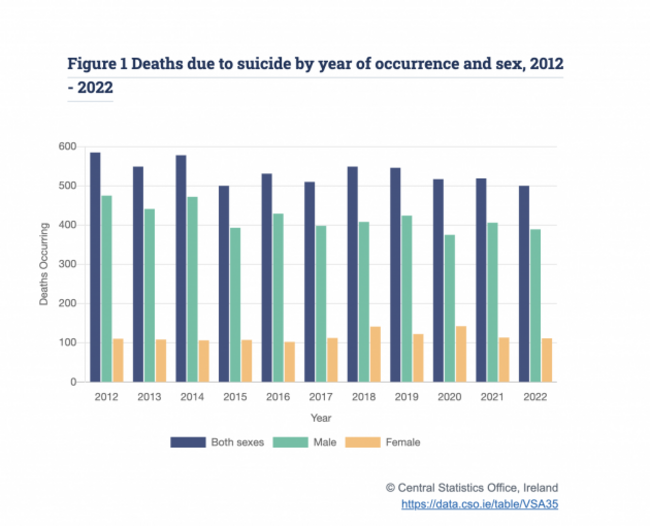
Men are much more likely to die by suicide, but women have consistently higher rates of self-harm and non-fatal suicide attempts. The new Strategy has set a national target of reducing the suicide rate to seven per 100,000 or lower by 2035 with the adoption of a whole-of-government and whole-of-society approach.
I work as a psychiatrist. That is to say, I spend a considerable amount of my time helping people to recover from severe mental illness. Like all frontline healthcare workers, I encounter occasional suicides, and the fallout for family and friends is never less than heartbreaking.
Naturally, my colleagues and I put considerable time and effort into trying to prevent suicides. In my experience, almost everyone does not want to die almost all of the time. But suicidal thoughts can occur with mental illness or in the context of an overwhelming event in life.
A problem arises when someone finds themselves in a state of distress so intolerable that they simply cannot live with it, yet their normal coping strategies for resolving or even soothing that distress are not working. This intense distress can occur very suddenly in some people and might last as little as a few minutes before it dissipates, or before helpful coping strategies kick in. This is why restricting access to means and methods is so important.
The majority who decide to live will usually recover from their episode of illness or overcome their stressors.
Whether someone has died by suicide is a legal decision made by a coroner, usually in the context of an inquest. The CSO draws on this when publishing national mortality statistics, including data on deaths by suicide. It is likely that suicide rates were traditionally underreported because of societal stigma, religious values and various other reasons.
Suicide has always been a very challenging topic for society to confront, despite its ubiquity. Sadly, most major psychiatric illnesses carry a suicide rate of around 10%, although this long-term risk exists over a lifetime. Some suicides are unrelated to mental illness.
In the past decade or so, various health services have tried to apply to suicide the term “never event” (originally coined by former US National Quality Forum chief executive Dr Ken Kizer in 2001) as though it’s somehow possible to prevent them all. Mental health teams can certainly prevent a great many suicides, and psychiatrists can even predict suicide rates in populations. But asking a psychiatrist to predict exactly who among their patients will die by suicide tomorrow is like asking a cardiologist to say who among their thousands of heavy-smoking patients with diabetes and high blood pressure will have a sudden fatal heart attack tomorrow. It is simply not possible.
Now don’t get me wrong; psychiatrists and their teams constantly consider risk in the people for whom they care, using what is called structured professional judgment. We tease out individual risk factors and protective influences and contextualise using evidence-based knowledge and clinical expertise, all in an effort to provide the necessary support for recovery. It is nuanced and relies heavily on a good therapeutic relationship between the clinician and the person.
But at various times, research clinicians have tried to devise risk assessment scales or screening questionnaires that distinguish those who will die by suicide from those who will not. Unfortunately, human beings do not fit easily into checklists. The problem here lies with the statistics. The ability of a screening questionnaire to predict any event depends a lot on how rare or common that event is. For a rare event like suicide, it is far easier for screening to predict the large number of people who will not die by suicide than the small number of people who will.
Recent research bears this out. But it’s not a new concept. In one famous study from the 1980s involving 4,800 inpatients of a Veterans Administration hospital, researchers tested a wide range of screening measurements and questionnaires that were previously thought to predict suicide. The screening measurements predicted around 1,200 suicides that did not occur. Meanwhile, of the 63 suicides that did actually occur, only half were predicted by the screening measurements. In short, 19 suicides were wrongly predicted for every suicide that actually happened, while half of those real suicides were not predicted at all.
As the author put it, “Each trial missed many cases and identified far too many false positive cases to be workable”. Another meta-analysis of over 20 suicide studies among psychiatric inpatients found that, although some risk factors were significantly associated with suicide, the rarity of suicide as an outcome meant that less than 2% of patients rated by clinicians to be “high risk” actually went on to die by suicide.
And this is very important because there is a real human cost in overpredicting people’s likelihood of dying by suicide. It includes unnecessarily restrictive healthcare and even civil rights infringements. But also, if we spend too much time, effort and resources trying in vain to predict rare events like suicide using a tick-box exercise, we take away time, effort and resources from actually listening to people and supporting them to promote recovery and prevent even those suicides we cannot predict. This is why the emphasis of Ireland’s Strategy to Reduce Suicide and Self-harm is – and should be – on the prevention of suicide rather than the fruitless exercise of trying to predict it.
The strategy, which involves individuals, families, professionals and society at large, has been structured around five domains:
1. Preventing suicide and self-harm, reducing stigma and addressing the various societal factors (economic decisions, humanitarian events, public health responses) that influence the likelihood of suicide or self-harm.
2. Restricting access to the means and methods of suicide through policy, regulation and environmental design.
3. Implementing effective responses for people in suicidal distress or with experience of self-harm through a range of general and specific evidence-based interventions.
4. Ensuring compassionate, coordinated and accessible postvention support for people and communities affected by suicide.
5. Establishing evidence, surveillance systems and governance to allow the strategy as a whole to work effectively.
Today, 10 September, seems an appropriate day to hope that the new strategy makes a meaningful difference to people and their families. In the meantime, if you suspect someone may be having suicidal thoughts, know that asking them about it will not increase their risk of actually doing it.
If they confide in you, take them seriously, stay calm and don’t leave them to deal with it alone. Enquire about the immediate danger of suicide. Listen without judgment rather than trying to fix everything, but if you think they may act soon, treat it as an emergency.
Don’t promise secrecy. Point them towards their GP or existing psychiatric service, the emergency department or the helplines listed below. And keep checking in with them.
Dr Stephen McWilliams is a consultant psychiatrist at St John of God University Hospital, Stillorgan, Co Dublin, a Clinical Associate Professor at the School of Medicine, University College Dublin, and an Honorary Clinical Senior Lecturer at RCSI University of Medicine and Health Sciences.
If you have been affected by any of the content of this article, help is available from the following resources:
To embed this post, copy the code below on your site













have your say