Sign in. It’s quick, free and it’s up to you.
An account is an optional way to support the work we do. Find out more.
Sign in. It’s quick, free and it’s up to you.
An account is an optional way to support the work we do. Find out more.
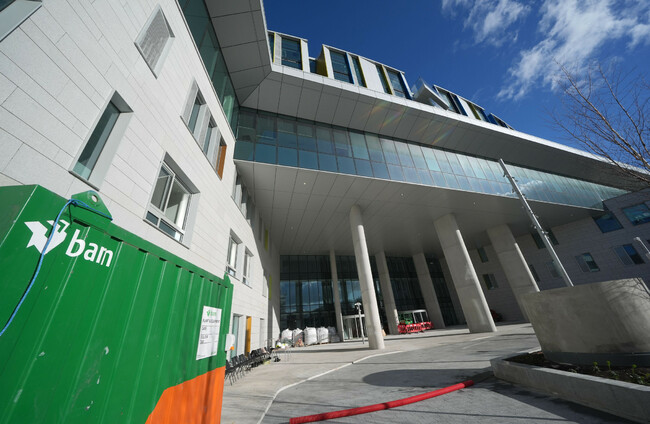

THERE’S SOMETHING ALMOST metaphysically absurd about watching a nation construct a monument to its own institutional dysfunction while calling it progress.
Each morning, as I scroll through updates on Ireland’s National Children’s Hospital – the latest including the unfolding of a public row between the Minister for Health and the project’s contractor – I’m reminded of that peculiar academic phenomenon where a research project becomes so elaborate in its methodology that it loses sight of its original research question entirely.
The NCH saga reads like a case study in what happens when bureaucratic momentum encounters the gravitational pull of sunk costs, creating a kind of institutional point-of-no-return from which no rational decision can escape.
We’ve spent eight years and counting constructing what amounts to a very expensive lesson in how not to build things, though I suspect we’re too invested in the narrative to learn from our own cautionary tale.
Let me share some numbers that have been keeping me awake at night, not because they’re particularly shocking in isolation, but because of what they reveal about our collective capacity for self-deception.
In 2018, Dublin’s three tertiary children’s hospitals provided approximately 334 beds between them. The gleaming new National Children’s Hospital promises 380 inpatient rooms. This is a net increase of 46 beds, or roughly 14% more capacity. Forty-six beds. For context, that’s about one extra bed per €43 million spent, if we’re being generous with our math.
The critical care expansion is genuinely meaningful, from 32 to 60 beds, an 88% increase that addresses a real capacity crisis. Mental health services gain 20 new CAMHS beds, filling a void that has haunted Irish paediatric care for decades. However, we have noted we won’t have the staffing for CAMHS. I know these improvements matter, genuinely and substantially.
But here’s where the institutional amnesia kicks in. We’ve somehow convinced ourselves that marginal bed increases justify transformational spending. The hospital’s cost has metastasised from an original €650 million to at least €2.2 billion, a figure that continues to evolve with the same predictable trajectory as academic conference deadlines.
Originally scheduled to open in 2018, the hospital has experienced fifteen separate postponements, each announced with the kind of administrative solemnity typically reserved for discussing research ethics violations. We’re now looking at a 2026 opening date, optimistically speaking, with commissioning delays I believe that that could push patient care into late 2027.
This timeline fascinates me as an academic exercise in institutional time distortion. By the time the hospital opens, the healthcare models that informed its design will have aged nearly a decade.
It’s like watching someone meticulously construct a perfectly calibrated solution to last year’s problem while this year’s crisis unfolds in real-time around them.
The children who needed these beds in 2018 are now adults. The medical staff who planned their careers around this opening have since emigrated, retired, or adapted to working within systems that were supposed to be temporary. We’ve built a time machine that travels exclusively backward.
What strikes me most about this project, beyond the staggering mathematics of its inefficiency, is how perfectly it embodies our institutional preference for monuments over networks. The NCH represents centralisation as aspiration. It is as if one magnificent facility will somehow solve the distributed challenges of paediatric healthcare across an entire nation.
This monumentalism feels distinctly academic in its logic. Like a department that believes hiring one superstar professor will elevate the entire program, or a university that thinks one signature building will transform its reputation, we’ve conflated scale with substance, confusing impressive infrastructure with improved outcomes.
The alternative, a distributed network of smaller, more agile facilities, would lack the ceremonial gravitas that institutional thinking seems to crave. There’s no ribbon-cutting ceremony for incremental improvements to existing hospitals, no architectural photography opportunities for upgraded equipment dispersed across multiple sites.
Perhaps most troubling is our apparent inability to learn from this experience while we’re still living it.
Each cost escalation is treated as an unfortunate but isolated incident rather than a symptom of systemic dysfunction. Each delay is framed as an unexpected challenge rather than evidence of fundamental planning inadequacies.
I’m reminded of academic departments that spend years revising their curriculum while never questioning whether their pedagogical assumptions remain relevant. The process becomes self-justifying. We must continue because we’ve already invested so much, and we’ve invested so much because the project must be important.
This circular logic creates what I’ve come to think of as institutional amnesia, not the inability to remember past mistakes, but the inability to recognise current actions as potential future mistakes. We’re so committed to the narrative of necessity that we’ve lost the ability to step outside the story and examine its premises.
Behind these abstract institutional failures lies a more immediate human reality. Children who need cardiac surgery don’t experience budget overruns as statistical curiosities. They experience them as delayed procedures, continued anxiety, families stretched across multiple hospital visits in inadequate facilities.
The staff who’ve been promised better working conditions for nearly a decade continue managing overwhelming caseloads in buildings that were meant to be temporary solutions. The parents who’ve organised their lives around promised opening dates have learned to stop believing official timelines.
Yet somehow, in our focus on the monument, we’ve managed to obscure these human costs. The hospital has become primarily a symbol, of governmental competence, of healthcare ambition, of Ireland’s arrival as a modern European nation. These symbolic functions may actually be more important to its institutional stakeholders than its medical functions.
What would healthcare infrastructure look like if we designed it like effective academic departments rather than monument-obsessed institutions?
Smaller, more flexible units that could adapt to changing needs. Distributed rather than centralised decision-making. Iterative improvement rather than revolutionary transformation.
The most successful academic programs I’ve observed grow organically, responding to student needs and faculty expertise rather than imposing grand architectural visions. They invest in people and processes rather than buildings and bureaucracy. They fail fast and adjust quickly rather than doubling down on initial assumptions.
The NCH represents the opposite approach. It is institutional gigantism as virtue, complexity as sophistication, delay as thoroughness. It’s a masterclass in how bureaucratic systems can become so elaborate in their own functioning that they lose track of their original purpose.
Imagine now its late 2027 and the National Children’s Hospital is finally treating patients – or, it may have experienced another delay, another cost revision, another round of commissioning complications. The specific outcome matters less than what the process has revealed about our institutional character.
We’ve built something magnificent and dysfunctional. It is a physical manifestation of our collective inability to distinguish between ambition and effectiveness. Like many academic projects that become more impressive in their complexity than their insights, the NCH succeeds brilliantly at everything except its stated purpose.
Perhaps that’s the most honest assessment we can offer. We’ve constructed a €2 billion lesson in institutional humility, disguised as a hospital.
Whether we’ll learn from this lesson, or simply repeat it at an even grander scale, remains the most interesting research question of all.
The building will outlast the political careers that created it, the bureaucratic systems that delayed it, and probably the healthcare models that inspired it. In that sense, at least, it truly will serve future generations, as a monument to the particular kind of institutional amnesia that allows us to mistake process for progress, scale for improvement, and expenditure for achievement.
Some monuments honour the past. Others, apparently, warehouse our inability to imagine better futures.
Dr Paul Davis is a lecturer at Dublin City University’s Business School. He specialises in supply chain management and procurement.
To embed this post, copy the code below on your site













have your say