Sign in. It’s quick, free and it’s up to you.
An account is an optional way to support the work we do. Find out more.
Sign in. It’s quick, free and it’s up to you.
An account is an optional way to support the work we do. Find out more.

In Politics by Numbers, broadcaster, author and spreadsheet stan Gavan Reilly takes a data deep dive into a political point of the week.
“WELCOME BACK TO day six of our coverage of Election 2049. Let’s go straight to the National Basketball Arena in Tallaght, and the count in Dublin South West, where the marathon count to fill the ninth and tenth seats is nearing completion…”
Does that sound a bit mad to you? An election count going into a sixth day, with exhausted staff filing through papers trying to decide who fills the tenth and final seat in a single constituency? It might sound far-fetched, but it’s not all that wild a proposal.
It’s all down to population, which seems to be increasing a little faster than the most assertive projections.
Last week the CSO released its latest estimates for the population of our state, outlining that 5,525,600 people lived in the Republic in April of this year. That’s a fairly steep increase: the last Census, only four years ago, put the population at 5.15 million. The population has thus risen by 7.3% in just four years.
Granted, the war in Ukraine created a particular spike in immigration just after the Census was taken, but the scale of increase is still unusual for a developed Western country. Go one census further back, to 2016, and the increase in 10 years is 16% – with over 750,000 more people now calling the State home than 10 years ago.
Doing a bit of backwards sums, you realise that this averages out to an increase of about 1.5% in the population every year – a combination of births, deaths, emigration and immigration. Simply extrapolate the same growth rate to the year 2049, and by the time Ireland marks the centenary of declaring its Republichood, the State would be home to 7.78 million people.
It goes without saying that an increase of this scale poses huge challenges for infrastructure and public administration in Ireland. (It would also be far higher than the CSO’s official projections, issued only two years ago, where the highest estimate was seven million by the year 2057.) But those challenges are too many to list here, and this is a column about politics by numbers – so let’s examine the political consequences.
The Constitution is explicit in creating a link between the population of the country and the size of the Dáil that represents it. It stipulates that there must be one TD for every 20,000 to 30,000 people in the State (which importantly does not discriminate between adults and non-voting children, or Irish citizens and others). The population of the last Census, for example, required the Dáil to expand from its existing 160 seats to 172 at an absolute minimum. 14 more seats were added, the extra two to offer some scope for county boundaries to be protected on the new constituency map.
14 more TDs doesn’t change the nature of the Dáil itself all that much, and most politicians were delighted that there would be more seats to fill at the next election. A bigger Dáil means incumbents are less likely to lose their seats, and challengers are more likely to gain one. Everyone’s a winner.
But go much bigger and the nature of how Dáils do their business – and how governments are formed begins to change. The next census probably means a population of 5.7 million, and add another 14 seats (at least). Then the threshold for a Dáil majority will be 90. One more census later and the population would hit 6 million, requiring a Dáil of 200 and a majority of 101. Coalitions and parties of that size require levels of handholding and egomanagement that nobody in Ireland has a guidebook for.
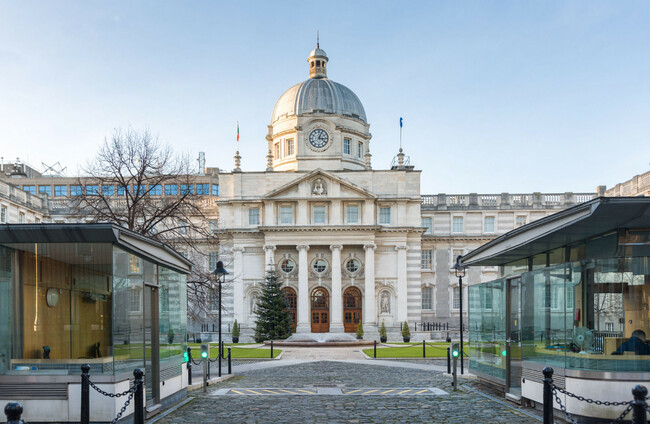
There’s one other snag to a growing Dáil: the environment of Leinster House itself. For starters, the Dáil chamber literally cannot seat many more TDs: it only has 178 physical seats and the next census will force remedial work to squeeze in some more. The Office of Public Works (OPW) have examined some options – including installing an extra row of seats in the now-disused voting lobbies, but those 22 seats would only offer breathing space for a decade.
A more acute pressure for the Oireachtas is finding space for those new TDs’ offices. Between their own assistants and other support staff, adding 14 TDs to the Dáil meant needing space for 60 more people. Many civil servants ended up being moved to other off-site office space as a result. I can say with some experience, as chair of the Oireachtas Press Gallery, that journalists had to put up a spirited fight to save some of our own workspaces within Leinster House itself.
That fight ended with success for now, but is destined to be repeated next time. There simply isn’t space in the existing buildings to squeeze another 60 workers in. Administratively it’s a ticking time bomb, and without dramatic decisions in the meantime – like incorporating Agriculture House into the complex, and forcing the Department of Agriculture to find a new home – there is no obvious quick fix.
Or, at least, that is the case as long as the Constitution remains as it is. Micheál Martin has suggested in recent months that Ireland should review the rule that limits the number of full Cabinet ministers to 15. Perhaps it might be time to review the rule that requires such a fixed relationship between the size of the country and the size of the parliament that represents it.
This will be a challenge for some politicians because, as already mentioned, the instinct of many is to create more scope for their own promotion. No county councillor with their eye on a Dáil seat will realistically make a strong case for a smaller Dáil. There might also be some reluctance for a government – any government – to spend political capital on the proposal, given how badly the last coalition was spanked by the family and care referendums in 2024.
But it isn’t strictly necessary for a government to back an idea for it to put a question to the people. Some of the referendums thrown up by citizens’ assemblies or constitutional conventions were put to public vote without the government of the day taking an active stance. Nobody in government lost any sleep when the 2015 referendum to lower the age of presidential candidates was defeated: they were able to facilitate a public vote without ever endorsing the idea itself.
Before too long we’ll have to face up to that question ourselves. It’s an honest question with no wrong answer: do we want to fix the Dáil at its current size, or do we want to keep the current ratio of public-to-TDs – even if it means more and more TDs, and more hassle trying to find somewhere to seat them all?
If it’s the latter, it won’t be long before constituencies become either geographically tiny or swamped by more and more seats. The marathon count to fill the tenth in Dublin South West is not all that far away.
Gavan Reilly is the Political Correspondent for Virgin Media News and the host of Monday with Gavan Reilly, which airs every Monday at 10pm on Virgin Media Play and Virgin Media One.
To embed this post, copy the code below on your site











have your say