Sign in. It’s quick, free and it’s up to you.
An account is an optional way to support the work we do. Find out more.
Sign in. It’s quick, free and it’s up to you.
An account is an optional way to support the work we do. Find out more.
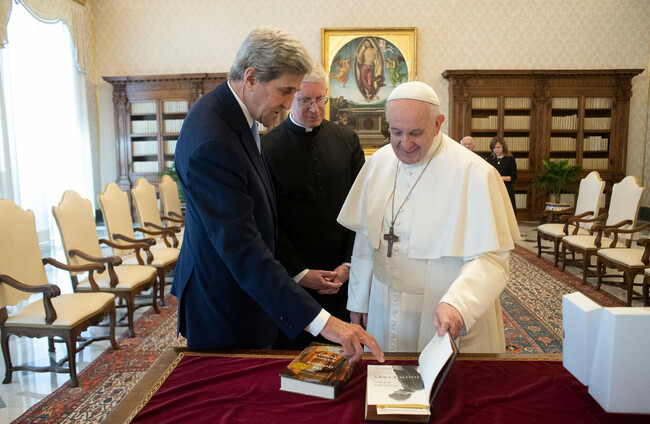

IT IS FITTING that the ‘The Climate Pope’ died during Earth Week, a week dedicated to Earth and the environment, a cause that became a rallying cry of his papacy in a world where many global leaders stayed silent.
Imagine a world where all our leaders spoke as clearly as Pope Francis on climate issues.
‘The Earth, our home, is beginning to look more and more like an immense pile of filth,’ he said in a major papal encyclical letter to the Church, which was dedicated to the environment and published on 18 June 2015.
‘The pace of consumption, waste and environmental change has so stretched the planet’s capacity that our contemporary lifestyle, unsustainable as it is, can only precipitate catastrophes.’
‘The throwaway culture of today calls for a new lifestyle.’
Addressing the United Nations in 2015, he suggested that ‘a selfish and boundless thirst for power and material prosperity leads both to the misuse of available natural resources and to the exclusion of the weak and disadvantaged.’
Two years after his appointment in 2013, Francis wrote Luadato Si’ (2015), where he set out his vision of climate change. In this landmark document, he outlined how ‘the human environment and the natural environment deteriorate together.’
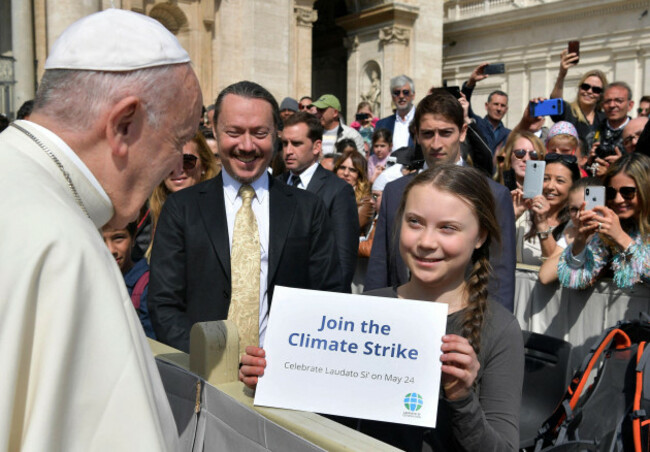
He said that environmental problems cannot be addressed in isolation but must consider the widening inequalities between the rich and poor. He suggested that an integral ecology approach is needed linking environment and climate issues to social, political and economic problems. That protecting nature must be aligned with social justice and human wellbeing.
‘What we need is a new way of thinking about human beings, life, society and our relationship with Nature,’ Francis wrote.
‘We are faced not with two separate crises, one environmental and one social but rather with one complex crisis which is both social and environmental.’
The release of the document was timed to perfection, prior to the United Nation’s (UN) climate summit COP 21, in Paris. The encyclical is widely considered to have influenced the level of global consensus reached in the build up to the conference at which 196 countries signed a treaty pledging to keep global warming below 2C.
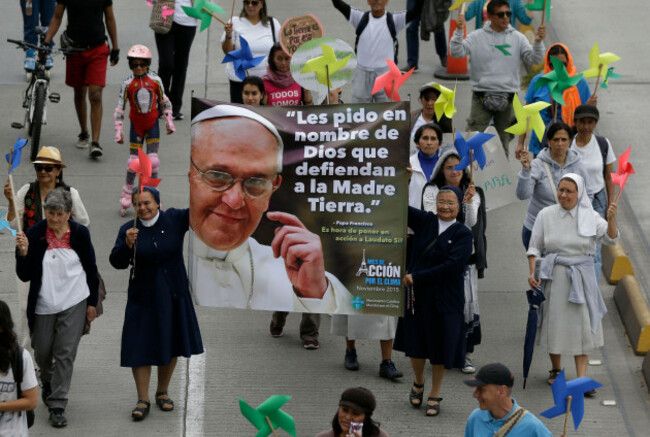
Pope Francis is considered to have exerted critical influence in three key areas: climate summits, indigenous people and climate activism.
In 2023, he wrote a follow-up encyclical Laudate Deum. Released after COP21, he was unapologetic: humanity was taking the Earth ‘to breaking point.’ In this document, he criticised the weakness of international politics for failing to implement the Paris agreement along with ongoing political ambivalence on climate issues.
At COP 28, Pope Francis’s interventions were considered important in gaining agreement among almost 200 countries to transition away from fossil fuels, along with the need to listen to the voices of indigenous people.
His writings and voice inspired activists across the globe. Laudato Si’ inspired the Laudato Si’ movement that coordinates climate activism worldwide. It has 900 Catholic organisations that motivate churchgoers from different denominations to think and act in a more climate-conscious way.
Unlike the unwavering and unflinching voice of Pope Francis on climate issues, many of us feel trapped in a spiral of silence. A paper in Nature Climate Change (2024) that surveyed 130 000 people across 125 countries surprised many by finding that the vast majority (89%) thought their governments should do more to fight global warming and that most (69%) would be willing to contribute 1% of their income to fight climate change.
People in China, the world’s biggest polluter, were the most concerned, with almost all (97%) saying its government should do more to fight climate change and 80% were willing to give a percentage of their income.
Even in the US, the world’s second biggest polluter, almost three quarters of its citizens (74%) said the government should do more while almost half (48%) were willing to contribute.
However, both people across the globe and the policymakers persistently underestimate the levels of support for climate actions.
Scottish data scientist and deputy editor of ‘Our World in Data,’ Hannah Ritchie outlined last year how this perception gap matters.
‘Governments will change policy if they think they have strong public backing. We’re all more likely to make changes if we think others will do the same.
‘If governments, companies, innovators and our neighbours know that most people are worried about climate and want to see change, they’ll be more willing to drive it.’
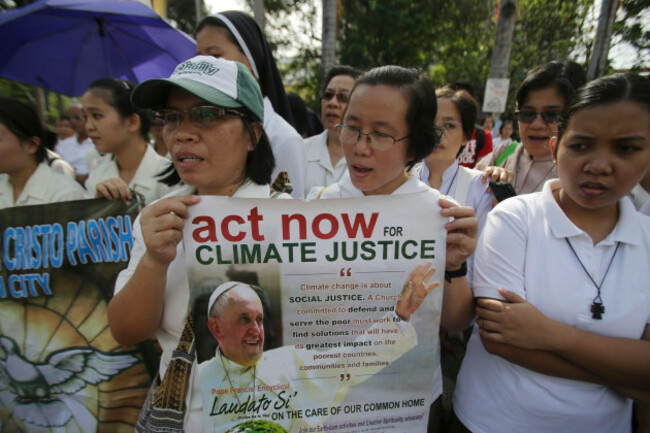
Ritchie suggested that if we systematically underestimate widespread support, we’ll keep quiet for fear of rocking the boat.
‘If we think that people in other countries don’t care and won’t act, we are more likely to sit back and consider our efforts hopeless.
Pope Francis saw this clearly and inspired hundreds of thousands across the globe to speak out.
Prime Minister of Canada, Mark Carney, was formerly the UN Special Envoy for Climate Action and Finance, and Finance Advisor for COP 26 to the British Prime Minister. Before that, he held posts as Governor of the Bank of England (2013-2020) and Governor of the Bank of Canada (2008 to 2013).
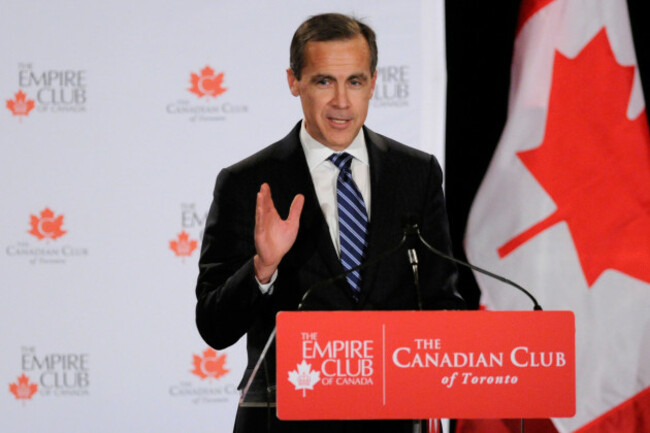
In 2021, in his book Values, Building a Better World for All, he wrote in the introduction about his meeting with Pope Francis. At a meeting of policymakers, business people, academics, labour leaders and charity workers in the Vatican to discuss the future of the market system, Pope Francis surprised the group by joining the lunch and sharing a parable:
‘Our meal will be accompanied by wine,’ he said. ‘Now wine is many things. It has a bouquet, colour, richness and taste that all complement the food. It has alcohol that can enliven the mind. Wine enriches all our senses.
‘At the end of our feast, we will have grappa. Grappa is one thing: alcohol. Grappa is wine distilled. Humanity is many things – passionate, curious, rational, altruistic, creative, self-interested. But the market is one thing: self-interested. The market is humanity distilled.’
And then the pope challenged the group:
‘Your job is to turn grappa back into wine, to turn the market back into humanity. This isn’t theology. This is reality. This is the truth.’
Pope Francis managed something that few world leaders or advocates have achieved. Through his words he called out the climate mayhem for what it is. A crisis of nature that is entangled in everything – money, industry, the economy, people, life – without all the complex language and indecipherable science.
Rest in peace, Pope Francis. May your words be taken up by this generation of activists and world leaders with a loud and unflinching voice. May your belief in a better world reverberate through the din of this one – in the whisper of a bird’s wing, the gentle breeze on our skin and in the thrum of the ocean.
Dr Catherine Conlon is a public health doctor in Cork.
To embed this post, copy the code below on your site








have your say