We need your help now

Support from readers like you keeps The Journal open.

You are visiting us because we have something you value. Independent, unbiased news that tells the truth. Advertising revenue goes some way to support our mission, but this year it has not been enough.

If you've seen value in our reporting, please contribute what you can, so we can continue to produce accurate and meaningful journalism. For everyone who needs it.

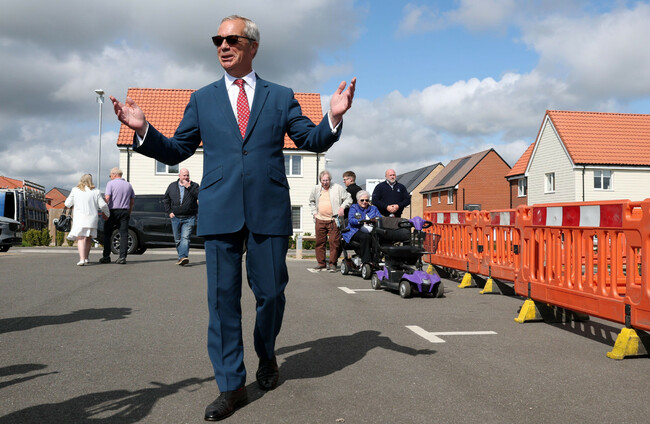
Nigel Farage at a polling station in Walton on the Naze, England yesterday. Alamy Stock Photo

‘Don’t jump to conclusions’: Reform’s rise and what it could mean for Ireland

The ascendancy of Reform has been described as ‘ominous’ by some in government, but today there’s been a cautious reaction.

THE IRISH GOVERNMENT is taking a cautious approach to reacting to the UK local election results, which are still being counted. 

UK prime minister Keir Starmer has said he takes responsibility for Labour’s “tough” local election results but has vowed to carry on as British prime minister.

With the first 40 of 136 councils declared, Labour have lost more than 200 councillors as well as losing control of eight local authorities.

Reform UK has gained 270 seats and control of one council, the Liberal Democrats have gained 29 seats and a council, and the Greens have gained 23 seats, with the Conservatives down 61, and independents, ratepayer parties and Your Party combined down a total of 59.

But what does the rise of Reform mean for Ireland, and are there jitters in government about what might come in a UK general election?

Asked for his reaction today at the North-South Ministerial Council in Antrim, Taoiseach Micheál Martin said he did not want to embroil himself in the politics of another jurisdiction.

Local and general elections are ‘two different beasts’

“I would caution against extrapolating from a local election the result of a subsequent general election. They are two different beasts completely, electorally. And we know that from experience and from history.

“That said, I think there is increasing fragmentation across politics everywhere. If you look across the European Union, its coalition governments, more or less in quite a majority of states, we’ve a fragmented sort of scenario in the Republic, so you are witnessing more and more fragmentation in politics,” said Martin.

The Taoiseach said what people have had to put up with over the last decade could be feeding into their voting, with Martin namechecking Brexit, the pandemic, the war in Ukraine, the energy crisis and inflation, and now the war in the Middle East. 

The public are “taking a lot” and that is creating anxiety out there, he said.

“People are afraid of the future. They’re afraid of what’s happening, and they’re very concerned. They’re very anxious about whether the world is going to settle down? And it’s one shock after the other. I think that’s impacting on politics more generally,” he added.

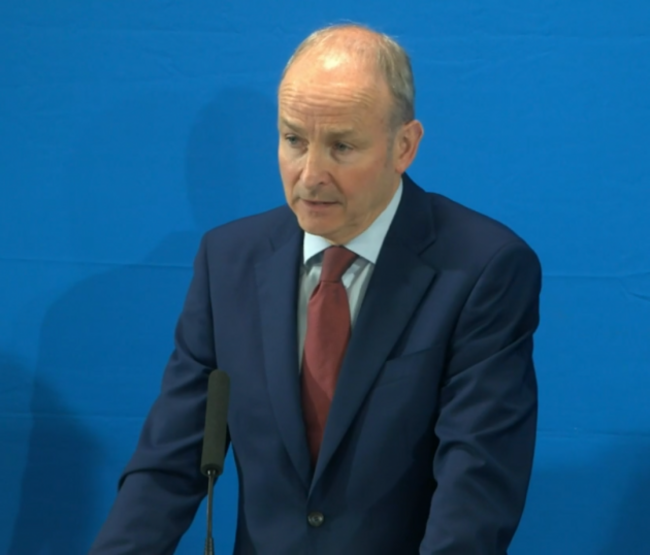
Screenshot - 2026-05-08T140012.973 Micheál Martin speaking in Antrim this afternoon. Christina Finn Christina Finn

However, speaking about the relationship between Ireland and the UK, Martin said it is “very good” right now.

“We will continue to have that relationship,” he added. 

“I think we need to be careful here, the election, the count isn’t over. We need to be careful of sort of suggesting that this local election means a certain result in a general [election], it doesn’t. You need to be very careful about that and not come to conclusions,” said the Taoiseach.

Tánaiste Simon Harris was also careful in his comments, stating that Ireland has worked long to disentangle ourselves from British elections.

What does the election result mean in the UK? 

“So I’m not going to comment on an election that takes place in a different country, other than I am reminded of the time President Clinton made the point that the people have spoken and then might just take a bit of time to work at exactly what they’ve said,” said Harris. 

Oftentimes, an election result and what it means is a “little bit more nuanced or complicated” than initially thought.

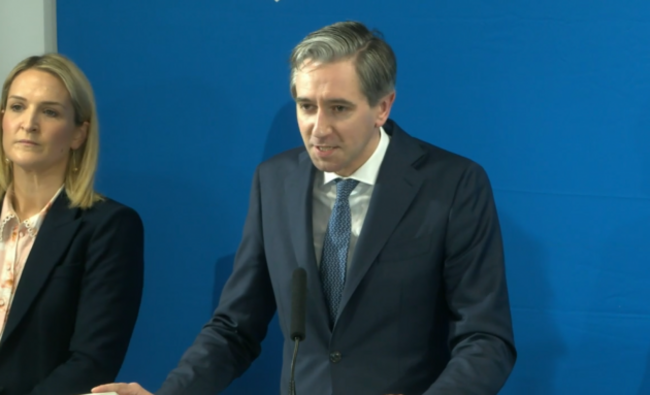
Screenshot - 2026-05-08T140331.833 Tánaiste Simon Harris answering questions at the press conference today in Antrim. Christina Finn Christina Finn

“There are multi factors, as the Taoiseach has suggested, certainly politics right across the western world is more fragmented and more contested now than it was in the past. But it is a statement of fact to say that the relationships between Ireland and the UK, and I believe the UK and the EU, are at their best that they have been since Brexit, and there has been no change of government in the UK,” he added.  

Privately, senior sources in government stated that the results coming out of the UK today are a “huge shift”, but said that what that means for the Labour leadership and the government down the line remains to be seen. 

They said that a huge amount of work has gone on behind the scenes in repairing burnt bridges since Brexit, and it would not be good for that to be washed away. 

Another also sounded caution, stating that these are just local elections. However, they said that obviously what Reform stands for is a worry. 

Bouncing Ireland into a referendum 

They said whether general election results in the UK will go the same way is too early to say, though they agreed that a Reform government could spell trouble for the cause of a united Ireland, with fears Nigel Farage could bounce Ireland into a referendum that it is not prepared for. 

This senior source said local elections allow people to send a message, but it is often the case that when it comes to a general election they want stability. They said it was still “ominous”, particularly the anti-immigrant sentiment and the calls for protectionism. 

While the results today might not be a major cause of concern for Ireland right now, former Taoiseach Leo Varadkar argued in his Sunday Times column last week that the Irish government must prepare for a reset in British politics and what it might bring. 

“Medium-term contingency planning needs to be done,” wrote Varadkar. 

Such scenarios have already been raised in the Dáil recently, with Social Democrats Gary Gannon stating that there is a problem with Ireland legislating on migration right now. 

“Within a short space of time, we could have a scenario whereby Nigel Farage is the prime minister in Britain and the Rwanda policy may be on the table again, resulting in an increased level of volatility… We are legislating for the moment on the assumption that everything will be as it is when we know that is not the case,” he said. 

It’s one thing not to jump to conclusions, but it is another not to prepare for the unexpected. Whether the government is doing this remains to be seen. 

Readers like you are keeping these stories free for everyone...
A mix of advertising and supporting contributions helps keep paywalls away from valuable information like this article. Over 5,000 readers like you have already stepped up and support us with a monthly payment or a once-off donation.

Close
57 Comments
This is YOUR comments community. Stay civil, stay constructive, stay on topic. Please familiarise yourself with our comments policy here before taking part.
Leave a Comment
    Submit a report
    Please help us understand how this comment violates our community guidelines.
    Thank you for the feedback
    Your feedback has been sent to our team for review.

    Leave a commentcancel

     
    JournalTv
    News in 60 seconds