Sign in. It’s quick, free and it’s up to you.
An account is an optional way to support the work we do. Find out more.
Sign in. It’s quick, free and it’s up to you.
An account is an optional way to support the work we do. Find out more.
LAST UPDATE | 8 Apr 2025
FIVE RELIGIOUS ORGANISATIONS have offered no contributions at all to a redress scheme for survivors of mother and baby homes, a report published by the Government has revealed.
The report, conducted by negotiator Sheila Nunan and published today by Minister for Children Norma Foley, involved negotiations with eight religious bodies with historical involvement in mother and baby institutions.
The process was seeking a financial contribution towards the cost of reparations to women in the homes. The State has already set aside €800m to compensate the survivors.
According to the report, only two out of eight religious bodies have offered a financial contribution towards the scheme since negotiations began, and only one of these was seen as realistic.
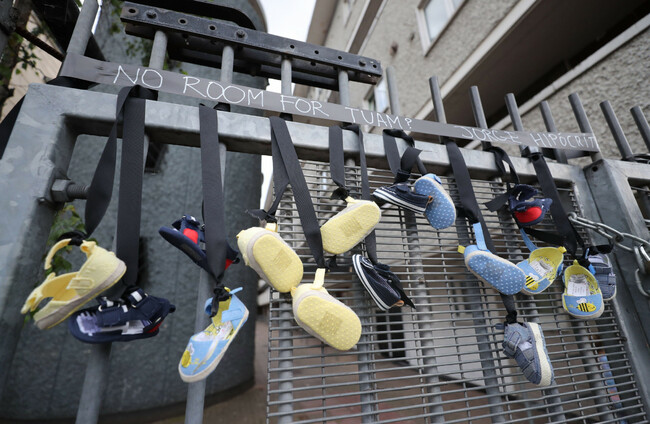
The Sisters of Bon Secours, which ran the Children’s Home in Tuam, offered a cash contribution of €12.97m, which Foley said is in line with what negotiators determined to be a “meaningful contribution”, and which the State has accepted.
An estimated 802 children died inside the Tuam home during its 36 years in operation.
The Sisters of St John of God offered a conditional donation of €75,000 to be used as a charitable donation towards a charitable purpose associated with mother and baby home survivors.
The group oversaw St Columba’s County Home in Co Kilkenny, where 140 infants died between 1922 and 1960.
A third body, the Daughters of Charity of St Vincent de Paul, offered a contribution of a building, which the government is considering accepting.
Two mother and baby homes, Pelletstown and the Belmont Flatlets, were run by the Daughters of Charity of St Vincent de Paul.
The five other religious groups “did not offer any contribution”, Foley said in a statement today.
The religious organisations which have made no financial contributions are:
“While ackowledging the financial contribution by the Sisters of Bon Secours, I believe that much more could have been done by the other religious bodies concerned,” Foley said.
She said that many of the religious orgnaisations are “very robust” when it comes to not wanting to share responsibility for what happened to women in the homes.
Foley told RTÉ’s News at One that “in many instances, the money is there”, mostly in net assets of the religious groups.
According to a financial assessment conducted by government negotiators, the eight organisations have a combined total of over €1.32bn in net assets, and over €86m cash in hand.
“I am calling on the religious orders to think again, to look at what has been done by some orders, and to think afresh … religious orders were involved in the day-to-day running of these facilities.”
The state-run redress payment plan called Mother and Baby Institutions Payment Scheme was established in 2024 to compensate survivors of the religious institutions.
As of 6 March, the government has spent less than 7% of its budget for compensating survivors of mother and baby homes, one year after the opening of the redress scheme.
To date, only €55m of the €800m available has been spent.
Around 34,000 people are eligible to apply for redress under the scheme. Speaking to reporters today, Foley estimated that “around 6,000 people” have availed of the scheme so far.
Sinn Féin’s spokesperson for children Claire Kerrane has expressed disappointment with the final report.
“That ten years of negotiations have resulted in only one of the bodies offering a cash contribution is an indictment of the very approach adopted by the government – an approach that has consistently prioritised religious orders over survivors,” Kerrane said.
“It is beyond belief that the government has continued to engage and negotiate with religious orders and ask them to pay into the fund rather than compel them to do so.”
She said that while no compensation could fully atone for the suffering of the survivors, “the refusal by these organisations to contribute adds insult to injury”.
She described the existing scheme as “already shamefully minimal and exclusionary”, adding that the refusal to pay by the religious orders was “completely unacceptable and would not be accepted from any other organisation”.
“The government’s commitment to merely review this report does little to inspire confidence that they will ever understand, much less address, the needs of survivors.”
Additional reporting by Sam Starkey and David Mac Redmond

To embed this post, copy the code below on your site











have your say