Sign in. It’s quick, free and it’s up to you.
An account is an optional way to support the work we do. Find out more.
Sign in. It’s quick, free and it’s up to you.
An account is an optional way to support the work we do. Find out more.
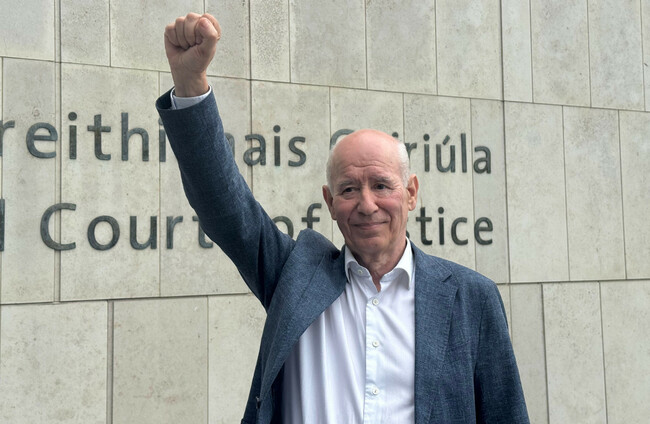
OSGUR BREATNACH’S WRONGFUL conviction for the Sallins train robbery half a century ago has now been declared a miscarriage of justice.
The mail train robbery took place on 31 March 1976 when the Cork-to-Dublin train was diverted near the Co Kildare town and an estimated £200,000 was stolen.
Breatnach was found guilty by the non-jury Special Criminal Court in December 1978, but his conviction was overturned a year and a half later after a court found his confession had been obtained under oppression.
At the Court of Appeal today, Ms Justice Isobel Kennedy said a newly discovered fact shows that there has been a miscarriage of justice.
She said the newly discovered fact concerned alibi evidence. She said there was no dispute from the Director of Public Prosecutions that that constitutes a newly discovered fact.
She noted that Breatnach asserts in his affidavit that he had “no hand, act or part” in the Sallins train robbery.
The judge said the court was satisfied that the threshold for granting a miscarriage of justice certificate has been met.
Breatnach, who is now aged 75, was one of a number of members of the Irish Republican Socialist Party who were subsequently arrested.
During interrogation, three men signed alleged confessions and all exhibited injuries they claimed were inflicted by gardaí.
The confessions were obtained at the hands of the “Heavy Gang” garda unit, whose treatment of prisoners in custody became the subject of an Amnesty International report in 1977.
In December 1978, Breatnach and two others were convicted by the Special Criminal Court on their statements.
Breatnach was sentenced to 12 years in prison, but his conviction was quashed in May 1980, after the Court of Criminal Appeal ruled that his confession had been obtained under oppression. He had spent 18 months in jail by the time of his release.
Within the same month, the IRA claimed responsibility for the theft.
A group of five human rights organisations collectively welcomed the judge’s ruling today.
Speaking on behalf of the five outside the Criminal Courts of Justice today, the executive director of the Irish Council of Civil Liberties Joe O’Brien said the ruling is a significant step forward for Breatnach’s “ongoing quest for justice and accountability”.
“While today it has finally been recognised that a miscarriage of justice occurred, the government still refuses to investigate the grievous wrongs that were committed against the men,” he continued.
He reiterated the groups’ calls for an independent public investigation into the case of the Sallins men.
“The men’s lives were irrevocably changed by what happened to them following their arrests,” O’Brien added, and said that although the justice minister claims there is no matter of significant public concern that would warrant reopening the case, they hoped he would reconsider.
“Two of the men are now sadly dead, Brian McNally just last month. Time does not diminish the human rights violations that were committed against these six men and how these live on for them and their families.”
Additional reporting by Emma Hickey
To embed this post, copy the code below on your site














have your say