Sign in. It’s quick, free and it’s up to you.
An account is an optional way to support the work we do. Find out more.
Sign in. It’s quick, free and it’s up to you.
An account is an optional way to support the work we do. Find out more.
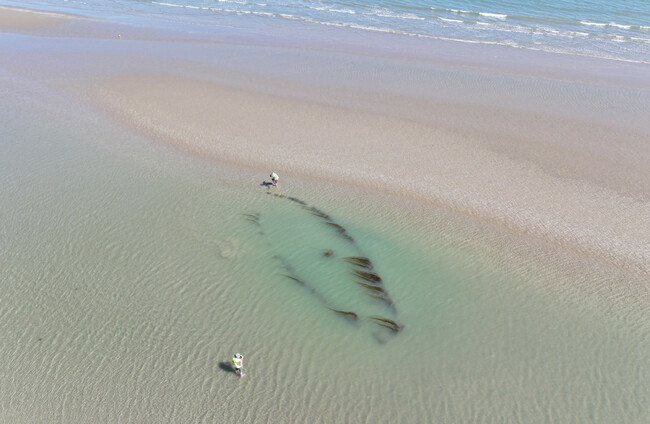
ARCHAEOLOGISTS FROM THE National Monument Service are assessing newly-revealed shipwrecks just off the coast of Portmarnock in north County Dublin.
Shifting sands uncovered one wreck that was previously visible in 2017 and in the 1990s.
Its reemergence was identified by local underwater photographer Nigel Motyer and a subsequent investigation by the National Monuments Service (NMS) led to the discovery of three never-before-recorded shipwrecks, some of which may date back as far as the 19th Century.
Karl Brady, a senior archaeologist with the NMS who led the inspection said:
“Prolonged periods of wind from a particular direction move beach sands constantly and, in this case, had temporarily stripped the southern end of the beach of sand leading to the exposure of these wrecks”.
The NMS team has surveyed and photographed the wrecks, and ongoing analysis of the materials, size, and construction style will help archaeologists to identify the wrecks.
“The newly-discovered wrecks are poorly-preserved due to continuous tidal and storm action over the years.,” Brady explained.
“In general, while only the lower portions of the hulls and bow areas have survived, our team has identified timber frames, planking, metal knees, and even a metal winch/windlass system at the bow of one of the boats.”
Some 50 wrecks are recorded for the Portmarnock/Baldoyle area in the Wreck Inventory, identified through years of painstaking historical and archival research by the NMS. These range from 14th century trading ships to 20th century coal-boats. The physical remains of at least 13 of these vessels have been located.
“18th and 19th century newspaper articles and specialist maritime sources can shed some light on the wrecks, where they were built, and the identities of the crew,” Brady said.
“In some cases, records exist detailing the final moments of the vessels, as well as rescue attempts undertaken by local lifeboat crews, often in severe weather.
“Many vessels have similar construction style over the centuries, and there are often no dateable artefacts recovered, so confirming the identity of the wrecks and aligning them with historical records is challenging.”
Research by NMS indicates that most of the vessels recorded off Portmarnock Strand were lost during bad or stormy weather.
“Several of the ships, en route to Dublin, may have attempted to seek refuge in Howth Harbour during stormy conditions but failed to reach the safety of the harbour entrance and were compelled to run ashore on the strand, a desperate measure to save lives.
“Other ships, originating from ports on the west coast of Britain and bound for various global destinations, seem to have been unfortunate victims of stormy weather, driven ashore at Portmarnock, often at night. There is an unusually high number of wrecks in this location.”
Minister Darragh O’Brien, who alongside housing and local government has responsibility for heritage, today visited with the underwater specialist archaeologists as they assessed the wrecks.
O’Brien said the discovery was “a very exciting development”.
“No doubt each of these shipwrecks has an important story to tell and we hope that, in time, we will learn more about them and the roles they have played in shaping our history.”

To embed this post, copy the code below on your site












have your say