We need your help now

Support from readers like you keeps The Journal open.

You are visiting us because we have something you value. Independent, unbiased news that tells the truth. Advertising revenue goes some way to support our mission, but this year it has not been enough.

If you've seen value in our reporting, please contribute what you can, so we can continue to produce accurate and meaningful journalism. For everyone who needs it.

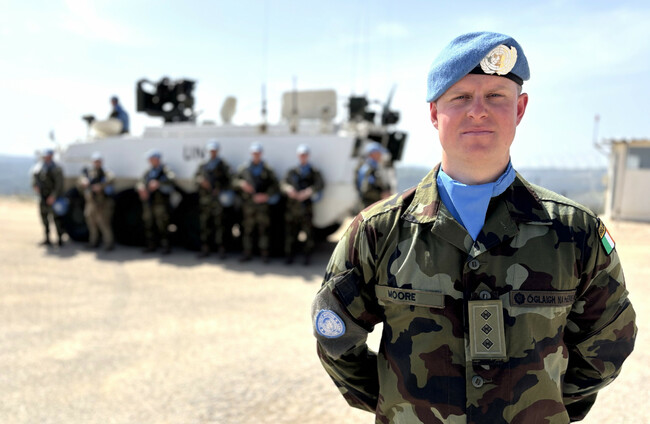
Captain Tadgh Moore who led troops at outpost UNP 6-52. Niall O'Connor/The Journal

Bombs and board games: Irish troops speak of their experiences of coming under fire in Lebanon

The Journal has travelled to Lebanon this week to meet up with Irish soldiers who have found themselves at the centre of a war between Hezbollah and Israel.

AN IRISH SOLDIER who led a small military team just metres from Israeli positions has spoken about playing chess as they sheltered in bunkers to keep morale high as ordnance rained down outside.

Captain Tadgh Moore is deployed as part of the 336 strong 125th Infantry Battalion in South Lebanon.

He was, for almost two months, the officer commanding UNP 6-52, a lonely outpost of 26 Irish soldiers located right on the blue line eight kilometres from the main base at Camp Shamrock.

The small outpost is just 400 metres from the Israeli town of Metula where there is a large IDF presence. The outpost overlooks a demarcation line of blue barrels and fencing known as the Blue Line. 

UNP 6-52 was the location where, during the early days of the Israeli invasion of Lebanon last October Israel surround 6-52 with Merkava Tanks in October 2024.

Israeli forces had told the Irish of the 124th Infantry Battalion to leave but the small team on that occasion stayed there and held their ground.

Moore and his team from the 125th Infantry Battalion were the crew that replaced those soldiers and he took up command in November.

The Journal spoke to the 26-year-old Donabate man in Camp Shamrock this week about what it was like to hold the UN line as Israel and Hezbollah traded ordnance.

Military people use the phrase “kinetic” to describe active war fighting and shelling.

“It was definitely a very kinetic, hostile environment we found ourselves in – however due to the Mission Ready Exercise we were well prepared.

“The most challenging time was definitely the kinetic and volatile nature of what we found ourselves in,” he said. 

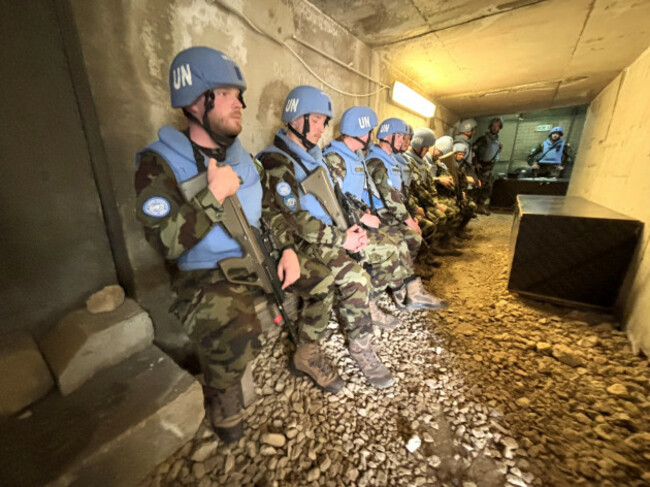
The young officer said that he and his team were forced to take shelter in bunkers regularly during their time deployed there.

It is understood that on one occasion they were stuck in the bunkers for three days straight while it was Moore’s responsibility to come out of the safety of the bunker to observe movements outside.

“We played chess and we talked in ways to keep the morale high – it was a challenge but it was certainly something where you just go back to your training, you rely on yourself and you have confidence in yourself and your ability to lead and the soldiers I was working with were of the highest calibre,” he added. 

Moore’s team consisted of 26 personnel – this include a cook and a medic – he said teams were broken down in to five elements to manage their operations. 

“Every day was varied, always challenging but it wasn’t something we couldn’t handle at any stage,” he added. 

Moore said that he is conscious that a lot of people at home don’t understand the life and work of the soldiers deployed to south Lebanon.

“I think people at home might not have an awareness, they don’t appreciate it. They are not aware what goes on but we have a long history of peacekeeping ourselves and we’re confident in our abilities,” he said.

Groundhog Known as Groundhog Irish soldiers must take to bunkers during shelling. A small team stays in observation posts outside during the incident to record what is happening. Niall O'Connor / The Journal Niall O'Connor / The Journal / The Journal

‘Groundhog, groundhog, groundhog’

Irish soldiers call the need to go to the bunkers “groundhog” – it is done when there is active fire incoming or they believe that it is imminent. 

A soldier, who cannot be named due to his role, described what it is like to sit in the bunkers during a “Groundhog”. 

“In terms of the sensation in the bunkers, you could recognise audibly that munitions were landing close by but in terms of the bunkers and the structural support, there was no shaking.

“they were all up to the required standard of force protection in the mission area.

“There was no shaking. The only thing you could really recognise ion the bunkers themselves was the sound of the munitions landing,” he said.

From Athlone to At Tiri

The Journal spoke to other soldiers about their time deployed in the hills of South Lebanon.

In October last year we met a number of them on their mission readiness exercise (MRE) in the Glen of Imaal military range. We also spoke to them at their parade in Custume Barracks in Athlone before they departed for the warzone

Our visit to Camp Shamrock was a chance to catch up with those soldiers and hear about their experiences.

One of those members we met in Athlone was Donegal man Private Keelan Barrett, a soldier on his first trip to Lebanon – we met him walking through Camp Shamrock this week and stopped to chat about his experiences. 

“It has been a pleasure serving out here with the UN in Lebanon in 2-45. I am two months away from getting home, it has been surreal out here – I feel like we have accomplished the mission so far.

“Yes, it is my first trip – it has gone above what I expected. It’s ideal with the good weather here today, it hasn’t always been like this and there were moments in bunkers and there were times where I wondered what was going to happen but you adapt to these situations and you pull through,” he said. 

The Journal / YouTube

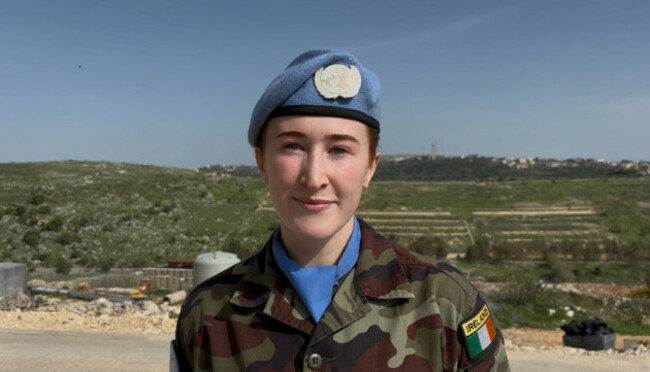
Another is Captain Jessica Doran who along with handling the press relations for the 125th Infantry Battalion she also works in the critically important Civil Military Cooperation team or CIMIC. She is on her first deployment to Lebanon. 

This is a team of soldiers who go out into towns and villages and interact with the public who are often deeply distressed by the destruction of their homes and deaths of their relatives. 

“I’m working here as the CIMIC team coordinator. We establish the link between the Battalion commander and the local community – that’s my job liaising with them.

“I’ve really enjoyed the trip. Before coming out I expected different challenges, like being in bunkers alot, but the work has been really enjoyable and especially because I’ve deployed with guys I trained with – it has been definitely a memorable experience.

“I was a bit naive coming out and I didn’t really know what to expect coming out and that kind of played to my benefit because I went in and really learned a lot and enjoyed my time here,” she said.

Jessica Doran Captain Jessica Doran who is Civilian Military Cooperation Coordinator at Camp Shamrock. Niall O'Connor / The Journal Niall O'Connor / The Journal / The Journal

Father and son

Another two soldiers we met in the wind swept pouring rain of the Glen of Imaal in October was Battalion Sergeant Major Patrick Enright and his son Private Adam Enright.

Patrick’s job is as the senior non-commissioned officer while Adam is a soldier tasked with patrolling.

Adam said: “It’s an honour to serve here with my dad, not a lot of people get to see that and get an opportunity to do something like this.”

And asked what it is like to be deployed to a warzone with your father: “He’s the Battalion Sergeant Major, but he’s still my dad”.

Patrick, who lives in Letterkenny, has done multiple tours of duty to multiple locations across the globe over a three decades long career in the Irish Army. 

“It has been a great honour to serve here with my son. with the Irish Defence Forces – I am very humbled to be here. 

“There has been trouble in Lebanon for a lot of years now.

“My first trip out here was in 1992 and that’s 32 years ago – Lebanon and UNIFIL has seen a lot of changes in that time, I would have seen it when it was at its worst and then when it was reasonably stable.

“It is great to see the place is starting to stabilise again, great to see the Lebanese Armed Forces coming back into the area again,” he said.

The Irish troops have two months to go before a new Battalion, the 126th, will take up their posts as peacekeepers in the hills of South Lebanon.

Readers like you are keeping these stories free for everyone...
A mix of advertising and supporting contributions helps keep paywalls away from valuable information like this article. Over 5,000 readers like you have already stepped up and support us with a monthly payment or a once-off donation.

Close
JournalTv
News in 60 seconds