Sign in. It’s quick, free and it’s up to you.
An account is an optional way to support the work we do. Find out more.
Sign in. It’s quick, free and it’s up to you.
An account is an optional way to support the work we do. Find out more.
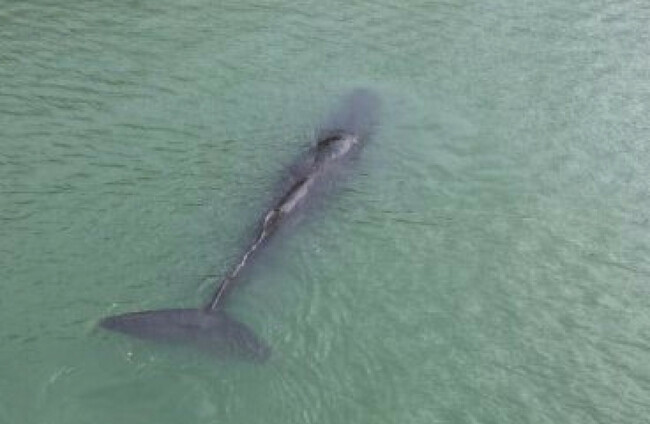
A SPERM WHALE sighted near the coast of Co Wexford has been reported to be swimming relatively strongly from the estuary out to sea, following earlier fears that it may strand.
The whale, which appears to be an adult sperm whale, was sighted early this morning at Arthurstown.
Aerial images captured of the whale show it incredibly close to land. Despite its current positive prognosis, the whale’s fate remains uncertain. It is still possible that it may end up stranding on land.
Sighting Officer at the Irish Whale and Dolphin Group, Pádraig Whooley, told The Journal that the group is continuing to monitor the situation. Adult sperm whales typically measure between 40 and 50 foot in length.
“Sperm whales don’t belong within 100 miles of the Irish coastline. They’re a deep diving whale,” Whooley said. “Everything about them is built for deep water environments. There’s no food for them here. They can’t use their navigation properly here.”
The whale was earlier reported to have been within a couple of feet of the shoreline during high tide earlier this afternoon. It was feared that as the tide fell, it would leave the whale stranded.
Whooley said that it was fortunate that it was high tide when it came close to shore.
“Even though it was remarkably close to the shore, there was still a good depth of water underneath it, so it hadn’t actually stranded. But the big concern was at half two, when the tide was falling very, very quickly, the whale that had water under it was going to find it had no water under it, and once it stranded, then it stays there for six hours.
“At this time of the year, six hours – the whale could overheat. It would be very unusual for a whale to spend a whole six hour tidal cycle high and dry on land and survive,” he said, adding that its body would start to shut down quite quickly, and crush itself to death.
If the whale does ultimately end up stranding, it is incredibly likely that it will die as a result. Whooley said that the options available in this case are to either “let mother nature run its course” or discuss options with veterinarians, such as euthanasia.
It is currently being treated as a sighting, and if it strands, the Irish Whale and Dolphin Group’s live stranding team will be on site to deal with it, he said.
In Clonea in Co Waterford, a fin whale was reported as having washed up and stranded in January of this year. The whale, which measures up to 20 metres in length, has been left to slowly decompose on the shoreline, as the council cannot gain access to it to dispose of its carcass.

To embed this post, copy the code below on your site














have your say