We need your help now

Support from readers like you keeps The Journal open.

You are visiting us because we have something you value. Independent, unbiased news that tells the truth. Advertising revenue goes some way to support our mission, but this year it has not been enough.

If you've seen value in our reporting, please contribute what you can, so we can continue to produce accurate and meaningful journalism. For everyone who needs it.

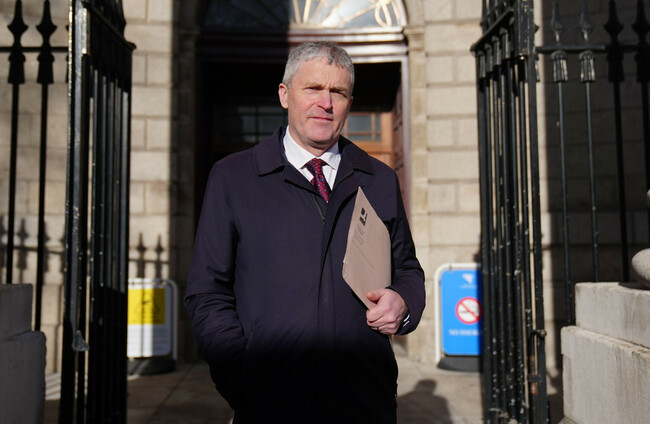
Pa Daly outside the Four Courts in Dublin in January 2025. Alamy Stock Photo

Supreme Court to hear Sinn Féin TD's appeal over super junior ministers at Cabinet

The High Court dismissed Pa Daly’s legal challenge to the attendance of super junior ministers at Cabinet last December.

THE SUPREME COURT has agreed to hear a Sinn Féin TD’s appeal against a decision in a case which sought to quash the appointment of so-called ‘super junior ministers’.

Pa Daly, along with People Before Profit TD Paul Murphy, brought separate legal cases against the government last year to ask the High Court to declare that the attendance of four ministers of state at government meetings was unconstitutional.

The TDs argued that the Constitution is clear in its description of government and places a limit on the number of ministers who can attend and vote at Cabinet meetings.

The High Court dismissed both cases last December. Daly subsequently sought leave to appeal to the Supreme Court, which has now been granted.

The Supreme Court can hear appeals from decisions of the High Court where it is satisfied that there are exceptional circumstances warranting a direct appeal to it. Known as a ‘leapfrog appeal’, it bypasses the Court of Appeal.

Ministers are appointed by the President of Ireland to sit as the country’s government. Ministers of State, however, are appointed by the Taoiseach and can be nominated by the cabinet.

There are currently 15 senior ministers at cabinet level, but Ministers of State, often referred to as junior ministers, can be selected to attend weekly government meetings. The practice has been frequent since the early 2000s.

In its determination, the Supreme Court said the core of Daly’s case “is that the statutorily permitted attendance on a regular basis at Government meetings by the four Ministers of State amounts in substance to a breach” of two articles in the Constitution. 

It said it is these which allow for the appointment of “not more than 4 specified holders of the office of Minister of State who regularly attend meetings of the Government”.

Concluding, the three-judge court said: “It is clear that this case raises fundamental issues concerning the interpretation of Articles 13 and 28 of the Constitution in relation to the functioning of the Government.

“These issues are novel and the prospective appeal presents questions of potentially lasting constitutional significance.”

It added that it would be in a position to organise a case management hearing “in early course”. 

‘Legal clarity will be established’

In a statement, Daly welcomed the Supreme Court’s decision.

He said he brought the legal challenge because “a culture has developed in which constitutional boundaries can be bent through backroom deals, at the cost of public trust in politics and the weakening of our democratic institutions”. 

“This is not about those currently serving as Super Junior Ministers. It is about the constitutionality of their role at Cabinet, which the Supreme Court will now determine.

“I now look forward to the case proceeding before the highest court, where legal clarity will be established in the public interest.”

Last December, High Court President Mr Justice David Barniville said he and his two colleagues – Ms Justice Siobhán Phelan and Mr Justice Conleth Bradley – had rejected the arguments made by Daly and Paul Murphy “in their entirety”.

“We are satisfied that there is no constitutional provision, express or implied, which limits the attendance at meetings of the Government to the 15 ministers who were appointed by the president (including the Taoiseach).”

The three judges said there was “no constitutional provision, express or implied”, and so no “disregard” of any constitutional provision by the regular attendance at Cabinet by ministers of state or super junior ministers.

“As no disregard – and certainly no clear disregard – of the constitutional parameters to the exercise of government power or breach of the constitutional provisions concerning the Government has been established, we are satisfied that deputy Daly’s claim must fail and he is not entitled to the declaratory relief which he seeks in these proceedings.”

Readers like you are keeping these stories free for everyone...
A mix of advertising and supporting contributions helps keep paywalls away from valuable information like this article. Over 5,000 readers like you have already stepped up and support us with a monthly payment or a once-off donation.

Close
JournalTv
News in 60 seconds