Sign in. It’s quick, free and it’s up to you.
An account is an optional way to support the work we do. Find out more.
Sign in. It’s quick, free and it’s up to you.
An account is an optional way to support the work we do. Find out more.
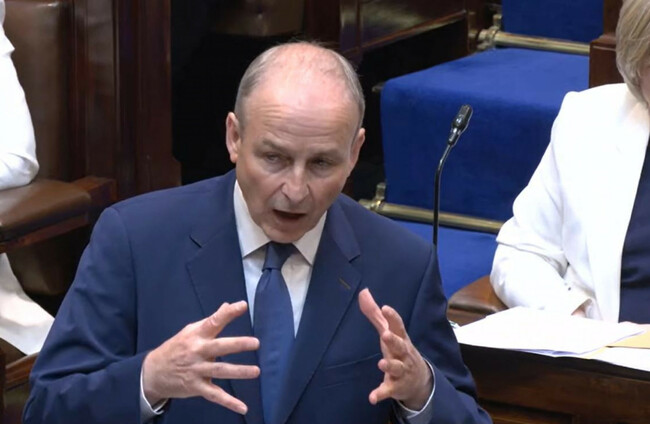
TAOISEACH MICHEÁL MARTIN has doubled down on his comments about nuclear energy, after stating earlier this week that the country should “consider seriously” its use.
Martin made the initial comments at a European Political Community summit in Yerevan, Armenia, as around 50 European leaders met to discuss energy security and geopolitical stability.
“We’ve made significant progress on renewables, particularly onshore wind and solar, and offshore wind will be a major next step. But we should also look at alternatives, including nuclear, given advances in technology,” Martin told reporters at the summit.
Back on domestic political duty in the Dáil this afternoon, the Taoiseach reiterated that Ireland should have a “serious examination” of nuclear power as part of its long-term energy plans.
Martin was asked about the issue by both Labour leader Ivana Bacik and Independent Ireland’s Ken O’Flynn during Leaders’ Questions this afternoon.
Once Ireland’s Celtic Interconnector with France is in operation, Martin said, Ireland will “for all intents and purposes, be importing energy generated through France’s nuclear capacity”.
O’Flynn pointed out that “Ireland bans nuclear energy at home while it imports nuclear generated energy directly from France”, calling it a contradiction.
The debate comes in the wake Fianna Fáil’s James O’Connor introducing a bill in the Dáil to reverse the ban on nuclear energy in Ireland.
Bacik called O’Connor’s bill “a hare-brained notion”, pointing out that “in countries with a planning system that actually works, nuclear still takes years and years”.
She described Fianna Fáil party as the “Don Quixote of Irish politics”, stating: “You’re frightened of windmills.”
Martin accused Bacik of exaggerating and making “silly statements” before stating that the reason for Ireland’s high electricity costs is that we are on an isolated grid, with the only interconnectors being two with Britain, as well as the near-completed Celtic Interconnector.
He also said that the government was also working towards a new undersea cable linking Ireland with Spain. The first steps towards that new interconnector were taken late last month, but it’s likely the project will take years to complete.
Bacik then pointed to Spain as an example of a country where lower-cost and lower-carbon electricity had lowered energy prices.
The ongoing political debate on energy costs and security comes as new research from Eurostat shows that Ireland has the highest household electricity prices in the EU, with the average household now paying €480 more per year compared to the EU average.
Sinn Féin leader Mary Lou McDonald told the Taoiseach in the Dáil that “the urgent need for an emergency budget grows by the day” and that families are “under huge pressure” due to the cost of groceries, fuel, insurance and energy bills.
Martin responded that the coalition “from the Budget onwards has focused on investment and services and alleviating pressures on families, and will continue to do so.
“We acknowledge that there are significant pressures on people because of a range of issues, not least the impact on fuel prices arising from the Middle Eastern war, which follows the tariff issue, which follows the situation with the invasion in Ukraine and the post-Covid inflationary cycle that occurred then.”
Martin said there was a need “to be careful” as continued Government spending would have an “inflationary impact”.
He said the “other mechanisms” would be available in the Budget to help people over the winter period, including tax measures.
To embed this post, copy the code below on your site














have your say