Sign in. It’s quick, free and it’s up to you.
An account is an optional way to support the work we do. Find out more.
Sign in. It’s quick, free and it’s up to you.
An account is an optional way to support the work we do. Find out more.
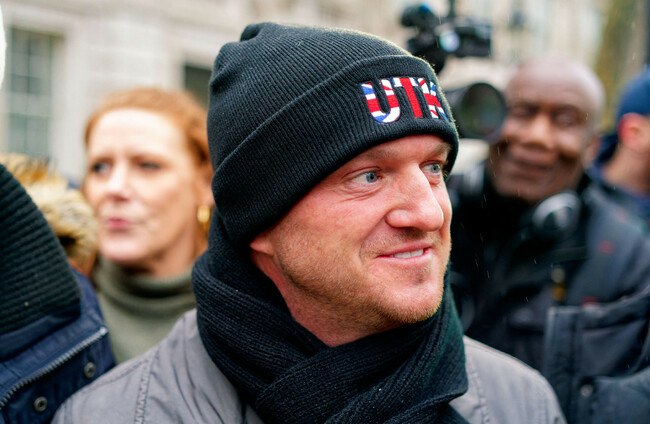

STEPHEN YAXLEY-LENNON, THE British far-right agitator who pretends his name is Tommy Robinson, was in Dublin last week.
If you’re not a bigot or terminally online, you likely missed this State visit from a man who regularly gives out about criminals crossing “open borders” for economic reasons.
Robinson first announced his trip to the old country in a post to his ‘super followers’ on X, who pay him a subscription fee to access bonus content, the day after he appeared in a UK court accused of harassing two journalists.
While he was here, he stopped by Conor McGregor’s “black forged inn” [sic] in Drimnagh, went to the grave of a relative who died during the 1916 Rising, and bought a 15-pack of cheese and onion crisps.
But it wasn’t all shamrocks and shenanigans.
The difficult thing about being a peripatetic content creator like Robinson is that you can never truly switch off, not when you have over two million followers awaiting updates on the supposed collapse of Western civilisation.
Between dozens of posts about protests in France and the Brazilian elections, he used his Irish visit to post some in-the-field content about Muslims praying at Croke Park and his annoyance at a pro-Palestine banner draped on Liberty Hall.
It was grist to the mill for Robinson, for whom John Bull’s Other Island is a prop for spreading hateful views about Muslims and immigrants.
For someone who loves Ireland as much as he claims to, he posts a lot about what a kip the country has become because it no longer looks like The Shire and dark-skinned people live here.
His interest in Ireland intensifies during major protests or instances of unrest, when he repurposes content from other social media accounts and re-shares it to his profile on X where he can monetise it.
We saw this during June’s anti-immigrant riots in Belfast and in the midst of the fuel price protests in April, when Robinson was name-checked by Justice Minister Jim O’Callaghan for using the demonstrations “to advance his own political measures”.
Most people won’t have noticed Robinson here, and fewer will care.
He’s allowed to travel here because Ireland’s borders are open to British nationals; as someone who travels on an Irish passport (he qualifies through his mother), he is technically an Irish citizen.
He is free to express his ironic views about foreign “invaders” taking over because we live in a democracy where you can say such things.
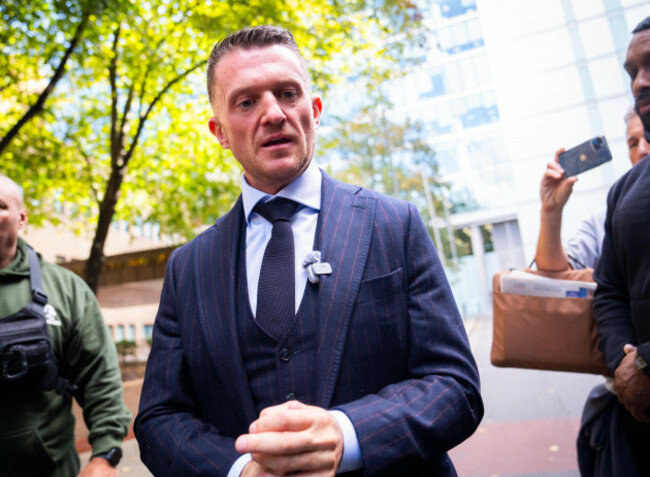
But Robinson’s influence does not depend on him being here.
His audience may be almost entirely online, but he has spawned a legion of imitators who have increasingly spread hate about Muslims and immigrants in Ireland, or claimed that the country is on the brink of civil war.
Irish far-right activists have repeatedly rallied around him and adopted campaigns he promotes.
In 2016, the mooted launch of the anti-Islamic group Pegida Ireland was announced at a press conference attended by Robinson; two years later, a far-right group held a ‘Free Tommy Robinson’ event in Belfast; a year ago, tricolours began appearing on lampposts across Ireland after a similar campaign was championed by Robinson in the UK.
There is also an ever-growing number of content creators online who are monetising hate and misinformation in Ireland, as Robinson does, which emboldens far-right and anti-immigrant groups.
For four successive years, the island of Ireland has witnessed serious anti-immigrant riots as a result of online agitators copying Robinson’s style and stirring things up until the powder keg explodes once something happens to light the spark.
It’s a stretch to say Robinson was responsible for those instances of unrest, but he was among the first to use social media in this way and is now arguably the most famous far-right provocateur in Ireland or the United Kingdom.
The hatred and misinformation that contribute to major unrest in Irish cities do not exist in a vacuum.
They are spread in thousands of social media posts every day, by people who mimic Robinson’s style or who are amplified by him.
Those views can have political consequences when government policies shift to the right on things like immigration, because ministers heed the concerns of citizens who have been influenced by rhetoric that seeps from online spaces and into society.
Robinson’s trip to Ireland may have passed most people by, but the hatred he trades in builds post by post, day by day, long before its consequences make the news.
He can return home after a few days; the hostility he encourages doesn’t leave with him.

To embed this post, copy the code below on your site










have your say