Sign in. It’s quick, free and it’s up to you.
An account is an optional way to support the work we do. Find out more.
Sign in. It’s quick, free and it’s up to you.
An account is an optional way to support the work we do. Find out more.
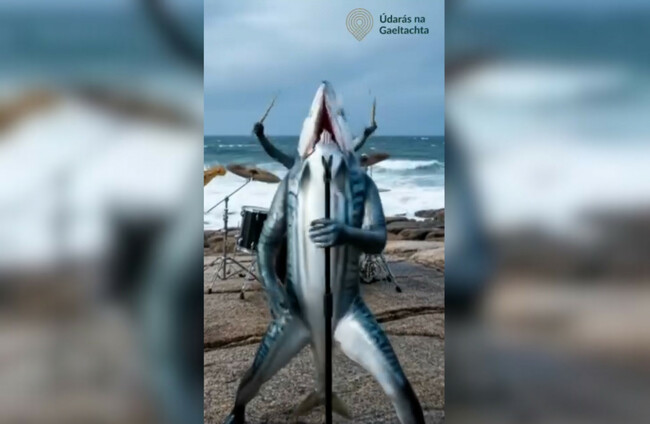
(Seo alt ónár bhfoireann nua Gaeltachta. Is féidir an bunleagan as Gaeilge a léamh anseo.)
STATE AGENCY ÚDARÁS na Gaeltachta is facing a backlash from artists for running a competition encouraging film-making using artificial intelligence (AI).
The Gaeltacht development agency announced the competition with an AI-generated video depicting scenes including a band fronted by a fish – who turns into a man – singing into a microphone, and a K-pop band performing on an Irish beach.
Údarás said Irish is a living language and that artificial intelligence is opening new doors for filmmaking in Irish. It’s offering a prize of €6,000 for the winner of its Togra Scéalaí competition, which it announced on social media.
“I don’t think this is where funds should be allocated,” commented one user. “All that will come out of it is a load of subpar projects that come from religiously spamming variations of written prompts until you get something half-usable, with patchwork splicing and no cohesion and minimal creativity.”
“This is so insulting to request AI when we are such a creative and artistic nation. I’m disgusted with the Irish Government for this. Pay Irish artists,” said another.
Another user commented: “People who actually care about what film can uplift and share aren’t going to use AI and aren’t afraid of hard work. They’ll take their work elsewhere that respects their time, skill and effort as artists. This is absolutely appalling by Údarás.”
Eoin McEvoy, a writer and translator who works through Irish, said he does not want to be overly critical of Údarás na Gaeltachta, but he believes the video is “ridiculous” and makes no sense.
“That scene with the singing fish — it’s an insult to what art is, and it shows such a lack of understanding of the creative process of artists and of what makes art worthwhile.”
The organising committee of Dublin-based Irish language arts collective Aerach Aiteach Gaelach (AAG) urged its 80 members not to engage with the competition. The LGBTQ+ collective said the arts community is “deeply disturbed by the negative impact that artificial intelligence is having on their craft”.
AAG’s organisers said there are negative impacts of artificial intelligence on artists’ ability to think independently, and it will have an adverse effect on human creativity.
In a statement, they also noted that artificial intelligence has a negative impact on the environment, which is a major cause for concern. AI causes greenhouse gas emissions due to the heavy energy consumption of data centres.
Údarás told The Journal that, as an agency of the government, it has a responsibility to develop an AI component to the 2023-2027 Irish Language Digital Plan.
Writer Eoin McEvoy, a member of the AAG committee but speaking in a personal capacity to The Journal, said he doubted whether AI would “improve anything in the Gaeltacht”.
“There are problems in the Gaeltacht with infrastructure and employment, and if money is being invested in Údarás na Gaeltachta, I believe it should be serving the Gaeltacht community above all else,” he said.
“And I don’t see how a competition like this, or anything related to artificial intelligence, will help with those problems.”
McEvoy says that the Irish-language arts are flourishing and that there is a strong community of artists in Ireland who create work through Irish.
He says there is not a gap in the Irish language arts scene, but if there is one, he believes it would be better to invest money in the arts and in developing talent rather than focusing resources on artificial intelligence.
“This applies to filmmaking in Ireland. Certainly, the Irish-language arts community is smaller than the English-language arts community working in Ireland, but the actors and directors are there,” he said.
“If it appears that there is a gap in terms of Irish-language directors or translators, put the money into training.
Bring in actors with English and teach them Irish, or bring in companies and teach them how to translate.
“There are many ways to address gaps like this rather than simply removing people and artists from the process and asking a machine to replace them. It is art and artists — that human connection — that will attract people to Irish, not machines.”
In response to a query from The Journal, Údarás na Gaeltachta said it is seeking to demonstrate its role and commitment as a “pillar of support for the audiovisual sector in the Gaeltacht”.
“As an organisation, on behalf of the Government, we have a responsibility to develop the Artificial Intelligence element of the Irish Language Digital Plan,” it said.
“To that end, we have put the Scéalaí project in place as an opportunity to begin a discussion around this aspect of artificial intelligence, as well as to present the tools, opportunities and challenges available to the Gaeltacht community and the Irish-speaking public.”
The organisation noted that they announced support measures of €600,000 for the creative sector in the form of a partnership with TG4, which is worth €1.2 million on 3 December, which they say will secure employment for the creative sector for the years ahead.
Údarás na Gaeltachta says that significant international changes are coming across many areas of the economy as a result of AI, and that they have a responsibility to ensure that Irish and the Gaeltacht are central to those changes.
“We recognise that there is concern arising from the uncertainty associated with artificial intelligence, but we are very clear that our role is to protect employment in the Gaeltacht, to identify threats to it, and to take appropriate steps if they arise.”
The Journal’s Gaeltacht initiative is supported by the Local Democracy Reporting Scheme

To embed this post, copy the code below on your site















have your say