Sign in. It’s quick, free and it’s up to you.
An account is an optional way to support the work we do. Find out more.
Sign in. It’s quick, free and it’s up to you.
An account is an optional way to support the work we do. Find out more.
RUSSIA HAS ACCUSED Ukraine of hitting an oil refinery with a drone strike, saying parts of unmanned aircraft had been found at the scene.
The Novoshakhtinsk refinery is located in Russia’s Rostov region, a few kilometres from the border with Ukraine’s separatist region of Lugansk.
“As a result of terrorist actions from the western border of the Rostov region, two unmanned aerial vehicles (UAVs) attacked the technical facilities” of the plant, the Novoshakhtinsk refinery said in a statement.
It added that as a result “an explosion occurred, starting a fire”.
The claim has not been independently verified.
Rostov region governor Vasily Golubev said earlier that drone fragments were found at the site but did not specify where the drones may have originated.
Golubev said the fire had been put out and all plant staff have been evacuated with no casualties.
Work at the plant has been suspended pending an investigation, Golubev added.
Russia has several times accused Kyiv of launching attacks near the joint border since starting a military intervention in Ukraine in late February.
The fire at the refinery comes days after Moscow accused Ukraine of firing at Black Sea drilling rigs off the coast of Russia-annexed Crimea.
“Massive” Russian bombardment of Ukraine’s battleground eastern Lugansk region and key city Severodonetsk has been “hell” for soldiers there, Kyiv said, while insisting that defenders would hold “as long as necessary”.
Moscow’s troops have been pummelling eastern Ukraine for weeks and are slowly advancing, despite fierce resistance from the outgunned Ukrainian military.
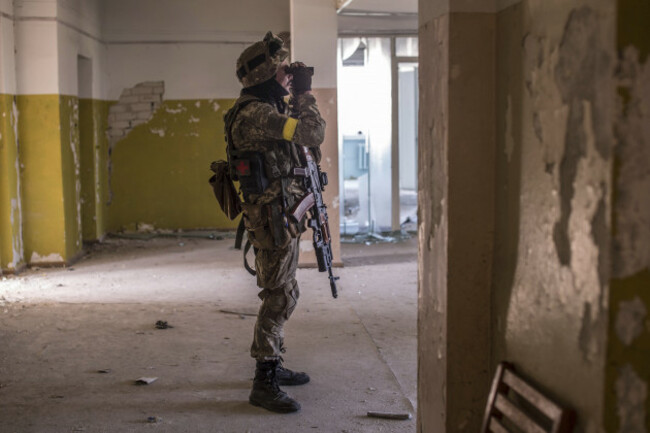
With President Vladimir Putin’s forces tightening their grip on the strategically important city of Severodonetsk in the Donbas, its twin city of Lysychansk is now coming under heavier bombardment.
“The Russian army is massively shelling Lysychansk,” Sergiy Gaiday, governor of the Lugansk region, which includes both cities, wrote on Telegram.
“They are just destroying everything there … They destroyed buildings and unfortunately there are casualties.”
He later wrote that “it’s just hell out there” after four months of shelling in Severodonetsk, across the Donets river – while adding that “our boys are holding their positions and will continue to hold on as long as necessary”.
In his daily address Tuesday, Ukrainian President Volodymyr Zelenskyy also accused the Russian army of “brutal and cynical” shelling in the eastern Kharkiv region.
“The Russian army is deaf to any rationality. It simply destroys, simply kills,” he said.
Fifteen people were killed by Russian shelling in Kharkiv Tuesday, its governor said.
Aid group Doctors Without Borders (MSF) said it had gathered accounts of an “outrageous lack of care to distinguish and protect civilians”.
Among hundreds of patients evacuated by train, more than 40 percent were elderly people or children.
Most said Russian or Russian-backed forces were to blame for a spectrum of gruesome injuries.
“Although we cannot specifically point to an intention to target civilians, the decision to use heavy weaponry en masse on densely populated areas means that civilians are inescapably, and are therefore knowingly, being killed and wounded,” said MSF emergency coordinator Christopher Stokes.
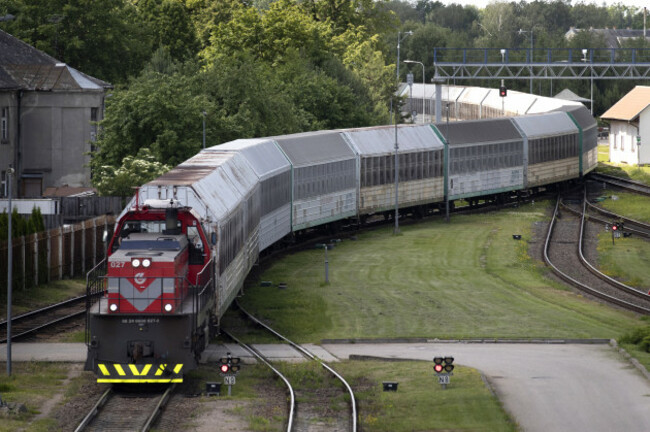
Away from the battlefield, Moscow was locked in an increasingly bitter dispute with EU member Lithuania over the country’s restrictions on rail traffic to the Russian outpost of Kaliningrad.
The territory is around 1,600 kilometres from Moscow, bordering Lithuania and Poland.
By blocking goods arriving from Russia, Lithuania says it is simply adhering to EU-wide sanctions on Moscow.
But Moscow accused Brussels of an “escalation” and summoned the EU’s ambassador to Russia.
The United States made clear its commitment to Lithuania as an ally in NATO, which considers an attack against one member an attack on all.
“We stand by our NATO allies and we stand by Lithuania,” State Department spokesman Ned Price told reporters in Washington.
A Ukrainian photojournalist and a soldier who was accompanying him appear to have been “coldly executed” during the first weeks of the Russian invasion, Reporters Without Borders said.
The press freedom group said it went back to the spot where the bodies of Maks Levin and serviceman Oleksiy Chernyshov were found on 1 April in woods north of the capital, Kyiv.
The pair had been searching the Russian-occupied woodlands for the reporter’s image-taking drone at the time.
The group said it counted 14 bullet holes in the burned hulk of their car, which was still at the scene.
It said disused Russian positions, one of them still booby-trapped, were found close by.
Also found were the remains of food rations, cigarette packets and other litter seemingly left by Russian soldiers.
Some of Mr Levin and Mr Chernyshov’s belongings, including the soldier’s ID papers and parts of his bulletproof vest and the photographer’s helmet, were also recovered, it said.
With reporting from PA

To embed this post, copy the code below on your site









have your say