Sign in. It’s quick, free and it’s up to you.
An account is an optional way to support the work we do. Find out more.
Sign in. It’s quick, free and it’s up to you.
An account is an optional way to support the work we do. Find out more.
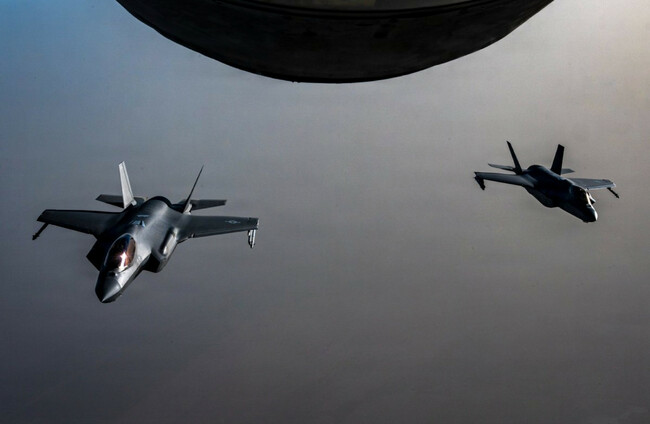
THE UNITED STATES said it shot down a pair of Iranian drones threatening the Strait of Hormuz, the latest escalation of violence as the war crept into its 100th day on Sunday with no end in sight.
Weeks of indirect talks marked by tit-for-tat threats and sporadic exchanges of fire have failed to secure a deal to end the conflict or reopen the vital waterway, a chokepoint for Gulf oil and gas shipments.
US Central Command (CENTCOM) said it destroyed two Iranian drones “that threatened international maritime traffic in the Strait of Hormuz”, hours after announcing it struck four other drones and coastal surveillance radar sites.
Tehran responded with a salvo of missiles at US allies Bahrain and Kuwait on Saturday, drawing a furious response from the Gulf monarchies and piling pressure on a shaky ceasefire agreed on 8 April.
CENTCOM said Iran launched seven ballistic missiles towards Bahrain and Kuwait, with six intercepted and one falling short. Iran’s Revolutionary Guards said they had targeted “enemy bases in the area” with missiles.
Bahrain, which hosts the headquarters of the US Fifth Fleet, denounced the latest attacks as “blatant aggression”, while Kuwait said they “represent a dangerous escalation”.
In Bahrain’s capital Manama, an AFP journalist heard three explosions as air raid sirens sounded.
In Kuwait, another AFP journalist heard repeated blasts near the international airport, where a Wednesday strike blamed on Iran killed one person.
“We woke up to a huge explosion,” said Reem, a mother of two. “My children were terrified, and I couldn’t calm them down.”
Iran’s foreign ministry denounced the latest US strikes as “flagrant” violations while condemning Washington’s “hostile and provocative behaviour”.
Efforts to turn the truce into a lasting settlement have repeatedly stalled, while the conflict has rattled global markets and increased pressure on US President Donald Trump at home ahead of midterm elections.
“The negotiations are at a deadlock, and Trump must break this deadlock,” Mohsen Rezaei, military adviser to Iran’s supreme leader, told CNN as he called for the release of some $24 billion (€20.62 billion) in frozen Iranian assets.
Washington instead may seek to use the funds to pay for damage wrought by Iranian strikes on Gulf allies.
The US “Treasury will utilise all tools available to allow Iranian assets to be made available to our Gulf allies to support rebuilding and repairs for any future damage caused by Iran”, a source familiar with Treasury Secretary Scott Bessent’s thinking said.
Lebanon – drawn into the Middle East war when Iran-backed militant group Hezbollah attacked Israel on 2 March – called on Friday for Iran to stop interfering in its affairs.
Beirut’s army chief Rodolphe Haykal left on Saturday for Pakistan, which has emerged as a central mediator between the United States and Iran.
Pakistan’s Interior Minister Mohsin Naqvi landed in Tehran the same day to meet Iran’s Foreign Minister Abbas Araghchi.
Iran, in its peace negotiations with Washington, has insisted the fighting in Lebanon and the war in the Gulf are inextricably linked.
On Saturday, Lebanon said an Israeli strike in the country’s south killed three of its soldiers. Israel’s military said it was “reviewing the incident” and insisted its campaign in Lebanon was targeting Hezbollah, not government forces.
The health ministry said two women were killed, and 22 people wounded in an Israeli strike on Saksakiyeh in the south.
The Israeli military, meanwhile, on Saturday announced the death of two of its soldiers.
The ceasefire announced in April did not stop the fighting in Lebanon, and a new conditional truce deal announced this week was flatly rejected by Hezbollah.
The latest unrest came amid a diplomatic row over the United States’ refusal to grant visas to some staff of Iran’s World Cup football team.
Iranian state television confirmed the team’s players and technical staff had received visas, but reported that 15 administrative and managerial members of the delegation had been refused.

An unnamed US administration official said: “We will not allow the Iranian team to abuse this system to sneak terrorists into the United States under false pretences.”
Iran’s embassy in Turkey demanded FIFA “hold the US accountable for violations of its rules and for the discriminatory treatment” of the Iranian team.
Iran’s Football Federation, whose chief Mehdi Taj was reportedly among those denied a visa, described the decision as “political interference in sport in its worst form”.
Adding to the tensions, Iran’s ambassador to Mexico said Saturday the squad had been notified that under conditions of their visas, the team must enter and leave the US on the same day as their matches.

To embed this post, copy the code below on your site












have your say