Sign in. It’s quick, free and it’s up to you.
An account is an optional way to support the work we do. Find out more.
Sign in. It’s quick, free and it’s up to you.
An account is an optional way to support the work we do. Find out more.
THE LEADERS OF Guyana and Venezuela are heading for a meeting today as regional nations seek to defuse a long-standing territorial dispute that has recently flared up.
The meeting aims to ease tensions over Essequibo, a vast border region rich in oil and minerals that represents much of Guyana’s territory but which Venezuela voted in a referendum to claim as its own.
Pushed by regional partners, Guyanese President Irfaan Ali and Venezuelan President Nicolas Maduro agreed to meet on the Caribbean island of St Vincent. The prime ministers of Barbados, Dominica and Trinidad and Tobago said they would also attend.
Venezuela’s president followed the referendum by ordering his state-owned companies to explore and exploit the oil, gas and mines in Essequibo. Both sides have put their militaries on alert.
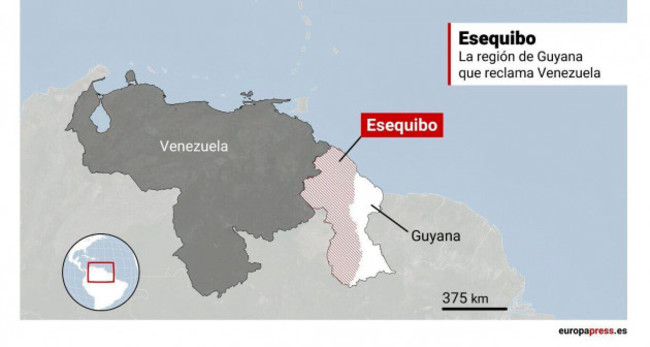
Venezuela insists the Essequibo region was part of its territory during the Spanish colonial period and argues the 1966 Geneva Agreement between their country, Britain and Guyana, the former colony of British Guiana, nullified the border drawn in 1899 by international arbitrators.
In a letter sent on Tuesday to Ralph Gonsalves, prime minister of St Vincent and the Grenadines, Guyana’s president said the Geneva Agreement states that the International Court of Justice should settle any border controversy.
We all want regional prosperity. Therefore, I say that we must work with a regional energy plan, a regional security plan, but we don't want anything done by force by anyone. Venezuela cannot force a position on us. They cannot want what belongs to us https://t.co/vdvrs1jVhr
— President Dr Irfaan Ali (@presidentaligy) December 13, 2023
“We are firm on this matter, and it will not be open for discussion,” Ali wrote on X, formerly known as Twitter.
Ali also said he was concerned about what he described as “inaccurate assertions” made by Maduro’s own letter to Gonsalves.
He disputed Maduro’s description of oil concessions granted by Guyana as being “in a maritime area yet to be delimited,” saying all oil blocks “are located well within Guyanese waters under international law, including the United Nations Convention on the Law of the Sea”.
The president also rejected what he said his neighbouring leader described as “meddling of the United States Southern Command, which has begun operations in the disputed territory.”
“Any allegation that a military operation aimed at Venezuela exists in any part of Guyanese territory is false, misleading and provocative,” Ali said in his letter to Gonsalves.
Maduro’s letter to Gonsalves repeats Venezuela’s contention that the border drawn in 1899 was “the result of a scheme” between the US and the UK and said the dispute “must be amicably resolved in a matter acceptable to both parties”.
The meeting between the two leaders was scheduled to last one day, although many expect the disagreement to drag on into next year.
Brazilian President Luiz Inacio Lula da Silva, invited to the talks at both sides’ request, has backed a peaceful solution and warned Maduro against “unilateral measures that could escalate the situation.”
Brazil has also reinforced its troops around the area.
“If this meeting is going to be useful to talk about eradicating the idea of going to an armed conflict, then I welcome it,” Ramon Escovar Leon, a lawyer specialized in international litigation told AFP.
The United States also conducted joint air force drills with Guyana last week as tensions began to flare up.
The dispute intensified after ExxonMobil discovered oil in Essequibo in 2015, helping give Guyana – which has a population of 800,000 – the world’s biggest crude reserves per capita.
The Venezuelan government’s anti-imperialist rhetoric has seen it accuse Ali of being “a slave” of ExxonMobil.
On Monday, Venezuelan Foreign Minister Yvan Gil told reporters there could be talk of “cooperation in oil and gas matters.”
Gil cited the Petrocaribe agreements, under which Venezuela supplies crude oil at preferential prices to Caribbean countries, and gas deals with Trinidad and Tobago.
He said these were “concrete examples” that “could serve as a basis for future agreements with the Cooperative Republic of Guyana.”
The row has other South American nations on edge.
Argentina, Brazil, Chile, Colombia, Ecuador, Paraguay, Peru and Uruguay issued a joint declaration calling for “both parties to negotiate to seek a peaceful solution.”
Colombian President Gustavo Petro warned the situation was potentially explosive.
“The biggest misfortune that could hit South America would be a war,” he wrote on social media.
- With reporting from AFP and Press Association

To embed this post, copy the code below on your site








have your say