Sign in. It’s quick, free and it’s up to you.
An account is an optional way to support the work we do. Find out more.
Sign in. It’s quick, free and it’s up to you.
An account is an optional way to support the work we do. Find out more.
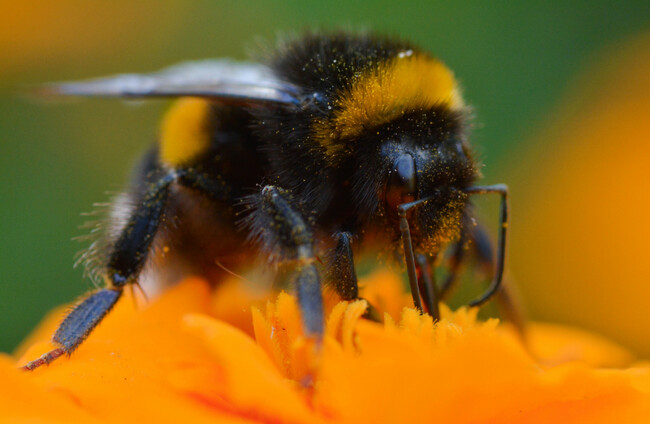
THE THREATS FACING bumblebees can be tested using a “virtual safe space” created by scientists, according to a new study.
Bumble-BEEHAVE provides a computer simulation of how colonies will develop and react to multiple factors including pesticides, parasites and habitat loss.
The tool, which is free and was developed at the University of Exeter in England, allows researchers, farmers, policymakers and other interested parties test different land management techniques to find out what will be most beneficial for bees.
Field experiments can take a long time and be very expensive, and results from the project could help refine and reduce the number of experiments needed.
The study, published in the Journal of Applied Ecology, said Bumble-BEEHAVE is a powerful tool that can make predictions.
“We know that pollinator decline is a really big problem for crops and also for wildflowers,” Dr Grace Twiston-Davies, of the Environment and Sustainability Institute at the University of Exeter’s Penryn Campus in Cornwall, said.
“Bumble-BEEHAVE takes into account the many complicated factors that interact to affect bumblebees.
This provides a virtual safe space to test the different management options.
“It’s a free, user-friendly system and we’re already starting to work with land managers and wildlife groups on the ground.”
Simulation
Bumble-BEEHAVE can simulate the growth, behaviour and survival of six UK bumblebee species living in a landscape providing various nectar and pollen sources to forage on.
Professor Juliet Osborne, who leads the BEEHAVE team, said the model is “a significant step towards predicting bumblebee population dynamics”.
It enables researchers to understand the individual and interacting effects of the multiple stressors affecting bumblebee survival and the feedback mechanisms that may buffer a colony against environmental stress, or indeed lead to spiralling colony collapse.
“The model can be used to aid the design of field experiments, for risk assessments, to inform conservation and farming decisions and for assigning bespoke management recommendations.”

To embed this post, copy the code below on your site














have your say