Sign in. It’s quick, free and it’s up to you.
An account is an optional way to support the work we do. Find out more.
Sign in. It’s quick, free and it’s up to you.
An account is an optional way to support the work we do. Find out more.
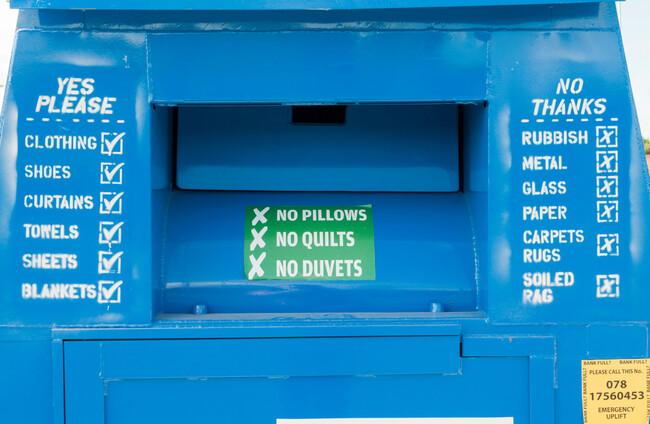
ONLY 30% OF clothes donated to bring banks or store take-back schemes are actually recycled, new research from environmental charity Voice Ireland indicates.
Using trackers, Voice Ireland followed 23 items of clothing donated in Ireland to see where they actually end up – and in the majority of cases it’s really unclear.
Ninety-five per cent of the tracked clothing was exported out of the country, and 60% left the EU. Over ten months the items travelled through 12 countries, including Poland, Pakistan, the UAE and Libya.
Despite 22 out of 23 items being in good, reusable condition, only seven found a second life, bringing the reuse rate to just 30%.
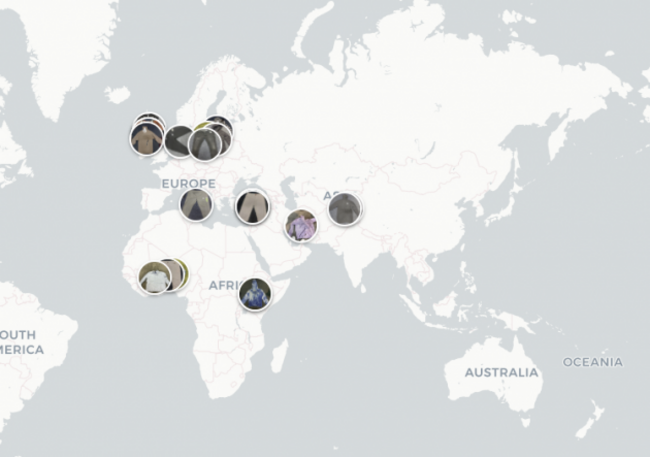
Thirteen percent were dumped or incinerated and the final destination for more than half of the items fell under the “unclear” category.
The investigation found that the most decisive element in ensuring clothes get a second life was not the condition they were in, but rather the composition: six of seven garments that went on to be reused were made of at least 98% natural fibres.
Looking into Penneys sustainability claim today, The Journal Investigates highlighted that blended fabrics – such as polyester-acrylic-polyamide cardigans are “all but unrecyclable with current technology”.
Globally, less than 1% of old clothes are recycled to make new garments, and blending fibres is basically a “one way ticket to landfill”, Ursa Trunk, a campaigner with the environmental NGO Changing Markets, told The Journal Investigates team.
As part of the investigation, the team tested the durability of products. This €16 cardigan – made from a fully synthetic polyester-acrylic-polyamide mix typical of Primark knitwear – was in a sorry state after just five days of wear, as it was already extremely bobbly, as can be seen in the picture.
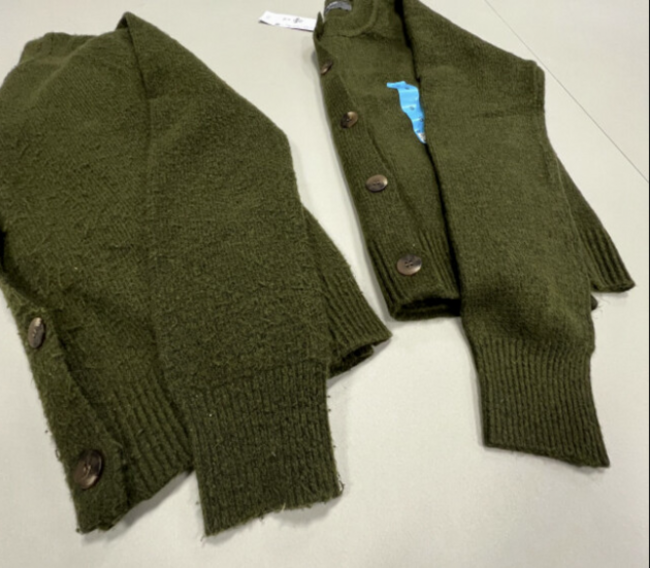
This cardigan will likely not be recycled if the owner sends it to the clothes bank at the end of its useful life
Voice Ireland’s research also suggests circularity is much higher when items are of good quality materials – and mono-materials rather than blends.
The team behind the research said that as well as clothing quality impacting recycling outcomes, there is also an issue with sorting systems.
As a test, the team deposited jeans with only one leg in a Clothes Pods (TRL limited), where it was then registered as a “reusable” garment and was immediately exported outside the EU from Northern Ireland without proper sorting.
The one-legged jeans reached a local second-hand clothing market in Lomé, Togo, where the signal stopped after 2 weeks. Voice classifies this item as dumped.
“This item should never have been exported,” it said.
It said receiving countries increasingly report shipments of unusable clothing entering under the label of “reusable,” with local marketers and municipalities left to manage the waste through open dumping, burning, or overloaded landfills.
Voice Ireland said the textiles recycling sector lacks transparency and accountability, particularly as there is no requirement for collectors or exporters to report on volumes of clothes collected, how much is sorted and how and where items are sent and for what intended purpose.
Additionally, there are no traceability mechanisms to monitor what ultimately happens to exported clothes.
“This leaves Ireland with no clear picture of a trade involving thousands of tonnes of clothing each year,” the report said.
Unsure of what exactly is happening with the earth’s climate? Check out our FactCheck Knowledge Bank for essential reads and guides to finding good information online.

To embed this post, copy the code below on your site













have your say