Sign in. It’s quick, free and it’s up to you.
An account is an optional way to support the work we do. Find out more.
Sign in. It’s quick, free and it’s up to you.
An account is an optional way to support the work we do. Find out more.
LAST UPDATE | 8 Jan 2025
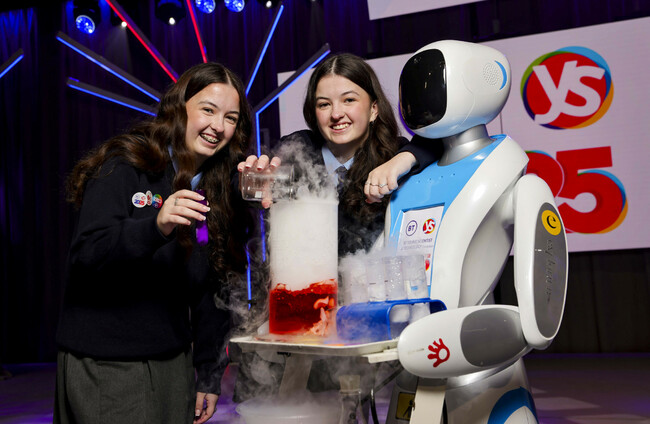
THOUSANDS OF STUDENTS have arrived at the RDS in Dublin for the 61st annual BT Young Scientist & Technology exhibition.
A total of 550 projects from 225 schools are aiming to win the €7,500 grand prize of Young Scientist of the Year and other awards in their respective categories.
Tomorrow, members of the public will be able to make their way around the exhibition floor and watch some of the live shows being held at the venue in Ballsbridge.
On a visit to the event this afternoon, The Journal spoke to students who have developed DIY systems to detect major weather events, machines that turn compost into hot water and apps to assist students with stutters to communicate in the classroom.
One student, Farrah Corbett from Coláiste Chiarán in Co Limerick, wanted to find out if there is any truth to someone having a “big Irish head”. She was inspired to investigate this burning question after a student from her school won the contest last year.
She told The Journal: ”I’m constantly hearing, especially when on holidays, ‘The big Irish head on you’ – we get recognised so easily.”
Corbett set out to by measuring Irish teenagers’ head circumference, shoulder width, height and distance between their heads and their shoulder and feet. Her father welded and 3D printed specially-made measuring tools to help her get accurate measurements.
She then compared the results from Irish teenages to the same measurements she took from teenages from African, Asian and eastern European backgrounds.
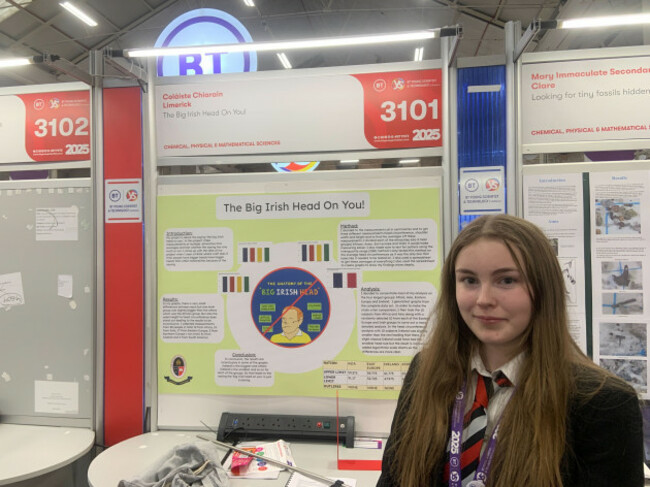
After testing for any outliers, through using a number of complex mathematic formulas, to ensure that the averages she measured were indeed accurate to her sample size, Corbett found that Irish people do not have a larger-than-average heads.
Corbett said there were some measurements where she found that Irish people had larger results – such as the distance from heads to shoulders – but, on average, noggins from Ireland are no different to any other.
Every single first responder who took part in Dana Carney’s project said they would use her app, designed to translate sign language in emergency scenarios, when out at work and attending to people in need.
The Mount St Michael student from Co Mayo is developing an app that, through machine learning, is able to translate Irish sign language (ISL) using a smartphone camera in real time – removing the need for the use of pencil and paper or third-party interpreting.
Carney gathered ISL users and over 160 first responders to re-enact emergency scenarios, giving them a minute to communicate a message using what paramedics would normally do in instances where they interact with someone who cannot hear.
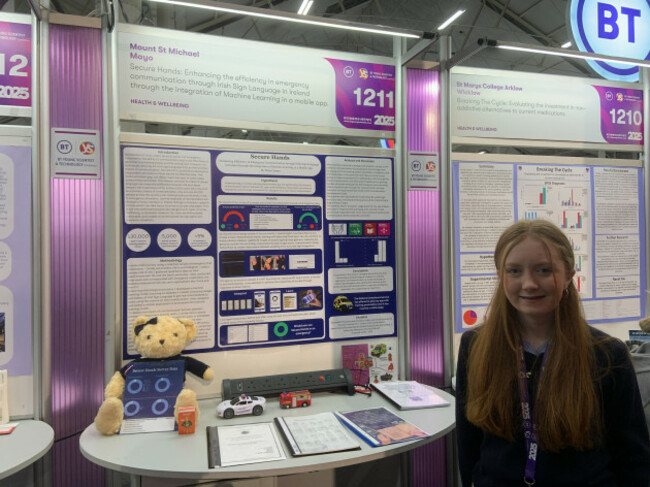
She then got them to re-enact the same scenario and, this time, use her app, Secure Hands, to communicate a message. She found that using her app reduced the amount of time needed to communicate the message by 22 seconds, on average.
Carney told The Journal she also hopes that this app will remove instances of biased interpreting – as her research has also found that rates of domestic abuse are high in cases of people with disability, especially those who are deaf and ISL-users.
“If paramedic ask a partner to interpret for someone, then what is going to happen? There will be biased interpretation and this can leave someone completely vulnerable, increasing the rate of domestic abuse – because people know they can get away with it.
“It also prolongs the amount of time that abuse lasts,” she told The Journal. “So my hope is that my project can reduce that and reduce the general communication gap, every second can mean life or death [in these scenarios].”
Mae Burns, Noah Hanrahan and Orla Connolly identified that vaping in St Joseph’s Community College in Co Clare was one of the most-harmful things that students take part in.
The trio have since set out to develop an app and portable test kit that examines the chemical make up of substances in vape liquid to enhance user safety. An initial round of testing found the presence of lead, arsenic, tin and nickel in popular vaping products.
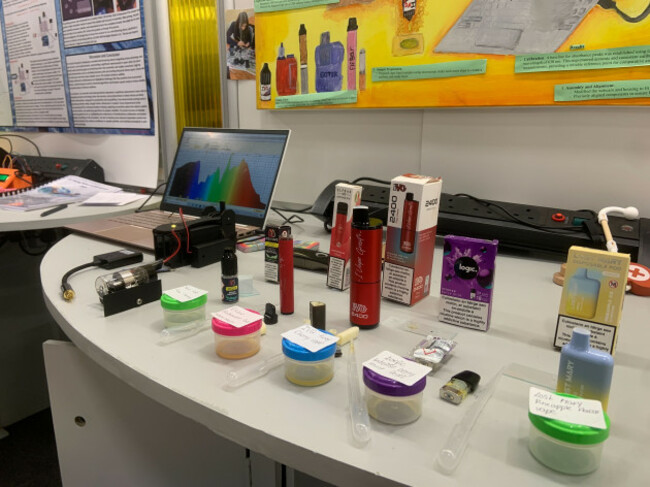
Currently, Burns told The Journal, the version they have on display at the RDS this week can only detect heavy metals in e-liquid. Connolly said, however, that they plan to look at ways to roll out accessible testing kits to detect all types of harmful substances.
Hanrahan explained that the software the group is using, Thermanio, helps to identify a number of different substances in samples fed into the machine. Burns said they hope this and future versions will help to spread more awareness of the harms of vaping.
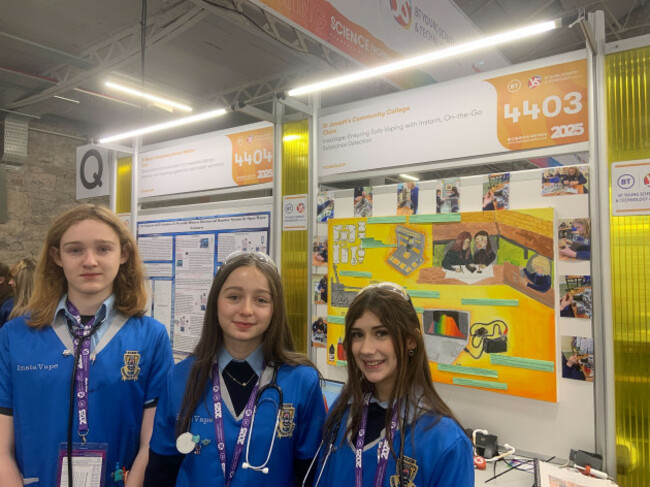
“Heavy metals are really not good for you,” Hanrahan said. “They cause different diseases, like lead poisoning and neurological issues and stuff.”
Connolly suggested that these devices would would in school settings and in other healthcare settings to test for unwanted substances. She said people who saw their project this week have told them stories where their vapes have allegedly been spiked.
More than 2,000 projects were submitted this year, seeking a place on the exhibition floor at the RDS in Ballsbridge. Over the next three days, 85 judges will choose projects that will win one of the 200 prizes that are on offer.
President Michael D Higgins opened the event this afternoon and wished all of those competing for a prize the best of luck this morning.
Members of the public can visit the exhibition from tomorrow and a number of acts will be hosted in the venue until Saturday, including presentations by Mark the Science Guy, interactive science shows by Circus 250 and 3D space tours.
The overall winner, and some international awards, will be announced on Friday evening.

To embed this post, copy the code below on your site










have your say