Sign in. It’s quick, free and it’s up to you.
An account is an optional way to support the work we do. Find out more.
Sign in. It’s quick, free and it’s up to you.
An account is an optional way to support the work we do. Find out more.
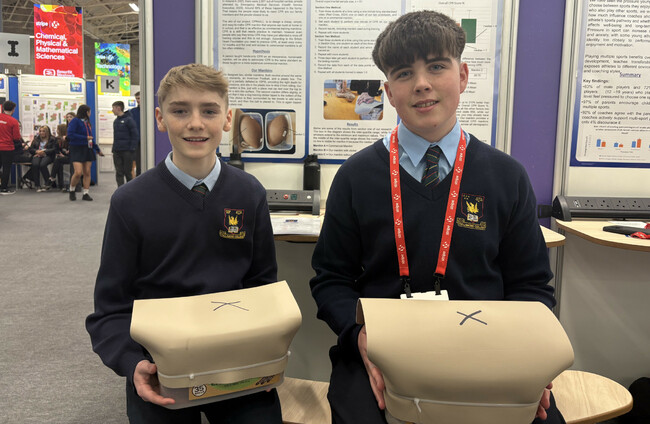
SCHOOLS AND HOUSEHOLDS across the country could soon be buying Diarmuid Eager and Frankie Sheehan’s homemade CPR training mannequins to teach students.
The two second year students from Tullamore College are certainly hoping so anyway – and argue that their version is just as good as effective as commercially available alternatives – just far cheapear to put together.
It may not look like much from the outside – it appears to be simply a plastic box with a dog clicker training device, tea towels and an American football inside, all covered by a vinyl sheet.
The entire thing only costs €10 to make, and is largely made up of household materials.
“We have a CPR machine in school and it cost the school €50 to buy,” Diarmuid explained, as the pair showcased their invention at the Stripe Young Scientist and Technology Exhibition at Dublin’s RDS today.
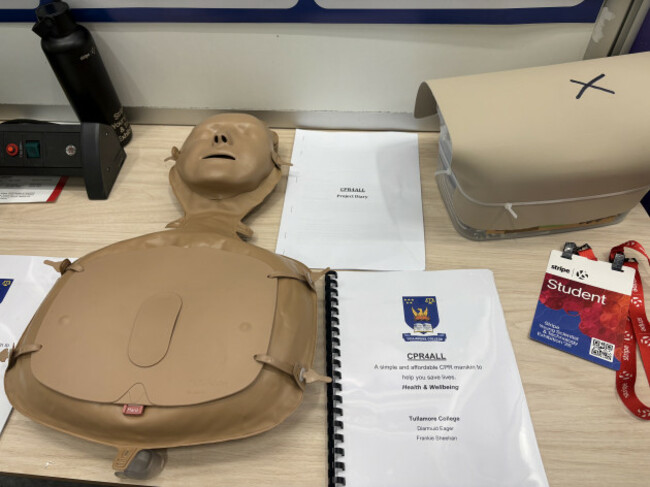
The Offaly duo constructed the new CPR trainer earlier this year, and trained a number of their fellow students on the machine.
“We trained people who had never had CPR training before,” Diarmuid explained.
The training involved some students using the homemade CPR training mannequin, while others used the store-bought €50 mannequin.
“The people we trained were then tested with a machine borrowed from the hospital that tells you the effectiveness of CPR.
“When we compared the results, our mannequins proved to be significantly better than the commercial mannequin at teaching CPR for only about a fifth the price,” Diarmuid explained.
After a live demonstration of the homemade CPR machine at the RDS today, the pair shared that they are eager for a wider rollout of their project to the public.
“We believe that there should be one of these mannequins, or something similar to them, in every household to teach people about how to do CPR and make it more accessible for everyone,” Diarmuid said.
Their project is one of 550 exhibits from 225 schools competing for a range of prizes at this year’s Young Scientist and Technology event.
In addition to Diarmuid and Frankie’s invention, seven of the other 550 projects are also from Tullamore College.
The exhibition is the largest of its kind in Europe – and showcases students’ talents in the areas of science, technology, engineering and maths.
Nearly a quarter of of the exhibition’s projects (24%) use or examine AI, according to organisers.
Among the dozens of AI-focused projects on display in the RDS are an AI-powered recycling sorter (which uses a scanner to recycle cans and paper), an AI-powered browser plugin for detecting bias, and an AI-based project predicting the winner of the Young Scientist and Technology Exhibition (very meta) from social and behavioural variables.
Another project asks the all-important question: Do teenagers trust AI more than their parents and teachers?
The project’s mastermind, Jayden McGahon from St Joseph’s School in Drogheda, found that it some cases, it appears they do.
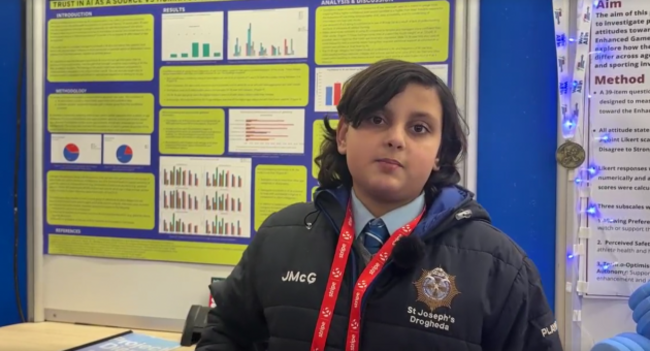
“I found teenagers trust AI more than their parents for factual information, but for emotional and personal advice, they trust their parents and adults in general,” Jayden said.
Does Jayden have faith in AI?
“No, I trust teachers more,” he said.
Transition year student Alex O’Connor harnessed AI to provide us with a way of dealing with those pesky Asian hornets and protecting bees.
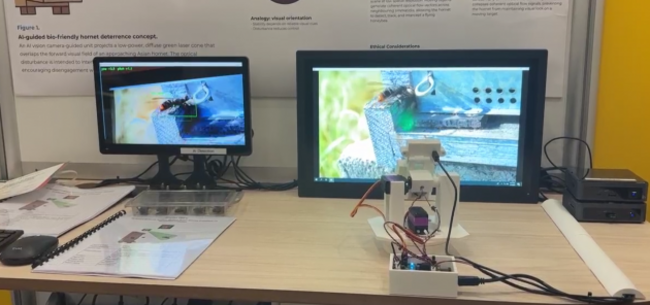
Alex, one of a number of students who travelled all the way from CBS The Green in Tralee for the event, created an AI-powered, 3D-printed condenser unit which shines a laser on Asian Hornets when they’re hovering outside beehives.
“What this does is – when an Asian hornet travels in front of the unit, it breaks the laser’s optical flow, which prevents the hornets from being able to hover outside the beehive,” Alex explained.
What was Alex’s inspiration for his creation?
“I heard about the Asian hornet hives on the news, and I hated hearing that the bees were in danger,” Alex said.
Elsewhere, Olivia Owanta from Ardgillan Community College answered a question about another pesky creature – the seagull.
Olivia’s project posed the question: Do seagulls know when we have our lunch?
She analysed the activities of dozens of seagulls close to her school in Balbriggan, and found that seagulls would gather around the school ahead of lunch, seemingly intuitively knowing that food was on the way.
She concluded that, yes, seagulls do know when lunch is eaten by pupils.
“It’s quite interesting,” Olivia said. “Our school is a constant food source.”
The Young Scientist and Technology Exhibition will continue at the RDS until Saturday. The winners will be announced on Friday.

To embed this post, copy the code below on your site












have your say