TheJournal.ie uses cookies. By continuing to browse this site you are agreeing to our use of cookies. Click here to find out more »
Dublin: 13 °C Wednesday 19 June, 2013

Falklands War: Irish response to Belgrano sinking drew British anger

One of the most controversial incidents of the Falklands War saw a change in the Irish government’s approach to the conflict and a considerable backlash from the British media and public.

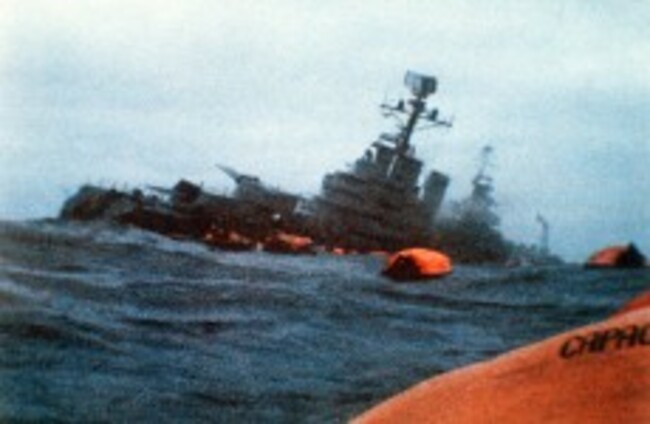
The Belgrano sinks in the South Atlantic Ocean after being torpedoed by the British Royal Navy's submarine Conqueror on 2 May.
Image: AP Photo

ANGLO-IRISH RELATIONS worsened in the aftermath of the one of the most controversial incidents of the Falklands War in the summer of 1982.

Having supported the UN Security Council Resolution 502 which condemned the hostilities and demanded an immediate Argentine withdrawal from the islands as well as European Economic Community sanctions, the Haughey government’s position changed with the sinking of the Argentine navy ship on 2 May.

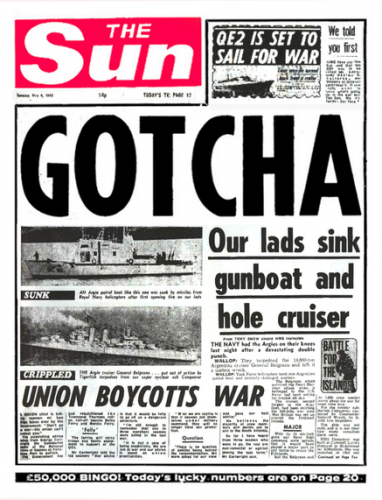
The sinking of the ARA General Belgrano, with the loss of 368 Argentine lives, was one of the most controversial incidents of the entire conflict and spawned the infamous ‘Gotcha’ headline on the front page of The Sun newspaper.

There were significant questions raised about the justification for the attack given that it happened outside the 200-mile exclusion zone that had been imposed around the islands by the British in April.

In a statement on 4 May, three days after the sinking of the Belgrano, the Irish government called for an “immediate meeting” of the UN Security Council, to prepare a further resolution for an immediate ceasefire.

The British were incensed by this, seeing it as an attempt to keep the Falklands in Argentine control while a diplomatic solution was worked on, a state of affairs that was unacceptable to the government of Margaret Thatcher.

‘Peace-loving nation’

At the UN Security Council in late May, Ireland sought to give a mandate to the UN Secretary General, Javier Pérez de Cuéllar, to forge a diplomatic solution to the crisis with Charles Haughey quoted in media reports at the time as saying this was part of Ireland’s role as a “peace-loving nation”.

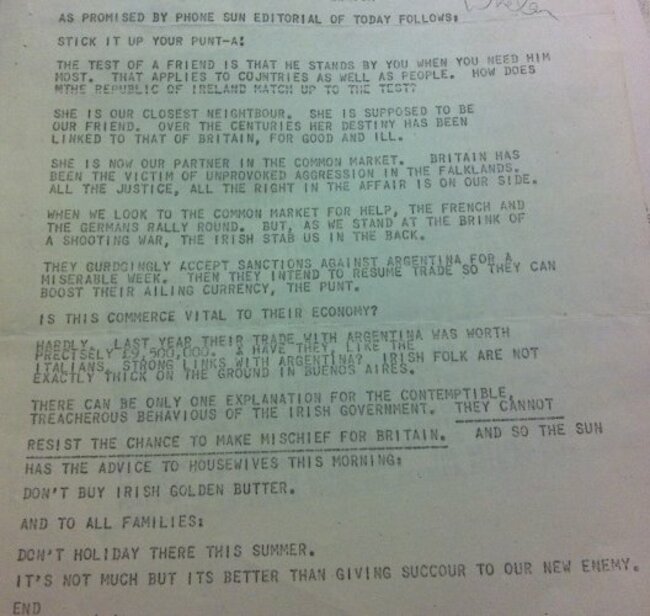
This stance drew considerable ire from the British press, among them the country’s best-selling daily newspaper, The Sun, which in its editorial on 19 May blasted the government saying “as we stand at the brink of a shooting war, the Irish stab us in the back”.

The full text of the editorial – titled ‘Stick it Up Your Punt-a” – was reproduced in a telegram from the Irish embassy in London on the same day:

Embassy telegram Sun editorial

Five days later another telegram, marked with a handwritten note: “Taoiseach to see please”, outlined the depth of the British public’s anger towards Ireland.

The telegram states that the embassy told the Irish Press office in London that it “had received more letters on the government’s stand on the Falklands than we had on any other single issue for a long time (though I didn’t say so the last such occasion was the murder of Lord Mountbatten)”.

“I told them that most of the letters and telephone calls were not in agreement with the government’s policy and were generally of an articulate rather than an inarticulate nature,” the embassy message states.

The embassy message also summarised the content of the letters with those writing them questioning why Ireland was seen to be siding with the aggressor, pointing out that Argentina – under a military junta – was effectively a dictatorship.

‘Pro-IRA’

According to the Irish diplomats in London, the letters also conveyed claims from people that the Irish government was pro-IRA and not interested in improving Anglo-Irish relations.

Many of those who contacted the embassy said they were cancelling holidays to Ireland and were cutting off business links with the country.

“A general conclusion is that most of those who contact us wish to cut off all contact with Ireland and with Irish people in Britain,” the telegram states, adding that even members of the Irish community in Britain were calling the embassy to voice their opposition to the Irish government’s stance.

Despite all of this it noted at the end that the calls “should not be necessarily seen as reflecting the views of the general Irish community” and adding “our experience would indicate that there is a large amount of support for the Irish government’s policy on this issue”.

Letters to the Taoiseach were little better with a number disclosed in the state papers and marked in handwriting with the words ‘abusive’.

In one letter, dated 22 May, the author writes that Ireland was taking an “anti-British stand on the Falklands”. It went on to say:

Falklands letter 1

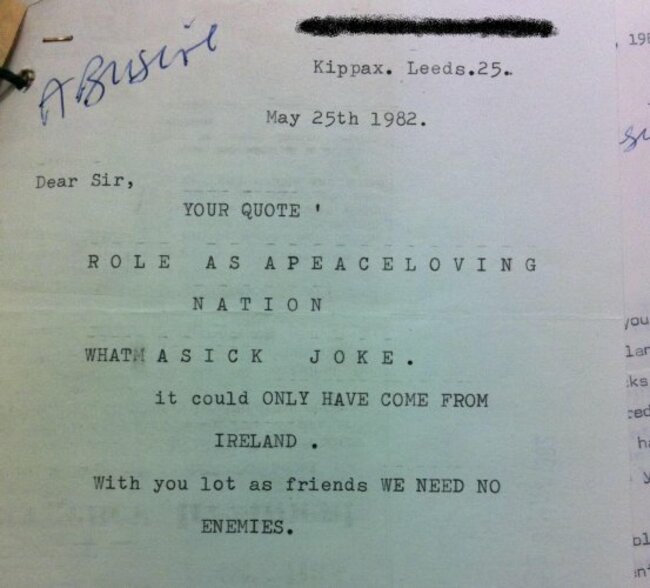
In another letter, dated 25 May, Haughey’s contention that Ireland was playing the role of a “peace loving nation” was described as a “sick joke”.

Falklands letter 2

The effect of the 4 May statement after the Belgrano sinking was described as the “greatest single controversy in Anglo-Irish relations for a decade” by Noel Dorr who was Ireland’s ambassador to the UN at the time at an event marking the 30th anniversary of the war recently.

Britain would eventually invade the Falkland Islands by land in late May before advancing to the capital Port Stanley and forcing Argentine troops to down their arms. A cease was declared on 20 June and Britain retook control of the islands which remain a British Overseas Territory today.

In total the war lasted 74 days and cost the lives of 259 Britain servicemen and 649 Argentinian soldiers as well as the lives of three female residents on the islands.

For further study, see National Archive Reference Nos: 2012/90/866-875; 2012/59/936; 2012/59/16-17;2012/59/66-68; 2012/59/71-72

Previously: After Falklands invasion, Thatcher sought Haughey’s ‘urgent help’

Explainer: What’s going on in the Falkland Islands?

Read all of TheJournal.ie’s stories on the 1982 State papers, just released>

  • Share on Facebook
  • Email this article
  •  

Read next:

Comments (62 Comments)

  • Not sure why people buy that rag of newspaper in this country they have shown in the past that they are just sensationalist vultures.

    Reply
  • I see that filthy rag of a paper pops up once again.

    Reply
  • Don’t buy the Sun!

    Reply
  • When the NUJ and British Sun and its readers are fiercely pro British they are only “being what they are” that’s normal.
    What is not normal is when the Irish branch of the British National Union of Journalists are anti Irish in Ireland and create and encourage anti Irish ideas in Ireland and Irish people.

    Reply
  • Where’s the surprise ? The Sun is nothing but a bigoted, biased, xenophopic rag full of bullshit, lies & propoganda. Also, the article only relects the level of anti0irishness & the way the british looked upon the Irish at the time. I know. I grew up in England during those times. If you were Irish & in anyway in favour of a united Ireland, you were in the IRA or an ‘IRA-lover’. Racism towards Irish people was so common it became expected. ‘Bog-rats’ . ‘Micks’, ‘Thick Paddies’.. all par for the course. At least now a lot of it has passed, and it’s now even somewhat trendy to be Irish or part Irish as most of the anger & hatred has turned towards the Muslims.
    My father, in no way connected with any political or paramilitary organisation, always insisted our phone was being tapped whenever we rang back home to relatives during the 70′s & 80′s.. No-one believed him. It was only years after that he was proved right.
    Besides, what about the fact that the ship WAS sunk OUTSIDE the exclusion zone.
    Just another dark statistic in the long and infamous list of British war crimes that get conveniently left out of history books in favour of all the famous ‘victories’.
    As for The Sun.. how in the hell did we ever let it go on sale in this country, even worse, under the guise of ‘The Irish Sun’ ..has there ever been a more contradictory title ?

    Reply
  • Almost 2013 and there are still people who buy that utter toilet roll of a newspaper

    Reply
  • Admiral William Brown (also known in Spanish as Guillermo Brown) (22 June 1777 – 3 March 1857) was an Irish-born Argentine Admiral. Brown’s victories in the Independence War, the Cisplatine War, and the Anglo-French blockade of the Río de la Plata earned the respect and appreciation of the Argentine people, and today he is regarded as one of Argentina’s national heroes. Creator and first admiral of the country’s maritime forces, he is commonly known as the “father of the Argentine Navy.

    Reply
    • Reg 29/12/12 #

      You should also read up about Major Patricio Dowling, an Argentinian office of Irish decent who made himself very unpopular with the islanders during the early days of the invasion.

      Reply
  • There’s nowt wrong with the Currant Bun. What do you buy when other comics are out of stock?

    Reply
  • The Argentinians claimed (rightfully in their opinion and that of a great many others) that the islands, or Malvinas, belonged to them, and they were justified in taking them back… Also, at the time, and still, there are 6 counties of this island, that exist as a colony, under rule by a foreign govt, the same govt that was occupying the Falklands.. As for aggressive acts, if you take a countries lands by force, don’t be surprised if one day, that country seeks to take it back the same way, especially if all political & diplomatic means come to nothing.
    The Falklands war was a blessing for Thatcher.. she would never have been re-elected without it, at a time when the British economy was in tatters and unemployment was rife.. ‘oh what a lovely war’… I wonder would she have been so quick to wage war on China had they invaded Hong Kong……

    Reply
    • You seriously need to bring yourself up to speed on Falklands history Andy.
      The British did not “occupy them by force” – they were the first human beings to ever set foot on the islands, and had settled them many years before Argentina even existed!

      Reply
    • Mattoid, I never stated that they did occupy them by force, nor did I say who they rightfully belong to, I merely stated opinons that exist.
      Also, you might want to look into the French claim to the islands as they were the first to establish an actual settlement there before the Spanish…
      Regardless, laying claim to a tiny group of islands 5000 miles from the British mainland harks back to the old British Imperialist Colonial attitude that still seems to linger in the minds of those who still believe the British Empire exists.. much the same as can be said of their claim to the six counties.. very sad really in this day and age.

      Reply
    • mattoid 29/12/12 #

      Sorry if I misunderstood you Andy, but you did say “if you take a country’s lands by force” in a thread about the Falklands!

      Agreed, France may have a claim to ONE of the islands, but the British and French settlements were each established in ignorance of the presence of each other. If you accept the legitimacy of the French claim then you also have to accept the legitimacy of the British claim over the other island.

      Your argument about imperialism may have some merit, but if followed to its logical conclusion the Falklands should be returned to the seals and seagulls, and the vast majority of the Argentinian population should leave South America and return to Europe!

      Reply
  • Belgrano controversial? My arse. It was an enemy warship in the middle of a war. What do people think it was doing? Taking sailors to The Canaries on holiday? Whatever a bitch Thatcher was domestically, her approach to the Falklands was spot on. She should have sent CJ a telegram telling him to mind his own damn business.

    Reply
    • She should have, I mean the British government would never dream in interfering in the affairs of other countries would they

      Reply
    • Reg 29/12/12 #

      Militarily the sinking of the Belgrano was the correct decision even though the huge loss of lives was regrettable. The shooting war had already started and the British were exposed. Removing a major threat to the UK’s task force was sensible and stopped the Argentinians from committing its aircraft carrier. It didn’t matter what direction it was traveling in as that could have changed at a moments notice.

      Reply
  • n365 29/12/12 #

    The British were correct in defending the Falklands as any other country would do when their citizens come under attack. The sinking of the Belgrano was a horrific act yet these things happen in wartime. The Irish Government at the time should have fully supported the British government during the conflict.We do rely on Britain for so much ,they are the only nation that have really helped us post independence. I would rather live in a country under thatcher rather than Galtieri.

    Reply
    • n365 you speak a lot of truth but many believe that the sinking of the Belgrano was unlawful. It was outside the exclusion zone set by Britain, it wasn’t prepared for combat and it was heading away from the islands. It was an aggressive act by the British.

      I don’t believe our Government were siding with the Argentinans, I think they were just questioning the fairness of the attack. It also came after the British had received a peace offering from Argentina.

      I believe it is right and proper to question such acts rather than giving a country carte blanche to behave as they see fit as the Americans seem to afford the Israelis.

      Reply
    • “It was an aggressive act by the British.”

      In response to aggressive acts by the Argies.

      Reply
    • True Damocles but a line has to be drawn which delineates right from wrong otherwise anything, even a bombing of Buenos Aires, could be justified.

      Reply
    • Actually Kevin, the Belgrano had orders to sail to sea for an eventual flanking maneuver on the British forces. The vessel was a warship in a wartime situation. Even the captain of the Belgrano admitted that the British were right to sink her.

      To be honest it would be like Germany complaining today about the sinking of the Bismarck.

      Reply
    • @Kevin
      Yours is a common misconception. An exclusion zone is designed to protect neutral shipping only and has no bearing on naval vessels involved in military conflict.
      The Argentinians themselves knew this, and regard the sinking of the General Belgrano as a legitimate (but unfortunate from their point of view) military action.

      Even though the GB was sailing away from the islands at the time, it was involved in strategic military manoevres (believed to be preparing a pincer movement).

      The red thumbs will probably roll in here, but they are the facts – ask yourselves why the Argentinians regard the sinking as legitimate…

      http://en.m.wikipedia.org/wiki/ARA_General_Belgrano

      Reply
    • @mattoid I might be completely wrong. I’m just basing my opinions on what I’ve read. I did read that the wiki entry you posted is completely biased in backing the British. Here is an alternative view http://falklandstruth.blogspot.com.au/2009/06/this-war-could-have-been-avoided-by-uk.html?m=1

      Reply
    • Reg 29/12/12 #

      Also to be remembered that the shooting war had already started when the Belgrano was sunk. Very naive to think that that once the war started that a major threat to the UK’s naval task force would be allowed to sail around the exclusion zone with impunity.

      Reply
    • mattoid 29/12/12 #

      @Kevin
      Which part of the wiki do you think is factually incorrect?

      Reply
    • “the wiki entry you posted is completely biased in backing the British”

      Of course anyone backing the British is biased. :rolls eyes.

      Reply
    • @mattoid It could all be factually correct but the fact that they make claims in the piece with [citation needed] indicates that they haven’t backed up what is written.

      Reply
    • Let’s be fair here.
      The British position in this world is underpinned by a powerful and effective fighting force.
      A force like that needs to be sharpened now and then.
      If you don’t want to be the sharpener then don’t pick a fight.
      This may seem harsh but that’s the reality.
      Despite the (many) faults along the way the world is now a more peaceful place thanks to our neighbours.
      ( there, I said it)

      Reply
    • n365 29/12/12 #

      Kevin,you may be correct in what you believe was the governments stance was at that time and I also agree that it was a horrible act ( most on board were just teenagers ) but if you put yourself in the position of the commander of the task force at that time,would you have left the Belgrano to swan around the south Atlantic? Taking into the consideration that the Argentinians made the first aggressive move by invading the Falklands , it was a no brainier. Our government should still have supported the British cause regardless. The Argentinian regime at the time were appalling.

      Reply
    • mattoid 29/12/12 #

      Agreed Kevin, but you seem quite happy to take your information from some blogger – can’t have it both ways!

      Reply
    • mattoid 29/12/12 #

      @n365
      Absolutely – the loss of life is certainly a tragedy, especially when so many of them were young and innocent.

      Unfortunately this is the reality of conflict, and the GB was an armed warship in a conflict zone at the time.

      The Argentine government committed the first act of aggression – did they not think the British might react with aggression?

      There is also a strong argument that fewer lives would have been lost if the Argentines had concentrated on picking up survivors instead of pursuing the submarine that carried out the sinking.

      Reply
    • Yet they deport the Chagos islanders a few years before to give away their home. Anyone thinking Britain was acting out of anything other than blatant self-interest in the Falklands needs a history lesson and to read more.

      Reply
    • Oh please, complaining aboit bias on Wikipedia then putting up an anonymous blog with one entry. Sinking the Belgrano ended the Argentine navy’s role in the war. Once the Argentines invaded The Falklands, any and all Argentine military vessels and personnel became fair targets until Argentina surrendered.

      Reply
    • mattoid 29/12/12 #

      @Robbie
      What they did to the Chagos Islanders was reprihensible, but that situation is totally different to the Falklands.
      You seem to suggest that the British looking after their own self interest is a bad thing – its a pity our own government don’t place our self interest higher up their priority list!

      Reply
    • Two sets of islands thousands of miles from Britain and whilst one group is sent off to destitution miles from home the other is defended with a flotilla of warships. They were both in the British commonwealth and should have been treated with equal regard by Britain. So the British establishment shafted one group of poor islanders and spent a fortune looking after another group who were better off. Sounds familiar to me..

      Reply
    • Are you joking… Israel and Palastine are basket cases… The north of Ireland is still in limbo land…

      Any country that uses their military to take resources from a weaker country is just a Bully and a thief..

      Reply
    • mattoid 29/12/12 #

      @Nellysroom
      Are you referring to Britain or Argentina?

      Reply
    • Should have sank more of their scrap! Brits think they are a empire! As Dan Breen once said the only regret was I didn’t kill enough of them

      Reply
  • That war was like 2 bald men fighting over a comb. It’s basically a rock in the Atlantic !

    Reply
  • The Sun is not country

    Reply
  • In fairness to Charlie Haughey, then Ireland had a leader who was not afraid to speak his mind, to stand up for principle, in spite of the inevitable consequence.

    Lest we forget, back in 1987, he was the man who pulled the country from the brink and laid the foundations for future prosperity, a prosperity that was later squandered by his erstwhile critics – Mary Harney & Charlie McCreevy etc

    Reply

Add New Comment