Sign in. It’s quick, free and it’s up to you.
An account is an optional way to support the work we do. Find out more.
Sign in. It’s quick, free and it’s up to you.
An account is an optional way to support the work we do. Find out more.

LAST UPDATE | 26 Jun 2025

THE MAYOR OF Budapest is defying the city’s police and the Hungarian government to host a Pride parade this weekend in the face of mounting efforts to push Hungary’s LGBTQ+ community to the sidelines of society.
Gergely Karácsony, the city’s left-wing mayor, has said he has been threatened with imprisonment for his organising of Pride – but he said the threat is an “honour” for him as he fights to protect LGBTQ+ rights in a hostile political environment.
He called for Hungary to establish a new constitution that protects human dignity and the human rights of vulnerable minority groups.
It comes as EU Rule of Law and Justice Commissioner Michael McGrath confirms the EU has written to Hungarian authorities regarding its plans for extensive use of facial recognition as Hungary tries to quash the right to protest.
The Hungarian government introduced strict new legislation this year curbing freedom of assembly, which, layered on top of previous laws that penalise visibility of LGBTQ+ related content, enabled its targeting of Pride parades.
Budapest’s police force ordered the Pride parade planned for this Saturday not to go ahead.
In response, Karácsony, as the city’s mayor, said he will host it as a municipal event, which he argued would fall outside the scope of the restrictions – but authorities are still insisting the event is banned.
“There has been months of debate over the legality of the event, but let’s face it = that’s getting boring, and it is unnecessary. We cannot ban freedom,” said Karácsony, speaking in Hungarian at a conference this morning with an English translator.
“The protection of human rights and respect for dignity are the foundations on which every just society is built. The law should protect that dignity… but dignity transcends the law. The protection of human dignity is a moral imperative,” the mayor said.
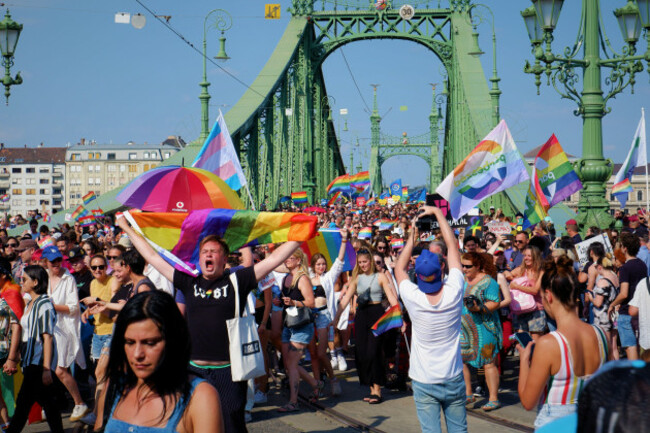
Hungary has some of the most repressive laws in Europe at the moment with regard to the LGBTQ+ community.
In 2021, it passed a bill that banned communicating with children and teenagers about sexual orientations and gender identities, both in media like movies or books and in educational settings. The law has had far-reaching consequences and has been condemned by civil society in Hungary and internationally.
A recent legal option from the EU Court of Justice said that Hungary is infringing on the treaty that sets out the EU’s fundamental principles of human dignity and equality, and that it has significantly deviated from the model of a constitutional democracy.
“We cannot go on like this,” the mayor of Budapest said this morning.
“There are now thousands of signs that we cannot go on like this and that Hungary is on the verge of change,” he said.
“Liberal democracy was our answer for how to form society in which human dignity including right to self-determination is upheld
Democracy is being challenged by powerful political actors worldwide.
“The ongoing debate and struggle over this issue will have a decisive issue on western civilisation and humanity as a whole.”
Karácsony said the country “needs a new constitution” and that the current constitution “protects the powerful instead of protecting people from the powerful”.
“We are standing up for our principles, and our principles must be more important than power,” he said.
“We must restore equality of life and the rule of law and create a constitution with the right to sustainability and to housing but also full equality of rights to same-sex couples and minorities in Hungary.”
The mayor was speaking at the International Human Rights Conference in the Central European University in Budapest.
Ireland’s former Taoiseach Leo Varadkar is also due to speak at the conference later today.
Meanwhile, European Rule of Law and Justice Commissioner Michael McGrath told The Journal in Brussels yesterday about the EU’s initiation of infringement proceedings against Hungary over the anti-LGBTQ+ legislation.
The EU Commission is currently awaiting a formal judgement by the European Court of Justice on the Hungary case.
McGrath said that the Court of Justice has sided with the Commission in every instance of alleged EU law infringement in Hungary to date.
“On this new law, which provides for the ban of certain gatherings or the potential to ban certain gatherings, we have written to the Hungarian authorities in relation to the use of facial recognition and data privacy issues that arise,” McGrath said.
“We await the response from them, and we will then evaluate that response and decide what action is open to the commission to take,” he said.
Asked about the length of the process, given that European citizens’ rights are at risk, McGrath said due process must be followed to ensure that the Commission has the legal right to intervene.
“We have to ensure that there is a solid, legal basis to any action that we take. The Commission has a 100% success rate with the actions it’s taken with Hungary – it’s important that we continue with that success before the courts,” he said.
“That legal analysis is something I have to respect. That process is still ongoing.”
Additional reporting by Muiris O’Cearbhaill in Brussels

To embed this post, copy the code below on your site














have your say