Sign in. It’s quick, free and it’s up to you.
An account is an optional way to support the work we do. Find out more.
Sign in. It’s quick, free and it’s up to you.
An account is an optional way to support the work we do. Find out more.
Updated 4.40pm
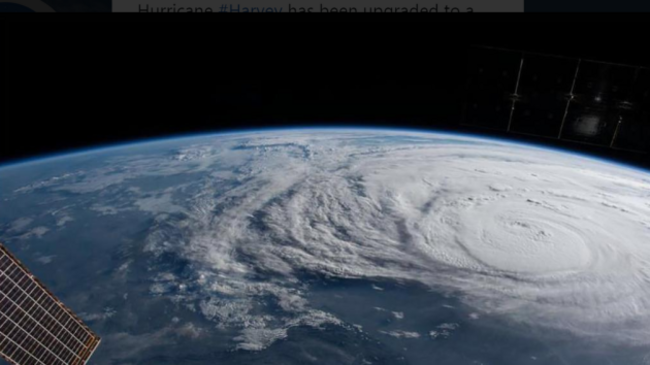
POWERFUL WIND AND heavy rain from Hurricane Harvey lashed the Gulf Coast of Texas today, uprooting trees, tearing off roofs and forcing tens of thousands of residents to flee.
Harvey, the most powerful storm to hit the US mainland in 12 years, roared ashore late yesterday at the town of Rockport — near Corpus Christi, a major US oil industry hub — as a Category Four hurricane on the five-level storm scale, packing sustained winds of 215 kilometers per hour.
A few hours later the storm made a second landfall just north of Rockport as a Category Three hurricane, with winds of 205 km/hr, the National Hurricane Center said.
Over the next hours Harvey lost strength as it moved inland over south Texas and eventually dropped to a still-dangerous Category One storm, with winds of 136 km/hr.
“Additional weakening is forecast, and Harvey is likely to become a tropical storm later today,” the NHC said at 1pm Irish time.
More damage however is expected from the heavy rain than from the strong wind: the NHC warned of likely “catastrophic and life-threatening flooding” due to the massive rainfall forecast and the huge storm surge, which could reach nearly four metres in some places.
“Harvey is expected to slow down through the day and meander over southeastern Texas through the middle of next week,” the NHC said.
President Donald Trump granted Texas Governor Greg Abbott’s request to declare a “major disaster” zone in the state to speed federal aid to the millions in harm’s way. Abbott in turn activated more than 1,000 National Guardsmen to help with evacuation and recovery.
Before the storm hit, the US Federal Emergency Management Agency (FEMA) prepositioned emergency supplies and authorities issued mandatory evacuation orders in many areas.
As he headed to the Camp David presidential retreat for the weekend with his family, Trump said: “Good luck to everybody”.
‘Significant disaster’
Harvey, the most powerful hurricane to hit the mainland since Wilma struck Florida in 2005, could dump up to more than one metre of rain on the area over the next few days — and cause billions of dollars in damage.
2005 was a huge year for hurricanes — before Wilma, Hurricane Katrina pummelled New Orleans, leaving more than 1,800 dead and becoming one of the greatest hiccups in the presidency of George W. Bush.
Coastal Texas is a fast-growing area, with some 1.5 million people moving into the area since 1999.
Authorities said the combination of dense growth and perhaps a year’s worth of rain falling in just four or five days could prove deadly.
Supermarket aisles were stripped bare, homes and shops had boarded up windows, and long lines snaked outside gas stations.

The National Hurricane Center (NHC) warned of the “complete destruction of mobile homes,” of many buildings “washing away,” and some areas being left “uninhabitable for weeks or months.”
‘Here to assist’
In 2005, Bush faced severe criticism after FEMA appeared unprepared for the devastating damage inflicted by Hurricane Katrina.
“Keep on top of hurricane Harvey don’t make same mistake Pres Bush made w Katrina,” Republican Senator Chuck Grassley urged the US leader in a tweet.
In a series of tweets throughout Friday, Trump said he was closely monitoring the storm’s progress and said he was “here to assist as needed.”
Riding out the storm
In Corpus Christi, many residents appeared bent on sitting the storm out, packing sandbags to protect their homes — until the supply of sandbags ran out.
Already, nearly 50,000 people in the city had lost power.
Sheriff Frank Osborne of Matagorda County, where evacuations were mandatory, described the high stakes.
“I’m not going to put one of my deputies’ life on the line to save somebody that didn’t leave when they were asked to,” he told local TV station KHOU.
Officials in Houston, the biggest city in the storm’s path, closed its port but did not anticipate mass evacuations.
Inland cities like San Antonio welcomed evacuees on Friday, but some at the shelters told AFP that supplies were lacking.
In Louisiana, Governor John Bel Edwards described a “worse-case scenario” in which the storm leaves Texas, gains new strength over the heated waters of the Gulf, and then heads toward Louisiana.
Meteorologist Eric Holthaus told AFP the prospect of the storm stalling on the coast, lashing it with heavy rain for days, was “just terrifying”.

To embed this post, copy the code below on your site















have your say