TheJournal.ie uses cookies. By continuing to browse this site you are agreeing to our use of cookies. Click here to find out more »
Dublin: 10 °C Thursday 23 May, 2013

New campaigns against cyber bullying launched

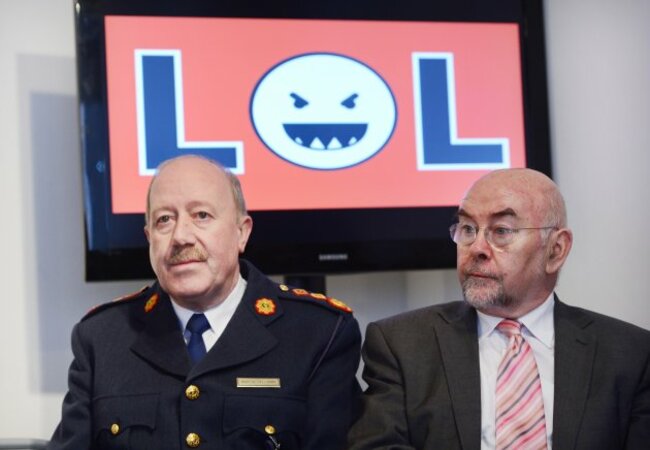
Teen-led campaign Watch Your Space and the Garda programme Connect with Respect were launched by Minister Ruairí Quinn and Garda Commissioner Martin Callinan this morning.


(YouTube: WatchYourpace)

LAUNCHING TWO INITIATIVES aimed at tackling cyberbullying today, Education Minister Ruairí Quinn noted that new technologies bring with them both opportunities and dangers.

“The opportunities should be celebrated and the dangers should be put out there,” he told reporters.

The projects being launched, including the Watch your Space public awareness cyber-bullying campaign and the Garda Primary Schools Programme module Connect with Respect, have been in the pipeline for some time but “some of it is reacting to tragedies and fatalities in various parts of the country”.

“The level of awareness now of the phenomenon of bullying, of the incidence of bullying, of the 24/7 dimension it has now taken on, is much higher than ever before.”

Quinn also mentioned the increased awareness and new guidelines around homophobic bullying.

Commissioner Martin Callinan said the Gardaí wanted to get involved with the campaign, launched to coincide with Safer Internet Day, to create a safer space for students.

“Children and young people are some of our most valuable commodities. We must ensure that as a community-based police force, we serve all strata of society. Children and young people are extremely vulnerable and it is important we keep them at the centre of everything we do.”

04/02/2013. Safer Internet Day 2013. Temple Bar Ga

Callinan and Quinn at today’s event in Dublin (Image: Sasko Lazarov/Photocall Ireland)

The Watch Your Space anti cyber-bullying campaign includes online content, school-based events and media elements. Its website has information and advice for secondary school students on coping with online situations and facilitating positive intervention by witnesses.

The newly-introduced primary school module, to be given by Gardaí, hopes to change the attitude of bystanders online. They want to make them more likely to intervene positively and effectively in online bullying situations.

It also aims to help students to understand the impact that cyber bullying can have on different people, and to recognise that it is not acceptable.

A recent study showed the most commonly reported form of cyber bullying is being the target of nasty or hurtful messages.

Callinan had this message:

It is important to stand up to bullying, whether it’s online or in the real world, in a safe and effective way. Directly confronting someone who is being aggressive or hurtful is not always the best way to go about it. You can reoprt online bullying to the website, reach out to support the victim, and tell an adult you trust.

This year there is a budget of €500,000 to implement the Government’s Action Plan on Bullying.

The recent suicides of a number of teenage girls has sparked concern from parents and the wider community about the dangers of the Internet, specifically social websites popular with teens, including ask.fm.

Matthew from Watch This Space told TheJournal.ie that the attraction to such sites is not always clear to adults.

“There is a weird interest in what people think,” he explained. “People don’t necessarily trust their friends enough that they are telling the truth. So they set up an ask.fm account to see what people really think about them. It is a weird desire, mostly among younger teenagers.”

Another teen from the group, Grace, adds that she doesn’t really understand the draw either.

“I came through a generation of Spill It, a former version of ask.fm, so I know that those things aren’t worth it.”

Spill It was popular among teens a few years ago. It’s tagline reads: “What do they like about you? Let your friends and family spill it.”

Facts and figures

A study, conducted by Dr Brian O’Neill and Thuy Dinh from EU Kids Online and DIT and published today, found almost seven in 10 parents were unaware that their child had been bullied online.

The report also found:

  • More than half of children bullied online said they were ‘upset’ or ‘fairly upset’ by it
  • Online bullying had a lasting effect on 44 per cent of bullied children
  • 14 per cent said they were ‘deeply affected’ for a couple of months or more – a stat much higher than the European average of 2 per cent
  • A quarter of nine to 16 year olds have been bullied – either online or offline
  • 28 per cent of victims tried to fix the problem themselves.
  • 25 per cent of victims hoped the problem would just go away
  • The most technical response to cyber bullying is to block the person
  • Only 15 per cent reported the bullying using an online reporting tool
  • Only 29 per cent of parents of bullied children were aware of the bullying
  • Almost three-quarters of young people who have been bullied talk to someone about it – usually a parent or friend but rarely (6 per cent) a teacher

Read: Number of primary school children with depression rises

MORE: National guidelines on mental health in secondary schools published

Read next:

Comments (25 Comments)

  • Jesus I’m sorry to say but the only thing that will really stop online bullying is removing anonymity and kids that do it getting a good belt of the brush

    Reply
    • Does that apply to adults too? Does it apply outside of the classroom? Extend your argument out, what type of world would that be to live in?

      Reply
    • Wrong!
      It is because websites often now force a facebook/twitter account to sign up that kids are getting so upset – it opens up their real identity to trolls and bullying. This would not happen if they had an anonymous identity for external websites and kept their real identity accounts only for close friends.

      The WWW has been around for a good while without this issue ever coming up – it is only the recent policy of twitter and facebook to encourage real identities in accounts that has created issues. And why do they encourage this?

      Advertising.

      Reply
    • But by removing anonymity in all cases it would solve half the problem. Then any little troll who tries to act the big guy gets to deal with the Gardaí.

      Reply
    • Look at the site here, and see how ready a person is to call another person a “troll” because they disagree with that person’s point if view. How exactly would you label someone a troll? Who decides? Who carries the brush and who decides that a certain person has earned the right to be hit with it?

      Reply
    • You cannot moderate bullying globally. It will always be there. And serious trolls could use Proxy Ip’s to hide their identities very easily and not be traced.
      Opening up your kids personal data to the world is just not something that should be encouraged. Never mind bullies – there could be a lot worse out there. Anonymity protects their true identity and the personal impact of targeted bullying on them psychologically.

      Reply
    • censored 04/02/13 #

      As others have stated forcing kids to lose their anonymity on the internet is a truly appallingly bad idea. Not only does it expose the kids to more bullying but it also ensures that their internet footprint is identifiable for their entire life. When you’re 40, do you want prospective employers reading your immature 13 year old posts?

      Anyway, anonymity on the net is a good thing for all ages. It’s interesting that so many on the journal call for it to be removed. Why? So you can call round to my house and beat me up if you don’t like what I’m saying?

      Ireland has a higher than average incidence of bullying and the effects are 4X greater than in other countries.
      http://www.irishtimes.com/newspaper/breaking/2013/0204/breaking43.html

      Reply
    • I’d imagine that stat balances with the high Facebook use by Ireland as well.

      The Bebo system was actually better at controlling who had access to profiles, and I’d imagine easier for school staff to identify any troublemakers.

      Reply
  • Thought the ad was a nice idea but trying too hard. Actors are acting too much and piano gets irritating after a while. Plus it’s far too long to retain interest especially with no punchline. Just saying.

    Reply
  • It’s all well meaning but…

    Reply
  • I do feel thta these t safeinternet days and campaigns against Cyber bulling do absolutely nothing for kids or peopl that are been bullied or kids or adults that bully . These are just another feel good waste of money programme paid to a PR companies by Government Depts .

    It all comes down to Education which should be done both at home and in the classroom

    I for one never bother to reply to anonymous posters or feel the least bit threatened by made up egghead names on twitter or elsewhere

    Reply
  • Way too long. Way too wishy washy and abstract. Most kids would have turned over after about 20 seconds.

    Facebook could easily build in a ’3 strikes and your banned from my friendlist’ thing if they wanted to.
    Kids should be able to moderate their contacts.

    If they are using external websites away from their close friends they should be encouraged to use anonymous accounts only.

    Reply
  • Jason 04/02/13 #

    That was unexpectedly good.

    Reply
  • We at Helplink think it is great that the government are starting to sit up and realise that they need to assist in counteracting bullying in all forms. The statement that technology is a tool and can be used for good as well as bad is very true our services show that. Recently we learned of statistics that show one of the major ways in counteracting social media bullying is very simple – teach young people and people in general how to set their privacy settings! You would be amazed at the amount of people who do not know how to do this correctly. Check out our YouTube channel here where we have shared how to this and have some other anti-cyber-bullying vids: http://www.youtube.com/user/HelplinkTV

    Reply
  • Drimnagh Castle CBS have been running their own campaign for the last few months https://twitter.com/DrimnaghCastle

    Reply
  • Long for the good old days when computers had an off switch…

    Reply
    • Exactly..
      I struggle to understand why cyber bullying is any different to any other form of bullying except that the media have made it so; if anything, it should be easier for the victims to deal with..

      Reply
  • good that they’re highlighting the issue, but a shite video without a concise key message.
    governments here rarely do anything positive for the youth, particularly in poorer and rural areas, where suicide and anti-social behaviour is more serious every year.

    Reply
  • BullyTag 11/02/13 #

    Bullying can be stopped. Check out http://www.bullytag.com and stay tuned for the upcoming Cyber reporting Tool from @bullytag.

    Reply
    • Sadly the prevailing (and rather backwards) view in Ireland is to ban smartphones altogether in schools, rendering your product useless here. Perhaps you might get in touch with educators in Ireland and show them your service so that it might be rolled out here. That would of course require schools to row back on the phone ban, but so be it!

      Reply
  • Ger 04/02/13 #

    Have to agree. Overacted and too long. Editing doesn’t do it any favours: gaps between speakers are miniscule, but still too long.

    Also, if the actors are going to be visibly READING their lines off cards, don’t do close-ups. You can see from their eye movements that several of them are, and it’s so distracting and ridiculous, when juxtaposed with how dramatically they’re reading it.

    But it is well intentioned. A dramatically cut down version (or versions; think <10 seconds) could work.

    Reply
  • Just read this article and i find it almost funny that the journal.ie are highlighting it considering a fair few of their articles attract or contain elements of bullying and hatred and trolling by a large amount of users towards certain people or organisations.

    Reply
    • I don’t think it is the articles that contain elements of bullying/hatred/trolling? It is the members who, through an open forum, voice their opinions on the articles, or related issues (most of the time!). If discussions get heated when people disagree this can lead to what you view as the bullying/hatred/trolling. In my experience here I generally see people with closed-minded or ignorant views getting challenged, sometimes a bit unfairly, but they are free to fight their corner – exactly as they would do in a pub or around a dinner table. You would expect that the majority of commenters would be able to respond to this if they are able to make a comment in the first place that might be controversial.
      Everyone also has the option of reporting comments to the administrator.
      The article is really focusing on young people and the serious issue of cyber bullying they experience, which can have a lot more serious implications for them than grown ‘mature’ adults, given their naivety, innocence, insecurities and susceptibility to abuse, and lack of awareness of how to deal with it.

      Reply
  • Is that teen fashion today, jaysus what happened to the world.

    Reply

Add New Comment