Sign in. It’s quick, free and it’s up to you.
An account is an optional way to support the work we do. Find out more.
Sign in. It’s quick, free and it’s up to you.
An account is an optional way to support the work we do. Find out more.
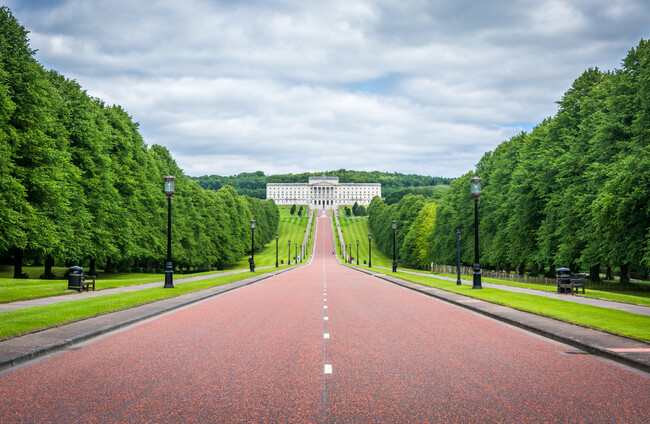

POLITICS ON ITS hill at Stormont has always been a hard climb. That has been the story of the 25 years since Good Friday 1998; how politics has struggled in the peace, how it has rarely had the ease or the freedom of a run downhill.
There has always been something; some reason – some row – to make things difficult. It has been arduous, tiring, work.
That is how it began, and how it continues, from the starting point of the arguments over decommissioning and the phrase ‘no guns – no government’ that described those early battles after Good Friday; and how, in unionist thinking then, the IRA made government impossible, and how there was a choice to be made between politics or the ‘private army’. It could not be both.
A message from Stormont
Last month, a message was sent to me, including a line that my “longstanding prediction about the final death of Stormont may be right this time”.
I’m not sure that I have predicted that outcome but rather argued that it has had too many of these crisis moments. And, after the last rescue mission of 2020, I said that if it failed again, then it should fail forever. I wrote that in my book ‘Political Purgatory’.
But Stormont, it seems, is always allowed another chance and more time.
That is why it is still there; allowed these things, because if it collapses entirely, then it says the ‘peace’ has failed.
All of the talk in the here-and-now is about the autumn. If Stormont is to be put back together again, it will be then. Or will it?
That message that was sent to me last month was from an MLA: “I can’t see Jeffrey [Donaldson] doing it,” they wrote, “too much of a stretch and not enough courage.”
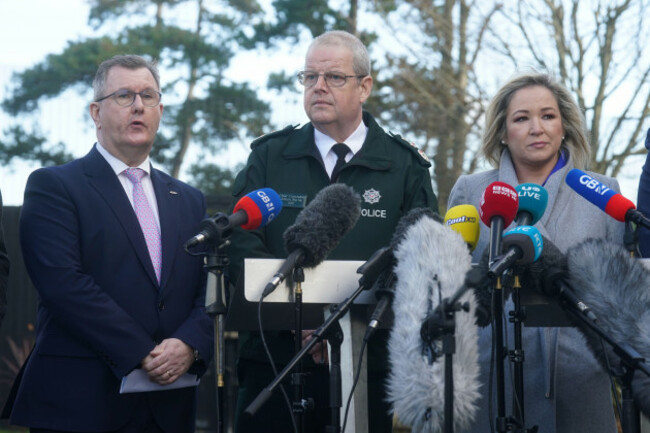
Politics has been swimming in the turbulent waters of the ‘sea border’ that became part of the post-Brexit trading arrangements, and that has made Northern Ireland different from the rest of the United Kingdom.
At a Feile Derry event last week, I said that those who shouted loudest for Brexit cannot now wash their hands of the Protocol and the Windsor Framework. Politics is both what you demand and what comes with it. It is what has made this latest Stormont mess.
So, we have had another year-plus standoff; more uphill politics, more climbing and a mountain of statements that the Executive must be restored. It hasn’t shifted the DUP. And, from others, there has been the argument that there should be no return to an “unreformed Stormont”.
In other words, the current system of government does not work and won’t work and has to change. The so-called news conferences on that hill and elsewhere, are not news. They are ‘repeat’ conferences, old hat, a waste of time.
On Tuesday, I tweeted: What does back to Stormont mean? If it is having Stormont for the sake of it, then we should forget about it. So much that is broken here, stems from the failure of that place.
What does back to Stormont mean? If it is having Stormont for the sake of it, then we should forget about it. So much that is broken here, stems from the failure of that place https://t.co/Sgg4kLjUDq
— Brian Rowan (@BrianPJRowan) August 22, 2023
A tweet from the veteran political editor Ken Reid on Thursday morning said it all:
Magnificent view over Belfast from my hospital room in the City Hospital. Stormont in the distance . A lot more activity in this ward than on the hill. The pressure on staff is unrelenting. What a contrast.
— Ken Reid (@bigkenreid) August 24, 2023
Stormont has to be something more than a building. It has to prove itself; show that politics can work, that it is worth having.
The sea border is the latest in a long list of reasons why politics has struggled – struggled from decommissioning to ‘Stormontgate’, from the arguments over the Maze Peace Centre project through welfare reform, flags, parades, the Past, RHI and the fallout from Brexit – these, the endless battles of politics, the many disagreements – the damage.
Yet, politicians and others, from all places, still come to Northern Ireland, to see the peace, to look at it, to talk to us, to ‘learn’. It’s incredible.
That year changed everything. Follow the electoral trend since then:
Sinn Féin now the largest party at Stormont;
Michelle O’Neill waiting to be First Minister;
Sinn Féin the largest party in the local government elections;
Unionists no longer hold a majority of the Northern Ireland seats at Westminster.
That shift, as much as the turmoil of the sea border, has created the political storm.
The last time Stormont was saved was in January 2020 when Julian Smith was Northern Ireland Secretary of State and Simon Coveney was Tánaiste and Irish Foreign Minister.
It was their ‘joint’ work and effort (not joint authority) that made the New Decade – New Approach Agreement possible – that brought the parties back into the Executive after a three-year absence.
It did not last long, and this is the issue – if it is rescued again, how long before its next fall?
And how many Stormont falls before we finally realise that it doesn’t work? Recently, in a podcast for the Belfast Telegraph, I was asked about Stormont and when it might return, and I said I didn’t care.
It has failed too many times; perhaps the biggest failure of the peace process. Stormont for the sake of Stormont, is not worth having.
There has to be good reason to bring it back. What colour will the leaves be then? I just don’t know.
In this broken place, there is no such thing as urgency or a deadline.
But, even when it is stuck, politics is moving. For many, there are more important things than Stormont.
Brian Rowan is a journalist and author. He is a former BBC correspondent in Belfast. Brian is the author of several books on Northern Ireland’s peace process. His new book, “Political Purgatory – The Battle to Save Stormont and the Play for a New Ireland” is out now at Merrion Press.
To embed this post, copy the code below on your site










have your say