Sign in. It’s quick, free and it’s up to you.
An account is an optional way to support the work we do. Find out more.
Sign in. It’s quick, free and it’s up to you.
An account is an optional way to support the work we do. Find out more.

In Calling 353, bestselling Motherfoclóir author and podcaster Darach Ó Séaghdha casts a linguistic eye on how we talk about what it means to be Irish, the signs we post to each other about Irishness – and what really lies beneath it all.
YOU MAY HAVE already seen Christopher Nolan’s The Odyssey by now, but even if you haven’t, it’s likely that you’ve heard a bit about it and seen a few opinion and reaction pieces to it on the wine-dark internet. I was going to spare you mine, but given how translation is so urgently relevant to this particular adaptation, I couldn’t let the opportunity slide.
When Brad Pitt and Orlando Bloom made the execrable Troy 22 years ago, nobody talked about which version of the Iliad director Wolfgang Peterson preferred. The idea that there were substantial differences between different versions was not a mainstream idea then, nor was it in 2015 when The Boy Next Door was released, a movie widely mocked at the time for a scene where Jennifer Lopez gets her hand on “a first edition of The Iliad”. It was, of course, a first edition of Alexander Pope’s famous translation of the Iliad.
But now we are in 2026, and Emily Wilson’s translation of Homer’s epic poem – the first time a translation of the work into English by a woman has been published – has been recognised as the primary reference point for Nolan. So what, I hear you shout at your phone, surely a Greek word has an English word that means the same thing and it doesn’t matter who translates it? Oh, dear reader, bless your innocent heart.
One example that nicely illustrates the delicacy of translating a poem is presented to us in the beginning of the Odyssey when the protagonist is described as polytropos – poly meaning many, tropos meaning turns, manners, or ways. Some have interpreted this as meaning that Odysseus has travelled extensively (a key point in the story), others that he himself is full of tricks and cunning ways (another relevant detail in the story).
Examples of how this has been done before in poetic translations include the following:
You could be forgiven for looking at these and concluding that there was unanimous approval of the epic poem’s protagonist. However, Wilson, in her version, simply calls Odysseus “a complicated man”. Not only does she cut through the bombast, but she matches the syllables of the original word.
I was delighted to see that in her Substack she illustrates her thoughts on this translation choice with an image from the video for Avril Lavigne’s Complicated – she doesn’t take herself too seriously. Having said that, if you read the piece you’ll see she approaches the work of recreating the sense and meaning of the original Greek with complete respect.
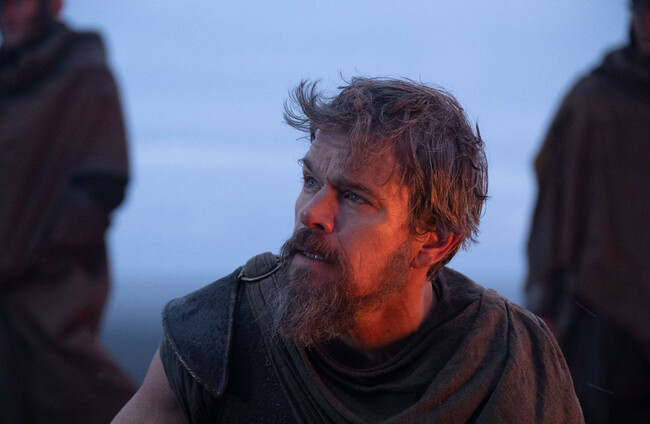
Some high profile naysayers have voiced their disapproval of certain casting decisions in Nolan’s Odyssey. It’s true that former Dalkey resident Matt Damon doesn’t look very Greek, but that’s not even the half of it for these poor cratúrs who are very indignant about the lack of realism in a story where a bunch of dudes are turned into pigs and one of the female characters hatched from an egg.
Some people think adaptations of Greek and Roman literature should be played by British actors with Rada accents, an idea so ridiculous that you could only believe it if things had always been that way and you’d never questioned it.
And challenging such ideas has been at the heart of literature in Ireland for a long time, especially with regard to the epic poetry of Homer.
In Patrick Kavanagh’s poem Epic, he recalls a bitter land dispute in Monaghan which occurred in the same year as the Beer Putsch in Munich, and as he wonders if he can ever make great art when he is so far from the important things happening in the world he is visited by a much older poet:
“Til Homer’s ghost came whispering to my mind
He said: I made the Iliad from such
A local row. Gods make their own importance.”
The keepers of the Odyssey in oral tradition were not posh actors and academics but farmers and fishermen, and the unwritten stories that survived had a resonance that new generations of audiences could relate to. This is an idea that profoundly influenced Seamus Heaney, whose literary translations of Greek tragedy and epic poetry are informed by his own relationships with language from growing up in Northern Ireland.
Heaney’s most quoted line about hope and history rhyming comes from The Cure At Troy, his translation of Philoctetes – in this story, the many turns of Odysseus are cast in a different light as he is presented as a manipulative older politician in a seemingly never-ending conflict rather than a straightforward hero.
The most obvious example of the influence of Homer’s work on Irish literature is James Joyce’s Ulysses, but you already knew that so let’s revisit that another day.
Instead I want to take a different turn. One of the greatest poems about the gift of translation is On First Looking into Chapman’s Homer by John Keats, who compares the unlocking of the Odyssey to non-Greek speakers like himself to achievements as momentous and recent as the discovery of Uranus and the first reveal of the Pacific Ocean to European eyes. Keats and Chapman, two very serious fellows; of course Brian O’Nolan, under the guise of Myles na gCopaleen, decided to use them as a comic duo in his regular Cruiskeen Lawn piece in the Irish Times, each story ending in a groan-inducing pun.
Imagine having the audacity of ending an article with a pun! I would never even troy.
Darach will be back next Sunday with more thoughts on the words and Irish cultural phenomena that unite us.
To embed this post, copy the code below on your site














have your say