Sign in. It’s quick, free and it’s up to you.
An account is an optional way to support the work we do. Find out more.
Sign in. It’s quick, free and it’s up to you.
An account is an optional way to support the work we do. Find out more.
A PROPOSED GOVERNMENT-backed savings scheme should be designed to encourage younger investors through simple, tax-free incentives and easier access, according to a Dublin-based think tank focused on EU policy.
In a paper published this morning, the Institute of International and European Affairs (IIEA) argues that Ireland’s current approach to investing is too complex and that more people should be brought into long-term markets, particularly younger savers who tend to hold wealth in deposits or property rather than equities.
Personal investment accounts (PIAs), the paper says, should be designed for ease of use, with low barriers to entry and tax deducted automatically at source by providers rather than left to individual investors.
The paper also says most products should not require minimum investment amounts and that accounts should be portable between providers to increase competition and flexibility.
Developed in partnership with US financial services group BNY, which manages assets in Dublin and Cork, the paper also calls for a wide range of investment options within the PIA system.
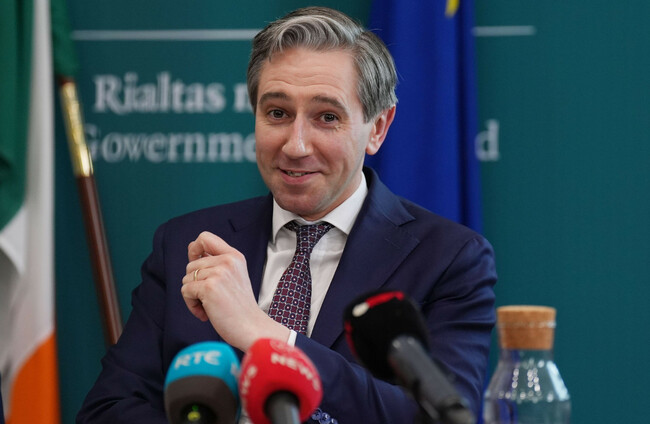
Finance Minister Simon Harris has previously said the scheme will include a tax-free threshold and a flat annual charge above that level, as part of efforts to address what he described as Ireland’s “lack of an investment culture”.
He has also said there will be no entry or exit tax, with providers expected to handle tax administration.
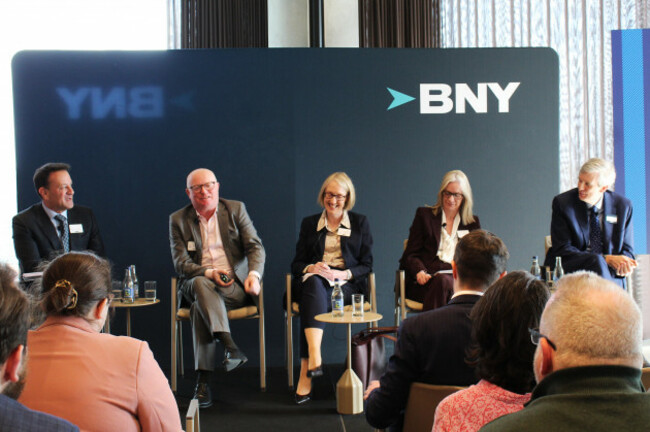
A panel discussion hosted by the IIEA this morning, and moderated by former taoiseach Leo Varadkar, focused heavily on how to keep any new system simple enough for first-time investors, particularly younger people.
A key theme in the discussion was how to design a system simple enough for first-time investors, particularly younger people, without overwhelming them with choice.
Paul Kilcullen, Ireland country manager at BNY, pointed to the lack of clear investment routes for young people in Ireland at present.
“My 13-year-old son told me, ‘Dad, can you help me invest?’ and I said, it’s actually quite difficult, there is no real structure,” he said.
He argued that earlier engagement with investing could have long-term effects on behaviour.
“If we get it right for the younger generation, I think that would permeate right the way through all socioeconomic groups and all age groups,” Kilcullen said.
Central Bank of Ireland representative Anna Marie Finnegan said one of the key risks was that too much choice could deter participation.
“Sometimes the number of different products overwhelms. There might be a piece there just in terms of keeping it simple,” Finnegan said.
She also warned that marketing needed to avoid unrealistic expectations, saying schemes should not be framed as “a get rich quick scheme” and that risks and benefits must be clearly presented.
IIEA chief economist Dan O’Brien pointed to international comparisons and the scale of wealth already held in deposits, noting that while some level of tax exemption would be workable, there were risks that would need to be managed carefully, including potential knock-on effects for the banking system if large sums moved into investment products.
O’Brien said a flow of around €10 billion in the first year would be “a success” for the scheme, while other panel estimates suggested the system could grow to as much as €50 billion over its first five years, depending on uptake and design.
A consistent concern across the panel was how to balance access with protection for less experienced investors and those with limited savings.
Niamh Moloney of the London School of Economics said the challenge lay in how tax incentives are used to shape behaviour.
She said international examples offered useful lessons but cautioned against assuming a single model could simply be copied into Ireland.
“There’s no magic product,” Moloney said. She added that any design models would need to reflect domestic saving habits and financial culture here.
The IIEA paper also points to international models such as Sweden’s investment savings account and UK-style tax-free wrappers as potential reference points, while arguing Ireland’s approach must reflect its own savings profile, where deposits and property dominate household wealth and equity participation remains low.
Kilcullen suggested that early incentives, including starter contributions or matched savings for children, could help build what he described as a “culture of investment”.
Finnegan said simplicity would be essential to ensuring broader participation.
“It needs to be accessible,” Finnegan said.

To embed this post, copy the code below on your site













have your say