TheJournal.ie uses cookies. By continuing to browse this site you are agreeing to our use of cookies. Click here to find out more »
Dublin: 9 °C Wednesday 22 May, 2013

Troika recommends cuts to specialist doctors’ salaries

In a leaked document, the Troika suggests a number of radical measures to address the health service overspend including hiring specialists from abroad, cutting doctors’ pay and making savings on the cost of drugs.

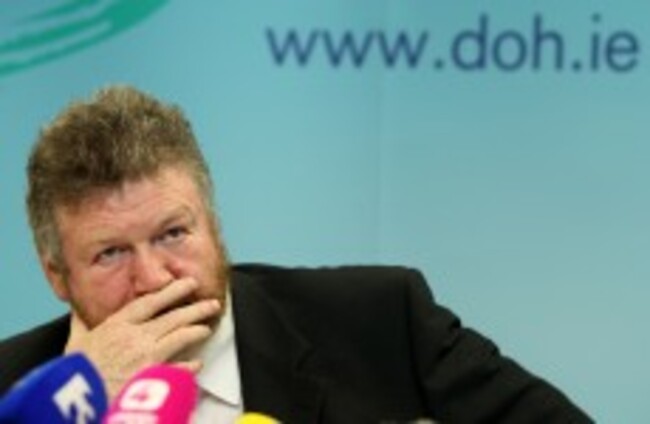
Health Minister James Reilly (File photo)
Image: Sam Boal/Photocall Ireland

THE TROIKA HAS strongly criticised the Irish health service, saying that continued “slippages” and “delays”  in implementing reforms have led to “spending pressures” contributing to the near €400 million budget overspend last year.

A leaked European Commission document, seen by TheJournal.ie, reveals a litany of problems within the health service with the Troika highlighting the issue of the overspend in health throughout the 88-page review of Ireland’s bailout programme.

The cost of drugs and the issue of pay come in for particular scrutiny with the EU-IMF mission saying that “high remuneration” pay for doctors “may warrant attention” and suggesting the government could “review the fees and salaries paid to medical professionals”.

It also raises the possibility that the government could address a shortage in medical specialists by hiring qualified candidates from other EU countries.

“All options should be kept on the table” when it comes to addressing savings in the public service pay and pension bill, the document says, adding that pay scales and allowances should be an option for review in addition to the anticipated reduction in staff numbers.

The EU-IMF mission says that additional spending pressures by the end of last year and the unwinding of temporary measures in the year ahead means there is a structural gap of around €700 million that needs to be addressing.

There was an estimated overrun in health spending of around €370 million by November last year and the document notes that commitments made by the government to address the overrun in the health were “only partly implemented”.

“Health measures were specified to address the health overruns, although their implementation and effectiveness was not as anticipated,” the Troika says.

Drugs and pay

The cost of drugs and the amount paid health service workers come in for particular scrutiny in the document with the Troika outlining ways in which these could be addressed.

It suggests that the government puts in place a so-called “claw-back mechanism” where a rebate is charged on pharmaceutical companies on a quarterly basis as happens in other EU countries.

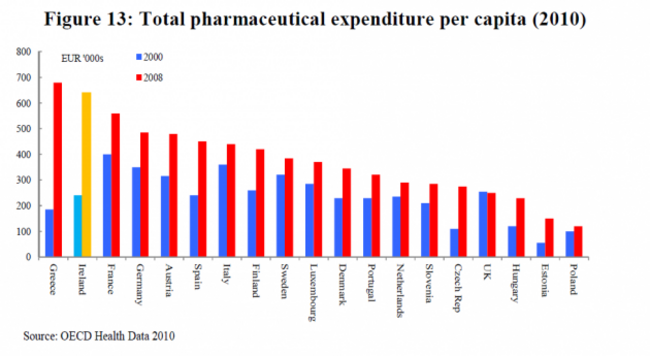
The Troika also suggests that the health service should promote greater use of generic dugs and ensure prices of medications are more in line with other countries pointing out that the health service’s drugs bill is 34 per cent more per capita (individual person) terms than the EU average.

drugs per capita spending

If you’re having trouble viewing this graph, click here

Salaries paid to staff working in the health service come in for particularly scrutiny from the Troika which says that the “high level of remuneration of doctors, in particular specialists” is an issue which “may warrant attention”.

Though it does note the pay cuts and changes to work practices already agreed with hospital consultants it suggests that a more “comprehensive” review should be considered and also suggests that a shortage in specialists could be addressed by hiring from abroad.

“There may be value in strategies to further open the supply of labour to suitably qualified specialists from other countries,” the document says.

It cites figures from 2007 to 2011 which show that Ireland recognised 151 intra-EU qualifications for doctors per million inhabitants in comparison to the UK where it was 205 per million inhabitants.

Reforms

The document contains numerous references to the continued “spending pressures” in health with more general discussions about fiscal policy consistently referring back to the overruns in health in addition to social protection.

The Troika says that a “significant scope remains to increase the efficiency, cost-effectiveness, monitorability and sustainability of the health system” and identifies a number of key reforms announced last year that need to be implemented in the coming months.

These include the expansion of after-hours services by GPs, the introduction of a unique patient identifier and fuller recovery of the costs incurred from treating private patients in public hospitals.

The document notes that charging all private patients in public hospitals was a measure not adopted by the end of last year and for which there is no timetable for implementation this year.

The document lists the detail of the €780 million budget adjustment identified for this year including anticipated savings of €308 million from payroll cuts and €145 million from dealing with the pharmaceutical industry.

The Troika says there are “significant implementation risks” arising from the measures proposed for this year but says they need to be implemented “swiftly and fully”.

In a letter of intent from the Irish government, Finance Minister Michael Noonan and central bank governor Patrick Honohan say that they are “alert to the overruns experienced in the health sector, and are taking structural measures to correct then in a durable manner”.

They make a commitment to contain costs in the health service to within the €13.6 billion budget for this year.

- additional reporting from Gavan Reilly

Euroleaks: Troika wants less pay, more hours for public sector workers

More Euroleaks: Government to hire private companies to find work for long-term unemployed

Read next:

Comments (27 Comments)

  • And Nothing anywhere about our TOP Public Servants having a pay cut Let’s start at the top and then maybe we get some honesty and respect back in place Irish were never afraid of long hours or hard work but the Top P.S. such as our Politicians and Senators CEO’S ADVISORS ETC ETC are ridiculously and crudely overpaid

    Reply
    • Look at the next article. They say exactly that. And what they’re saying here isn’t necessarily wrong; unlike the Irish government, they are looking at ways to save money WITHOUT damaging front-line services.

      Reply
    • A Secretary General’s salary is peanuts compared with what private-sector CEOs pay themselves. So lay off the talk about fat cats in the public sector.

      A person at the mid-level grade I was at when I left the Irish Civil Service suffered an 18% cut in take-home pay in the space of just 13 months.

      Now I’m back in Ireland and goggle-eyed at the cost of doctors’ and dentists’ bills.

      Reply
  • So we have a shortage of specialists so they recommend we get them from abroad where the hours are better and services are better. What will we do to entice them?? Oh yeah cut the specialist salary that will be a great incentive ….. Oh yeah and that will be great encouragement for the specialists who have decided to stay and put up with the awful hours and condition, less pay… Oh no wait it won’t they will decide to leave for greener pastures leaving us with even more of a deficit of specialists with no hope of getting anyone decent to fill the spots. Fabulous plan!

    Reply
  • As someone who is on long term medication I’d be f’d without the drug payment scheme because the prices are ridiculous. Now that I am unemployed and will probably get a medical card so the whole cost will be on the state. I wouldn’t care if I was given generics instead to keep the cost down.

    But as for pay, I don’t think doctors and nurses pay should be touched. They saved my life and many other lives. They are infinitely more valuable to this country than the clowns in Leinster House or the paper pushers in the HSE. That’s where the cuts should come from.

    Reply
    • As popular as calling for cuts in Leinster house is, the scope of potential savings there is tiny compared to the health service which makes up a huge proportion of public spending. Acting as if nurses and doctors wages which make up most of that bill can be ring fenced and protected is farcical if you are serious about cutting public spending. My perception of the health service is that there was a culture of entitlement amongst its staff, especially the highly qualified, which is out of proportion to what is viable for a public servant. The problems of the health service are also in part due the fact we unlike Britain and Scandinavia we were not willing to pay a lot in the form of direst taxes for top class public services when we could afford it. This means most influential people of means are on private healthcare and so don’t demand a better public service leaving those who are less influential and vulnerable with a worse public system. If we were taxed more to fund better public services such as schools and hospitals and private ones were not subsidised we probably would have a more equitable society. The latter half of my post is all a bit pie in the sky though while our economy is still in the doldrums though, I believe it should have been done in the late 90′s.

      Reply
    • Barry
      We have the highest paid specialists in the world! So they saved your life! That’s what they’re trained to do. In fact if they lost your life when they had the ability to save it they’d be struck off! So they work hard! Nothing in what you’ve said suggests they should be the highest paid in the world.
      Please try to make constructive arguments that are factual and unemotive.

      Reply
    • Barry
      I’ve also just remembered that a UK Consultant or Specialist enters that role on around seventy five thousand pounds and reaches a maximum of around one hundred and fifteen thousand over a number of years. We start them all at the same peak salary and that’s tens of thousands more than the top salary in the UK. We the permit them to make hundreds of thousands in private practice on top. Let’s get real here !

      Reply
  • A doctor earning €30k more than another person might sound like a big difference but he or she would be lucky to see €10k of it once they paid high tax and all the other levies, not as big of incentive for all their training and responsibility as you might expect which is why many are going abroad

    Reply
  • go on the troika dragging this country kicking and screaming into the 21st century.

    Reply
  • Most consultants deserve their big salaries. They work harder than most people in the country and have done for their entire careers.

    Reply
  • What’s the betting the specialist fees and the private patients charges are not tackled but the poor will be got at again????

    Reply
  • No way should specialists pay be cut.

    Reply
  • What specialists? There’s barely any left in the country

    Reply
  • The real solution to the specialist problems is a reform of our training mechanisms for doctors. We need more training places in universities for medicine, and a more streamlined method of getting people to the Specialist grade.

    Reply
    • No we need more Irish doctors and to stop fee paying non nationals taking up the majority of places in our universities. We also need to recognise that we pay for the education of Irish doctors and employ them instead of cheaper alternative’s. But ultimately leave their pay alone they work hard enough train long enough and put in long hours

      Reply
  • Can someone clarify that graph for me, please. Are we spending E6,500 per capita on drugs? Is that the figure?

    Reply
  • Surely it can’t be a gob-smacking E650,000 approx per capita?

    Reply
    • That is what the graph is saying John. 650 (000s) of €, per capita. I cannot see any other way to ready that graph. That would be €2,916,550,000,000 per annum. Nearly €3 trillion euro.

      In other words it looks like the graph has a mistake in it.

      It is probably in raw yo-yos per capita, in which case it would be 2,916,550,000… nearly € 3 billion.

      Reply
  • The Troika have now shown themselves to be stupid.

    The definition of stupidity is expecting the Doctor in charge of the Irish Health Service to agree to, let alone approve a reduction in Doctors pay.

    Reply
  • a rough guide to self education…

    approx figures based on a quick fly thru on info

    Reply

Add New Comment