Sign in. It’s quick, free and it’s up to you.
An account is an optional way to support the work we do. Find out more.
Sign in. It’s quick, free and it’s up to you.
An account is an optional way to support the work we do. Find out more.
The FOI Files is a series from our team at The Journal Investigates. Each week, one of our investigative journalists brings you inside the fight for information that we’re all entitled to. They’ll share their documents, their stories – and tips on how to take the journey for yourself.
This week’s file is from investigative journalist Patricia Devlin.
See here for The Journal Investigates’ most recent investigations.
IN LATE 2020, then Heritage Minister Malcolm Noonan announced plans to establish a dedicated Wildlife Crime Unit within the National Parks and Wildlife Service (NPWS).
Eight months later, while launching a new wildlife crime protocol between the NPWS and An Garda Síochána, Noonan referred to a series of “devastating wildlife crimes”, including the shooting and poisoning of birds of prey, poaching, wildfires and the persecution of badgers.
Such crimes needed to be tackled “head on”, he said, adding that the new Wildlife Crime Unit was then being established within the NPWS.
But the promised standalone unit never materialised in the form originally announced. Instead, responsibility for wildlife crime was ultimately placed within a broader Wildlife Enforcement and Nature Protection Directorate.
In May 2024, while working on an investigation into Ireland’s underground wildlife trade, I asked the Department of Housing, Local Government and Heritage for records I expected would help explain what had happened.
Instead of answers, the request triggered a year long battle for information.
In a lengthy investigation spanning a number of months, The Journal Investigates monitored a number of illegal hunting networks operating throughout Ireland.
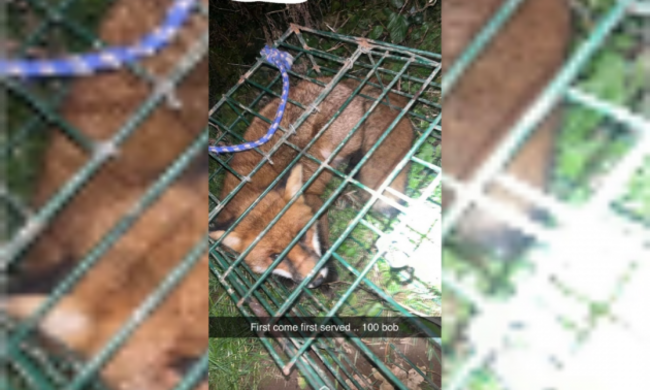
We discovered foxes, badgers, hares and rabbits being captured and sold as live bait in brutal wildlife crimes.
Animals were advertised using coded language, with foxes offered for around €100 and rabbits and hares sold for approximately €20 to €30.
As part of the investigation, I examined NPWS data covering 346 wildlife-crime prosecutions brought between 2010 and 2023. It showed that 67% did not result in a criminal conviction.
Of the 113 prosecutions recorded as convictions, just four resulted in suspended prison terms. However, not one offender was handed an immediate prison term during the period.
The low conviction and sentencing outcomes underscored calls for a more specialised enforcement approach, including proposals for a dedicated Wildlife Crime Unit within NPWS.
The apparent failure of the proposed standalone unit to materialise was therefore clearly a matter of public interest.
I wanted to know how the decision had been made to create a directorate instead. So, I asked for the records.
On May 7, 2024, I submitted a request under the Access to Information on the Environment, or AIE, Regulations.
I sought:
The request only concerned the policy and decision making process. It did not seek information about suspects, individual investigations or live criminal cases.
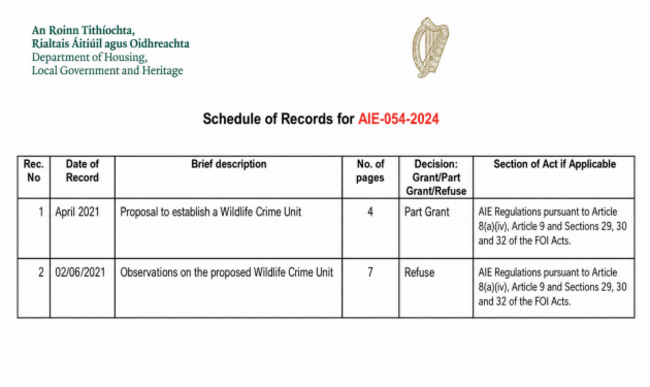
The department identified only two relevant records. The first was a four page proposal prepared by the NPWS Wildlife Crime Working Group in April 2021.
The second contained seven pages of observations on that proposal from an unnamed NPWS official, dated June 2, 2021.
Almost two months after my request, the department refused access to both records citing Article 8(a)(iv) of the AIE Regulations, concerning the confidentiality of a public authority’s proceedings.
It also relied on Article 9(1)(b), which allows information to be withheld where disclosure would “adversely affect” the course of justice, including criminal inquiries. The refusal additionally referred to sections 29, 30 and 32 of the Freedom of Information Act.
I requested an internal review. However, just a few weeks later, the department affirmed its refusal.
Again, the department stated that it had weighed the public interest in disclosure against the reasons for withholding the documents and concluded that there was “no strong public interest” in releasing the information.
That was difficult to reconcile with the public promise of a dedicated wildlife crime unit and the importance of safeguarding Ireland’s wildlife and natural habitats.
In August 2024, I appealed to the Office of the Information Commissioner (OIC) asking for an investigation into the refusal.
Because I had made the request under AIE Regulations, the appeal went to the Commissioner for Environmental Information rather than through the usual Freedom of Information appeal route.
Interestingly, just a few months into the OIC investigation, the department changed its position – slightly.
On December 19, 2024, the department released a redacted version of the first record but continued to withhold the second in full.
It then notified the OIC that it had offered me this revised decision. The investigator looking after my complaint asked if I wanted the appeal to continue – I confimed that I did.
On April 17, 2025, the Commissioner annulled the department’s refusal and directed it to release the requested environmental information in both records, subject to the redaction of information outside the scope of the review.
The department had argued that the documents formed part of a confidential deliberative process concerning the establishment of the unit and the organisation of NPWS enforcement structures.
However, the OIC found that the AIE exception protects only the final stage of a public authority’s decision making proceedings – not the entire administrative process leading up to it.
What also transpired was that the documents did not make it clear why the proposed unit was not established.
The Commissioner therefore found that releasing them could not adversely affect the confidentiality of the final decision making stage.
The department also argued that disclosure would provide an unfair insight into NPWS law enforcement operations.
It claimed the information could undermine the ability of authorised officers to perform their duties and adversely affect the course of justice.
Again, the OIC disagreed. The documents contained no information about individual cases, suspects or locations. Nor did they explain how or when particular technology would be deployed.
The Commissioner found: “The information contained in the withheld records is high level, and contains no specific or detailed information in relation to particular cases, locations or how and when the NPWS might deploy specific types of technology.
The refused information is of such a general nature that I cannot see how it could give any advantage to defendants of current and future prosecutions as argued by the Department, or otherwise adversely affect the course of justice.
The ruling added: “I am not satisfied that the Department has demonstrated sufficiently that the release of records 1 and 2 would cause a reasonably foreseeable risk on the ability of the NPWS to prosecute crime in the future.”
I didn’t receive the records straight away. In fact, the department sent them exactly one year and a day after I submitted my original request – May 8, 2025.
The first document was prepared by the NPWS Wildlife Crime Working Group in April 2021. It described law enforcement as an “extremely challenging” part of the daily work carried out by NPWS field staff.
It was also described as “a particularly heavy workload in many areas”.
Although considerable enforcement experience already existed within the NPWS, the working group identified a need for greater competence and consistency across the country, particularly among newer staff.
The proposal called for an expert support service that could provide guidance, advice, feedback and operational assistance to conservation rangers and other field staff.
It noted that a law-enforcement working group arising from the 2009 Grant Thornton organisational review had recommended appointing eight regional enforcement support officers.
The 2021 working group instead proposed a centrally based Wildlife Crime Unit.
Its goals included:
The proposed unit would maintain national records of prosecutions and alleged breaches where no action had been taken.
It would also collate intelligence, examine emerging wildlife-crime trends and act as a national contact point for enforcement matters.
The document proposed using drones, GoPro cameras and thermal imaging equipment to support investigations.
Training would cover taking statements, obtaining search warrants, preparing books of evidence and giving evidence in court. It would also focus on offences involving hare coursing, deer lamping, hedge cutting, poisoning and finching.
The second record contained observations from an unnamed NPWS official on how the proposal might operate in practice.
The official supported establishing a hotline through which members of the public could report suspected wildlife crime. It was envisaged as an anonymous telephone line, with no return call made to an informant in most cases.
The official also said the unit could perform a useful role by monitoring social media to identify offenders openly sharing evidence of wildlife crimes.
That proposal was particularly relevant to our investigation, which found animals being sold and evidence of illegal hunting being openly circulated in private online groups.
The document also supported establishing a national prosecution database and publishing wildlife crime figures annually. However, it raised significant questions about the proposed unit’s authority.
The official said the unit had been placed outside NPWS Regional Operations. It could therefore promote best practice, provide training and offer advice – but it could not direct regional staff or compel them to follow its guidance.
According to the document, only the head of regional management could ensure a consistent enforcement effort across the country.
The official also cautioned that it would be a NPWS headquarters unit rather than Ireland’s national Wildlife Crime Unit. Its remit would not cover wildlife offences dealt with by other bodies, including Inland Fisheries Ireland.
The clearest evidence of uncertainty appeared at the end of the second document. The unnamed official described the composition of the proposed unit and the identity of its head as “one of the most pressing issues” still to be resolved.
They said the job specification for the position they had applied for stated that the Wildlife Crime Unit would be led at assistant principal officer level.
The role also included establishing the unit and managing its staff and therefore the official understood that they were being appointed to lead it.
However, they subsequently learned that there would not be a full-time assistant principal assigned to the Wildlife Crime Unit.
The official therefore concluded that they would have a part-time role in the Wildlife Crime Unit and a part-time role in the Legislation and Guidance Unit.
The record ended with a request for clarification about who would ultimately be in charge.
When approached during our original investigation, NPWS disputed that a decision had been made not to proceed with the Wildlife Crime Unit.
It said the Wildlife Enforcement and Nature Protection Directorate represented an upgrade because a directorate was more senior, better resourced and had greater authority than a unit.
In the letter accompanying the released records, NPWS said a wider organisational review had recommended transferring wildlife-crime functions to a new Conservation Measures and Protection Directorate.
It said two directorates were ultimately created from existing resources instead of one.
One of these was the Wildlife Enforcement and Nature Protection Directorate, which NPWS said now leads the development of its wildlife-crime policies and strategies.
The service said it works with gardaí and other enforcement agencies on targeted operations, patrols and monitoring.
However, the released documents do not explain how the original proposal for a standalone Wildlife Crime Unit evolved into that structure.
As the Commissioner noted, they contain no information about the final decision, who made it or what influenced it.
After a request covering reports, risk assessments and correspondence, the department identified only the initial proposal and one official’s observations as relevant records.
The department based its refusal on weighty grounds, citing confidentiality, criminal investigations, prosecutions and the course of justice. Language enough to put off any requester forking out the €50 fee to escalate the complaint to the OIC.
But a public authority cannot establish an exception simply by naming a possible harm.
It must connect disclosure of the particular information being withheld to a specific adverse effect. That risk must be reasonably foreseeable rather than hypothetical.
When faced with this type of refusal, there are three useful questions to ask:
This case also demonstrates why it can be worth continuing an appeal even when a public authority releases some information midway through the process.
The partial disclosure in December was progress. But stopping there would have left most of the information hidden and the department’s broad interpretation of the AIE exceptions untested.
The final decision did more than secure the release of two records. It reinforced that public bodies must justify secrecy by reference to what documents actually contain.
If you have a burning FOI question about how to get certain records or why your request was refused, you can get in touch with our team at investigates@thejournal.ie. The Journal Investigates team will be back with another instalment of The FOI Files next Tuesday.

To embed this post, copy the code below on your site















have your say