Sign in. It’s quick, free and it’s up to you.
An account is an optional way to support the work we do. Find out more.
Sign in. It’s quick, free and it’s up to you.
An account is an optional way to support the work we do. Find out more.
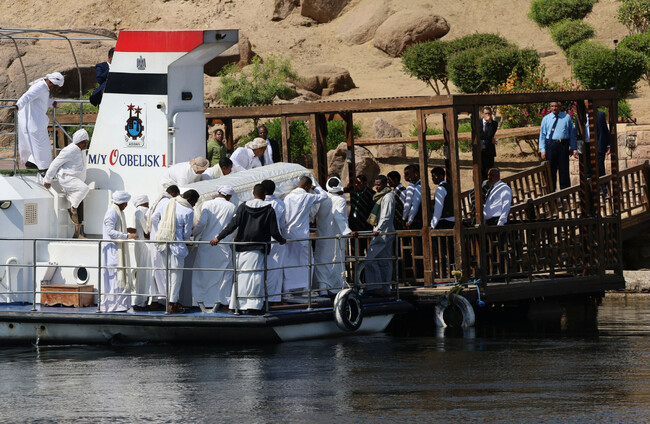
THE AGA KHAN IV has been laid to rest at a private ceremony in Aswan, Egypt.
The death of Prince Karim – the 49th hereditary imam of the Shiite Ismaili Muslims – was announced on Tuesday by the Aga Khan Development Network and the Ismaili religious community.
His son, 53-year-old Rahim Al-Hussaini, has been named as the Aga Khan V, the spiritual leader of the world’s millions of Ismaili Muslims, in according with his father’s will.
On Saturday, a private funeral service took place at the Ismaili community centre in Lisbon attended by Canadian Prime Minister Justin Trudeau, Spain’s King Emeritus Juan Carlos and Portugal’s President Marcelo Rebelo de Sousa.
The Aga Khan is considered by his followers to be a direct descendant of the Prophet Mohammed and is treated as a head of state.
The governor of Aswan welcomed Prince Karim’s family at the southern Egyptian province’s airport on Saturday.
“When his will was opened, it was found that he had requested to be buried in Aswan near his grandfather, Sultan Muhammad Shah, and his grandmother, Om Habiba,” said Major General Ismail Kamal.
Ismaili mourners marched as bells rang during the burial ceremony in the country’s southern Aswan province, as Prince Karim’s body was taken in a van.
They carried his body, draped in a white shroud, and placed it on a yacht on the Nile River.
Prince Karim, 88, was given the title of “His Highness” by Queen Elizabeth in July 1957, two weeks after his grandfather, the Aga Khan III, unexpectedly made him heir to the family’s 1,300-year dynasty as leader of the Ismaili Muslim sect.
The late Aga Khan evolved over decades into a business magnate and a philanthropist, moving between the spiritual and the worldly with ease.
He was a defender of Islamic culture and values, but also widely regarded as a builder of bridges between Muslim societies and the West.
The Aga Khan Development Network deals mainly with issues of healthcare, housing, education and rural economic development.
It says it works in more than 30 countries and has an annual budget of about one billion dollars for non-profit development activities.
Ismailis lived for many generations in Iran, Syria and South Asia before also settling in east Africa, Central Asia and the Middle East, as well as Europe, North America and Australia more recently.
They consider it a duty to donate up to 12.5% of their income to the Aga Khan as steward.
The Aga Khan was a regular on the racetrack and continued the family tradition of breeding thoroughbreds.
He also ploughed a large amount of his inherited wealth into philanthropic projects.
The Aga Khan was a notable supporter of Irish racing and one of the driving forces behind the redevelopment of the Curragh.
The Aga Khan Trophy is a renowned event on the Irish showjumping calendar, which takes place during the Dublin Horse Show at the RDS every summer. The trophy was donated by the Aga Khan’s father, a regular visitor, in 1926.
Khan was the owner of Shergar, a Derby-winning racehorse who was stolen from his stud farm in Co Kildare in 1983 and never seen again.
Shergar’s kidnapping is widely believed to have been conducted the IRA, with the star race horse’s remains still undiscovered to this day.
With reporting from Emma Hickey and Andrew Walsh

To embed this post, copy the code below on your site













have your say