Sign in. It’s quick, free and it’s up to you.
An account is an optional way to support the work we do. Find out more.
Sign in. It’s quick, free and it’s up to you.
An account is an optional way to support the work we do. Find out more.
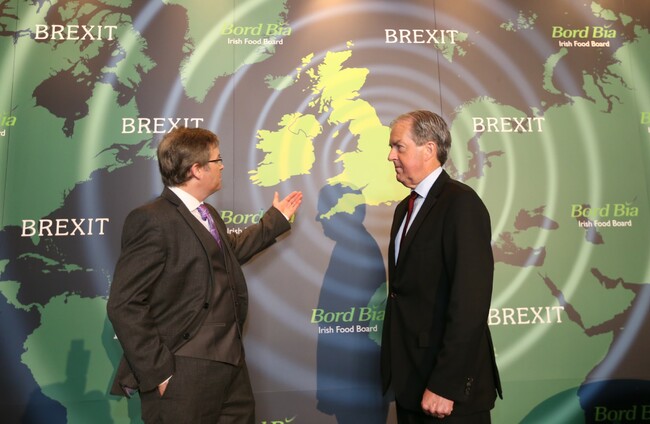
THE BUDGET FOR next year was announced yesterday by Minister for Finance Michael Noonan.
In his introductory speech before the Dáil, one of the first issues mentioned by Noonan was the issue of Brexit – and how to deal with the threat it poses to the Irish economy.
The Minister’s exact words were:
The UK’s decision to exit the European Union represents a real risk to our economy given the close links and the high level of trade between us. Around 16% of Irish exports go to the UK, but 40% of indigenous company exports go there.
In turn, Ireland is the UK’s fifth biggest export market. Over €1.2 billion of goods and services are exchanged between us on a weekly basis. This trade supports 400,000 jobs, split evenly between the two islands, with many more jobs in the supply chain.
He said that the Brexit result had encouraged his department to “reduce its forecast for GDP growth for next year to 3.5%” and said it wasn’t “possible to forecast the impact of” Brexit right now.
Noonan also stressed the importance of putting “in place safety nets to protect us against future economic shocks” and announced a list of measures that would do so, including:
For businesses, there are a whole host of other measures:

But Patricia Callan of the Small Firms Association (SFA) said that Budget 2017 was something of a “missed opportunity”, particularly in the fallout from Brexit.
We still have the issue of the self-employed paying the additional 3% in USC (Universal Social Charge) on earnings over €100,000.
And the threshold for CGT is still €1 million. It’s £10 million in the UK. That’s not adaptable to the post-Brexit world. With margins tightening after Brexit, you are going to see firms going straight to the UK rather than setting up here.
Callan says that the budget they have seen is “not at all Brexit-proof”.
“Hopefully the measures introduced will bring capital back into the market, but we need more support for small businesses should they fail,” she says.
The Sinn Féin spokesperson for Jobs Maurice Quinlivan agreed, saying that €3 million was “a pathetic sum of money and totally inadequate” for the challenges faced because of Brexit.
“The challenge is to protect cross border trade, the export trade and jobs; the government should be leading this campaign.
We will pay dearly for the failure to put contingency measures in place to protect against the fallout from Brexit.
Analysis

Although the Minister said these measures were in direct response to Brexit, it’s difficult to separate what is a Brexit policy and what is a policy to improve already difficult conditions for Irish workers – such as those implemented for struggling farmers.
Maurice Quinlivan went a step further, disagreeing that the VAT rate for the hospitality sector should be maintained, and argued that it was being used as an excuse to avoid reforming the the sector’s approach to pay and work conditions.
“Using Brexit to justify allowing the 9% VAT rate for the hospitality sector to continue unchanged says much about in whose interests the current government operates.
In terms of cross-border retail competitiveness, Lynn Drumgoole of Retail Excellence Ireland said that the “failure of the government to reduce the 23% VAT in light of Brexit, means we are losing competitiveness and retail jobs will be lost”.
As sterling continues to weaken the growth of cross border shopping and online sales to UK companies means there is a real risk to the growth of the Irish economy.
Brexit is a moving target

As Michael Noonan said at the beginning of his speech, it’s unknown what effect Brexit will have on the British or Irish economy, so introducing measures to safeguard Irish workers and businesses is difficult before knowing what exactly needs to be protected.
This is especially difficult as €1 billion is not that much ‘fiscal space’ to play with – especially with a housing crisis, the worsening problem in the healthcare system, and civil servants requesting pay increases.
Liam Lynch of the all-island group Chartered Accountants Ireland put it best when he said that although the indigenous businesses are “helped by Budget 2017, more must be done to prepare for Brexit”.
“The Government now needs to look beyond tax adjustments to tackle areas such as the mobility of Irish and UK citizens between our nations post-Brexit. The services sector needs the Government to look at cross-border accreditation of skills and qualifications after the UK has left the EU.
We may be exposed to new customs procedures and tariffs between our two countries, but measures to simplify administration and customs hold-ups need to be in the pipeline now, in good time for the post-Brexit world in 2019.
“We need to develop for ourselves what post-Brexit arrangements look like, before others do it for us,” Mr Lynch concluded.

To embed this post, copy the code below on your site















have your say