Sign in. It’s quick, free and it’s up to you.
An account is an optional way to support the work we do. Find out more.
Sign in. It’s quick, free and it’s up to you.
An account is an optional way to support the work we do. Find out more.
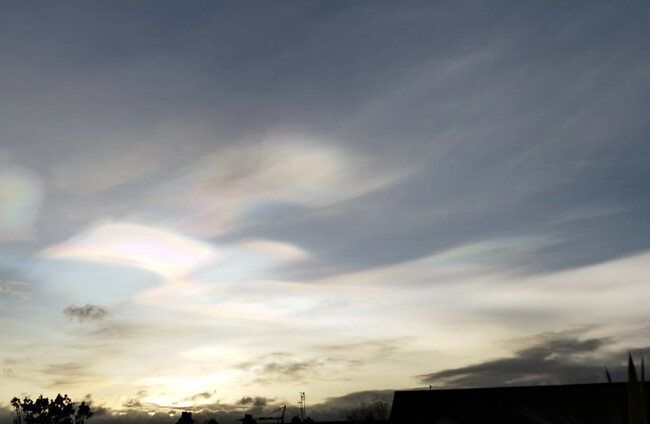
RARE ‘RAINBOW’ CLOUDS have been spotted across Ireland this morning.
The clouds have an iridescent or rainbow appearance and their presence is rare in Ireland.
The technical name for the eye-catching clouds are nacreous or polar stratospheric clouds.
Nacreous or polar stratospheric clouds were spotted in the sky over Ireland this morning. They can form in winter high up in the stratosphere, 15 - 25 km high, at very low temperatures, below −78 °C (−108 °F). pic.twitter.com/zcSB1uB4GV
— Climate Services @ Met Éireann (@METclimate) December 21, 2023
They form high up in the stratosphere, between 15 and 25 kilometres high, over polar regions when the Sun is just below the horizon.
Nacreous clouds only form below -78 °C so are most likely to occur during the polar winter.
The ice particles that form nacreous clouds are much smaller than those that form common clouds, and it’s these smaller particles that scatter light in a different way and create the distinctive iridescent appearance.
Due to their high altitude and the curvature of the Earth’s surface, these clouds are lit up by sunlight from below the horizon and reflect it to the ground.
Stunning images from some followers this morning of Nacreous clouds or polar stratospheric clouds. These clouds are between 68,500 feet and 100,000 feet in the Stratosphere and very rare in Ireland! pic.twitter.com/MX27gKTFRg
— Carlow Weather (@CarlowWeather) December 21, 2023
They are most likely to be viewed in places such as Scandinavia and northern Canada and because of this, they are often referred to as polar stratospheric clouds.
Due to the very low temperatures required, nacreous clouds are usually only visible from Ireland when the cold air which circulates around polar regions in the stratosphere is displaced and hovers temporarily over Ireland.

To embed this post, copy the code below on your site









have your say