Sign in. It’s quick, free and it’s up to you.
An account is an optional way to support the work we do. Find out more.
Sign in. It’s quick, free and it’s up to you.
An account is an optional way to support the work we do. Find out more.
 GE2024health led approach
FIANNA FÁIL HAS this afternoon clarified that it does not want to see the possession of all drugs for personal use decriminalised.
Its general election manifesto states that the party wants to continue to develop a “health-led response to drug addiction”.
The document states that if returned to Government, Fianna Fáil will “decriminalise drug possession for personal use”.
The document also states that legislation would be introduced that would require those found in possession of illegal drugs for personal use to attend educational or treatment programmes.
It has also promised to publish a formal national position on how best to regulate the use of cannabis.
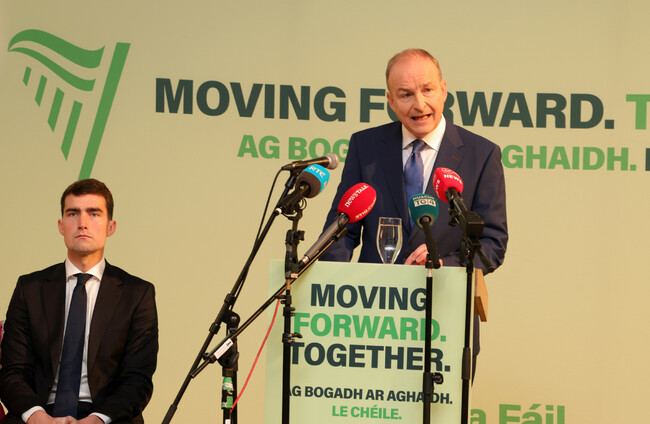
Speaking at the manifesto launch earlier today, party leader Michéal Martin said the approach outlined in the manifesto “reflects the understanding that the most effective way to deal with drugs is a health-based model, as opposed to a criminal justice-based model”.
He did not outline a timeline for implementation.
However, a party spokesperson has since clarified that Fianna Fáil is not proposing to decriminalise cocaine or heroin.
The spokesperson said the party is committed to implementing the Citizens’ Assembly on Drugs Use recommendation of a health-led response to possession of drugs for personal use, which will require legislative changes.
“We will look at decriminalising drugs such as cannabis, as is done in other countries such as Malta, Spain and Portugal, and not drugs such as cocaine and heroin,” they said.
The spokesperson said people in possession for personal use will, in the first instance be directed to addiction services, similar to the Austrian and Portuguese models.
“In introducing these measures we will engage with other countries that have introduced similar measures and health professionals that have expertise in this area. We will look at the amount of drugs that should be decriminalised for personal use and the number of times that a person can be diverted to health interventions, amoung other issues.
“Fianna Fáil believes that it is time for a change in how drug use is treated in Ireland,” the spokesperson said.
A new approach to drug possession, referring first-time offenders to the HSE for screening was first introduced by Simon Harris when he was Minister for Health in 2019. However, at the time, campaigners for decriminalisation for personal use were critical that the measures did not go far enough.
Last year, a Citizens’ Assembly on Drug Use recommended that a health-led approach to drug use be implemented by Government.
It recommended a degree of decriminalisation for the possession of drugs for personal use, in favour of referring people to health services.
This included the possession of cannabis, mushrooms (psilocybin), cocaine, and other drugs.
A decriminalisation model means that drugs remain illegal, but a person found in possession of drugs for personal use does not receive a criminal sanction.
Other pledges
Launched this morning in Dublin, Fianna Fáil’s general election manifesto spans almost 200 pages with 90 different proposals for voters to consider.
Among these is a pledge to increase the entry point to the higher rate of tax paid by workers to €50,000 if elected. Workers currently pay the 40% tax rate on income earned about €44,000.
On the Universal Social Charge, Fianna Fáil has said it would cut the lower rate from 3% to 1.5% “at a minimum” over the lifetime of the Government.
The party has also pledged to increase core social welfare rates by at least €12 annually and increase the State pension to €350 per week. It currently stands at €289.30.
It has also promised it would maintain the retirement age at 66 and legally enable people who want to work beyond the age of 65 to do so.
Other pledges include:
Despite a number of Fianna Fáil TDs sitting on the Oireachtas committee on Assisted Dying, the party’s manifesto makes no mention of introducing assisted dying.
In March of this year, the committee recommended that assisted dying be made legal in Ireland with a number of safeguards.
When asked by The Journal if its absence from the manifesto means that Fianna Fáil does not support the introduction of assisted dying, party leader Martin said “greater thinking through of the proposals and issue” is needed.
“We’re not in a position to commit to any legislative proposals,” he said.
Martin added the Oireachtas Committee did “good work” but he was “not satisfied” that it had an exhaustive look at the issues.
When asked if this undermines the work of Oireachtas Committees, Martin said: “We’re entitled as a party to have a position”.

To embed this post, copy the code below on your site















have your say