Sign in. It’s quick, free and it’s up to you.
An account is an optional way to support the work we do. Find out more.
Sign in. It’s quick, free and it’s up to you.
An account is an optional way to support the work we do. Find out more.
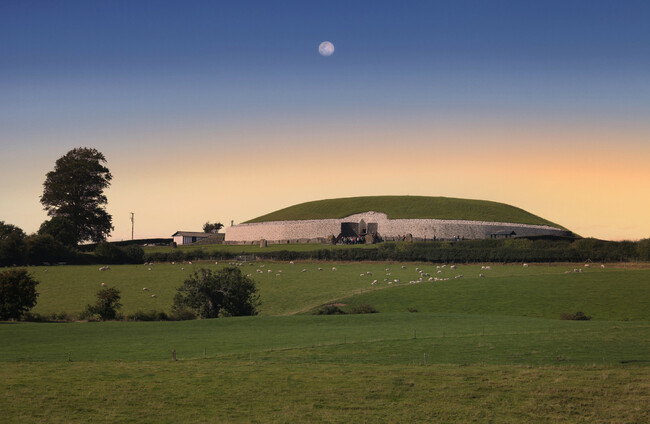
NEW RESEARCH LED by UCD has “overturned” the centuries-old belief that the prehistoric Newgrange monument in Co Meath was a burial site for the elite class.
Writing in The Conversation, the report’s authors said that the new research reveals a “complex pattern of small, mobile groups who moved frequently with their animals and gathered seasonally”.
They say this “deconstructs the myth that only important individuals were socially active”.
Neil Carlin, an archaeology lecturer in UCD, and Jessica Smyth, Associate Professor in Archaeology at UCD, are among the report’s authors – the full report can be read here.
The report said the evidence does not “support the existence of hereditary power or A dynasty” and that any shared ancestry can be explained as “resulting from preferential choice of partners within a dispersed community”.
It added: “In constructing monuments collectively, people were also constructing kin relations.”
This “kin network” among these small and mobile groups – achieved through communal feasting, ceremonies, and work – extended over hundreds of kilometres and many generations and “transcended biological kin”.
It noted that any genetic clustering shown from passage tombs is “likely to have emerged from kin work, rather than a purely hereditary network”.
Most of the individuals genetically sequenced from these monuments were more closely biologically related to each other than to the wider Irish population at the time, thus forming a genetic cluster.
But genetic clustering from passage tombs is likely to have emerged from extended kin groups created and maintained through their communal acts.
“People may have preferentially chosen their reproductive partners from within this extended community of passage-tomb users, some of whom were genetically distantly related,” stated the report.
Only a few examples of close family links occur in smaller and earlier tombs.
But within passage tombs like Newgrange, most biological relationships tend to have been distant, such as second cousins or a great-great-great grandparent.
The report’s authors said this “tells us that burial was not strongly determined by biological relatedness”.
It concluded that the selection of bones for deposition within passage tombs in Neolithic Ireland “does not seem strongly influenced by biological relatedness”
Rather, other “facets of identity, kinship, ability, role, cosmology and value influence these decisions”.
“The mapping of distantly related individuals interred within passage tombs far apart in time and place shows the shift towards more closely connected cultural and religious networks,” said the report.
“These likely comprised dispersed groups who were increasingly mobile across a wide swathe of Ireland in the later half of the Neolithic.
“The evidence certainly does not support the existence of hereditary power (a ‘dynasty’) in these populations.”

To embed this post, copy the code below on your site










have your say