Sign in. It’s quick, free and it’s up to you.
An account is an optional way to support the work we do. Find out more.
Sign in. It’s quick, free and it’s up to you.
An account is an optional way to support the work we do. Find out more.
TEACHERS IN DUBLIN who were unexpectedly told that their secondary school would be transitioned into a Gaelcholáiste have expressed anger over the lack of consultation over the decision.
Proposals to turn Synge Street CBS in Dublin 8 into a gaelscoil were first announced in September last year. The plan was later overturned in February but greenlit again in March.
Today, President of the teaching union ASTI Donal Cremin and General Secretary Kieran Christie and members of the association staged a lunch-time protest outside the building over the lack of communication with staff over the proposal.
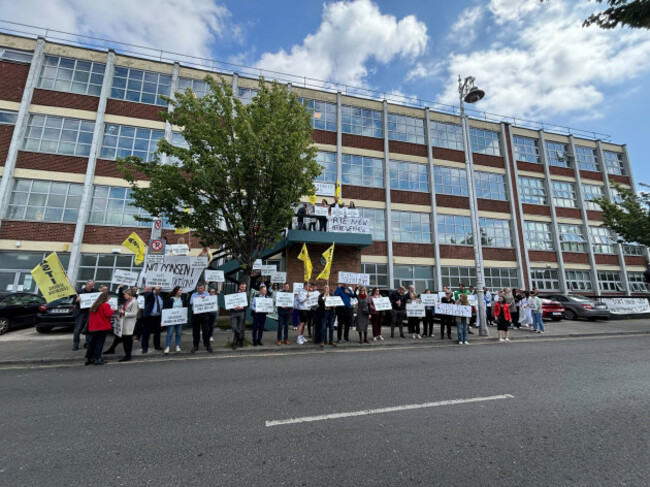
The ASTI said the decision will affect the staff’s working lives “in a fundamental way” and that there is an urgent need to discuss upskilling, transition and timeline plans with the teachers.
Many teachers spoke of feeling caught off guard by the announcement. The Journal previously reported that the school was only told of the plan the day before then-education minister Norma Foley publicly announced it.
Speaking at the event, Cremin told The Journal that staff, the department, the union and the Edmund Rice Schools Trust – which oversees the school and owns the property – need to “get around the table to discuss” the plan.
Communication between the union and the department has continued, Cremin said, but he claimed that there is a split between the school’s management over the decision. He said that the issue needs to be addressed to staff properly for the transition to be a success.
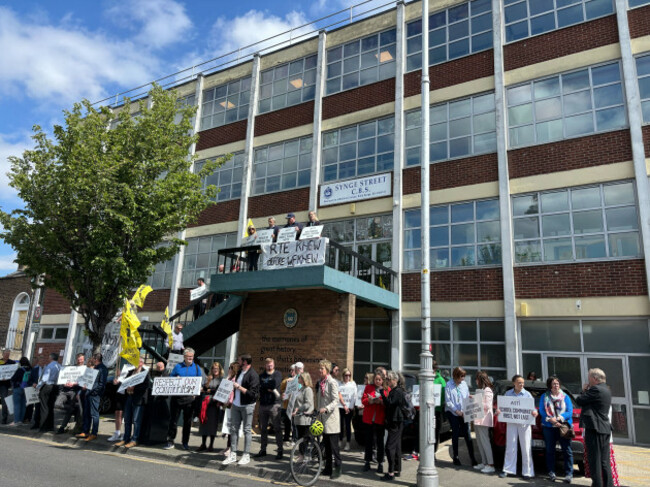
First-year students entering Synge Street C.B.S. in September 2026 will be the only class that is taught completely as Gaeilge. All other students who enrolled before will continue their education through English.
By September 2032 the school will be lán-Gaeilge. It follows a long-running campaign from residents and parents in the Dublin 2, 4, 6 and 8 areas who want a dedicated Gaelcholáiste option for when their children leave local Irish-speaking primary schools.
Students from Bunscoil Synge, Gaelscoil Eoin, Gaelscoil Inse Chór, Gaelscoil Lios na nÓg and Scoil Bhríde located in the Dublin 2, 4, 6, and 8 have frequently taken part in the protest to demand that a Irish-speaking secondary school be created locally.
The Department of Education has previously said that it remains committed to the establishment of a Gaelcholáiste in the Dublin South City area.
ASTI, however, has said that 91% of staff at Synge Street CBS are not in favour of the transition to a Gaelcholáiste.
Despite the school’s concerns, the Edmund Rice Schools Trust – which oversees the school and owns the property – told staff in March that the plans to enroll and teach students through Irish in September 2026 will proceed.
Labour councillor Fiona Connelly, Labour party leader and local TD Ivana Bacik and Fine Gael councillor Danny Byrne attended the protest alongside the teachers and the ASTI leadership this afternoon.
Bacik told The Journal that she has long-supported plans to introduce a gaelscoil in the area but urged that there needed to be better communication, cooperation and consultation with the staff at the school for it to be done properly.
Signs made by school staff read: “RTÉ knew before we knew”, “No Consent, No Consultation” and “Respect our Community”.
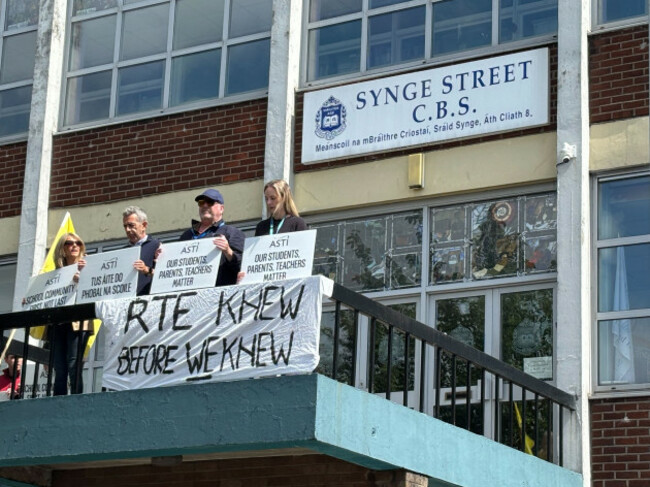
An assistant principal, who speaks Irish, will be appointed at the school and the Department and the Trust will provide upskilling resources to the staff. Teachers today said they are concerned over the efficiency of the upskilling programmes.
One teacher said he would not have the level of proficiency required to teach through Irish within two years’ time.
The ASTI standing committee has highlighted how a number of gaelscoileanna around Dublin have constant staff shortages and are sometimes required to temporarily hire English-speaking teachers to teach Irish-speaking classes.
Other teachers have recognised the need for a Gaelcholáiste in the Dublin 8 area, but that the speed of change is too fast, the lack of communication has increased concern for the future of their employment and the risk it poses to the school’s community and diversity seen in its population.
While most staff have recognised the need for a Gaelcholáiste in the Dublin 8 area, the speed of change and the lack of communication, they say, puts the future of their school and employment there at risk.

To embed this post, copy the code below on your site














have your say