We need your help now

Support from readers like you keeps The Journal open.

You are visiting us because we have something you value. Independent, unbiased news that tells the truth. Advertising revenue goes some way to support our mission, but this year it has not been enough.

If you've seen value in our reporting, please contribute what you can, so we can continue to produce accurate and meaningful journalism. For everyone who needs it.

Israel's Noam Bettan is fifth in the odds table - but this weekend's result could all come down to the public vote. Alamy Stock Photo

Could Israel win this year's Eurovision?

The second semi-final of the world’s biggest live music show played out in Vienna tonight – but what might happen on Saturday?

“WHO WILL WIN the Eurovision?”

It’s the go-to gambit for anyone attending or reporting on the song contest.

But, amid continued controversy over Israel’s presence in the competition, that straightforward question itself comes fraught with tension.

The second semi-final of the world’s biggest live music show played out in front of around 10,000 fans at the Wiener Stadhalle this evening. 

Norway, Australia and Romania were among the countries sealing a spot in the final. Israel and nine other acts – including the favourites this year, Finland – made it through from the Tuesday contest. 

The bookies are currently giving the Finns a 37% chance of topping the table come the weekend, with Greece and Australia next best placed.

For those who keep a close eye on this sort of thing, however, there’s every chance the Israeli singer, Noam Bettan, could emerge victorious from Saturday’s Grand Final, in spite of being rated fifth in the odds table.

Why? 

It’s all down to the voting system that governs how votes are distributed.

Entering a song seen as a ‘safe bet’ – solid, but no risk-taking, something that keeps you in contention after the expert juries have their say – and then relying on the public vote, which makes up the other 50% of the total score, appears to be Israel’s strategy.  

It’s certainly one that’s served them well in recent years. The country topped the popular vote in last year’s contest in Basel, and came second the year before that in Malmö.

Even in countries with a strong pro-Gaza sentiment, Ireland included, Israel ended up with a strong share of available viewer votes across the two contests. 

Broadcasters from five nations – Ireland, Spain, the Netherlands, Slovenia and Iceland – are boycotting Eurovision this year because of the war on Gaza.  

What happened last year? 

Several broadcasters who typically send an act to Eurovision, RTÉ among them, expressed concerns about voting patterns in the wake of last year’s final, prompting contest organisers the European Broadcasting Union (EBU) to overhaul the system in advance of the Vienna contest. 

Those complaints came about after Israel’s Yuval Raphael, who had finished mid-table after the professional jury votes were distributed, ended up leapfrogging over her competitors when the popular vote was added to her tally. 

Israel remained in contention to win as the remaining results of the night were called out – before eventually being beaten by Austria’s JJ in a split-screen play-off scenario. 

split The split-screen finish to last year's contest. EBU EBU

It emerged in the wake of the Basel contest that an agency of the Israeli government had deployed social media advertising and used state social media accounts to encourage voting for the act.

New reporting from the New York Times, published last weekend, showed Israel’s efforts to rally supporters behind its Eurovision act were broader and started earlier than previously thought.

The paper detailed how, after identifying the competition as a valuable source of soft power, the Israeli government spent at least $1 million on promotional campaigns linked to Eurovision voting efforts over the past two years.

And while there haven’t been any signs of the sort of coordinated vote-getting campaign witnessed last year, already the Israeli broadcaster, Kan, has received a warning from the EBU after Bettan appeared in social media posts that encouraged people to vote 10 times for his song. 

New measures to guard against third parties or state organisations promoting voting campaigns were introduced as part of the system overhaul ahead of this year’s Eurovision. While it wasn’t determined that Israel broke those rules with its posts, the EBU said they weren’t in the “spirit” of the contest.

What rules have changed?

Among the changes brought in ahead of this contest, 10 is the new maximum number of votes allowed “per payment method” – down from 20. People voting online also need to provide credit card details to ensure their votes originate from the correct country.

So will the changes make any difference? Or could we see a repeat of the sort of scenario that played out a year ago in Basel?

According to Kevin Cunningham, founder of the Ireland Thinks polling company, it’s likely the reduction in the number of votes a person is able to cast will have some impact on what happens – but it could be “marginal”. 

Whether it’s the Eurovision or a national election or referendum, the TU Dublin politics lecturer said, the same factors apply – in a field with multiple options, those with more motivation or more interest in a particular result can have an oversize influence. 

“In an election, if turnout is low your differential turnout, as it is called, often has a bigger influence. Like if turnout is 20% of the population, or 10% … the smaller it gets, the more skewed it gets.”

This impact is particularly noticeable in a contest like Eurovision, where only a small subset of those actually viewing go as far as to pick up their phone to cast a single vote, let alone 10 or 20.

Being allowed to vote multiple times accentuates the result of the contest, Cunningham said, “to a massive degree”.

The recent New York Times report found that in some countries, only a few hundred people voting repeatedly would have been enough to influence the outcome of the public vote. In Spain, Raphael picked up a whopping 33.34% of the televote, polling far ahead of all other options. 

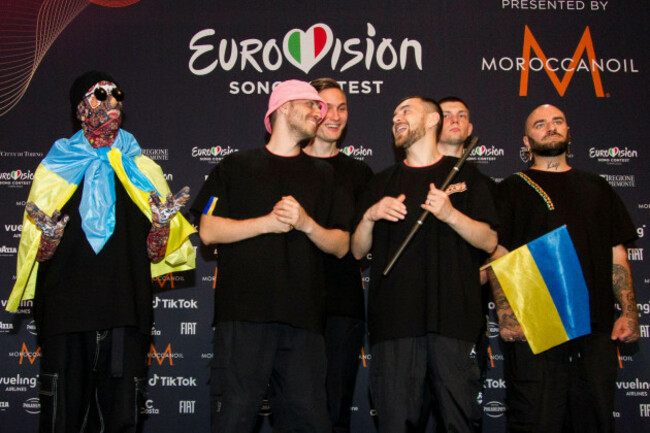
turin-italy-15th-may-2022-ukrainian-band-kalush-orchestra-press-conference-after-victory-of-european-song-contest-credit-marco-destefanis-alamy-live-news 'Motivated reasoning' has long been a feature of Eurovision voting. Opposition to Russia's invasion of Ukraine contributed to a massive public vote for the country's act in 2022, the Kalush Orchestra, who beat the UK to win the contest. Alamy Stock Photo Alamy Stock Photo

Many of the dedicated fan media covering the contest for social media or via specialist Eurovision podcasts believe Israel could once again end up in a split-screen finish this weekend, finishing either first or second.

“I can’t stand here and tell you that Israel won’t win Eurovision this year, because I think there is a good chance that we will see Israel do very, very well in the public vote, possibly win the public vote, on the basis of what happened in the last couple of years,” said Rob Lilley-Jones, host of the popular Eurotrip podcast.

“Any country that wins the public vote will be in with a chance of winning the Eurovision.”

Finland may be favourites, but there’s no sense that the singer-violinist pair of Pete Parkkonen and Linda Lampenius are running away with the thing, the podcaster added.

“You could have votes going here, there and everywhere, which means maybe we might have a record low scorer even win the contest, and in that scenario, you could end up with a country like Israel potentially coming through to win it.”

linda-lampenius-and-pete-parkkonen-from-finland-perform-the-song-liekinheitin-during-the-first-semifinal-of-the-70th-eurovision-song-contest-in-vienna-austria-tuesday-may-12-2026-ap-photomart Parkkonen and Lampenius are favourites to win with their pop-classical crossover Liekinheitin (Flamethrower). One fan who spoke to The Journal on their way into the contest, however, reckoned they 'peaked too early'. Alamy Stock Photo Alamy Stock Photo

Israel last hosted the contest in Tel Aviv in 2019 and would be entitled to hold the 2027 version in the event of a win this weekend. Security concerns may make that impossible, but it’s likely even the prospect of an Israel-hosted Eurovision would prompt more countries to simply sit things out for a year.

In that scenario, could the contest survive in its current form? 

Said Lilley-Jones: “I’m sure that Kan, the Israeli broadcasting company, would want to host the competition in Israel.

“Would artists be keen to take part? You know, some artists haven’t taken part this year for certain countries because of the current situation. It would bring a lot of uncertainty.”

Readers like you are keeping these stories free for everyone...
Our Explainer articles bring context and explanations in plain language to help make sense of complex issues. We're asking readers like you to support us so we can continue to provide helpful context to everyone, regardless of their ability to pay.

Close
38 Comments
This is YOUR comments community. Stay civil, stay constructive, stay on topic. Please familiarise yourself with our comments policy here before taking part.
Leave a Comment
    Submit a report
    Please help us understand how this comment violates our community guidelines.
    Thank you for the feedback
    Your feedback has been sent to our team for review.

    Leave a commentcancel