Sign in. It’s quick, free and it’s up to you.
An account is an optional way to support the work we do. Find out more.
Sign in. It’s quick, free and it’s up to you.
An account is an optional way to support the work we do. Find out more.
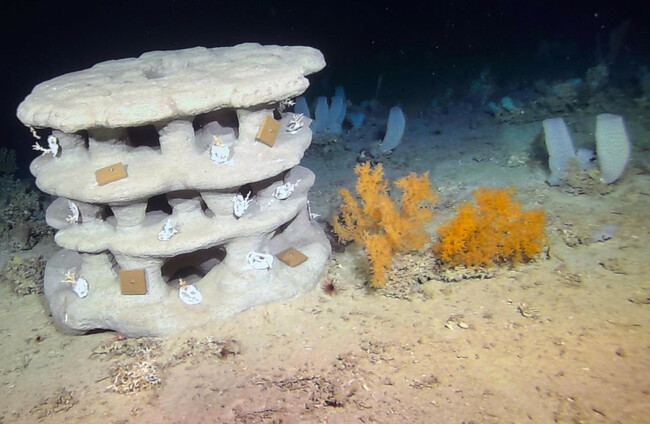
RESEARCHERS FROM UNIVERSITY of Galway are part of an international team working to restore deep-sea coral reefs damaged by bottom trawling by installing 3D-printed artificial reefs.
The research has seen 23 artificial reefs placed on the deep seabed off the south-west Porcupine Bank, off the west coast of Ireland and in the Bay of Biscay, France.
The early results are said to be “very encouraging” and researchers said the work could “open up new possibilities to scale up the restoration of damaged coral reefs elsewhere in the Atlantic and beyond”.
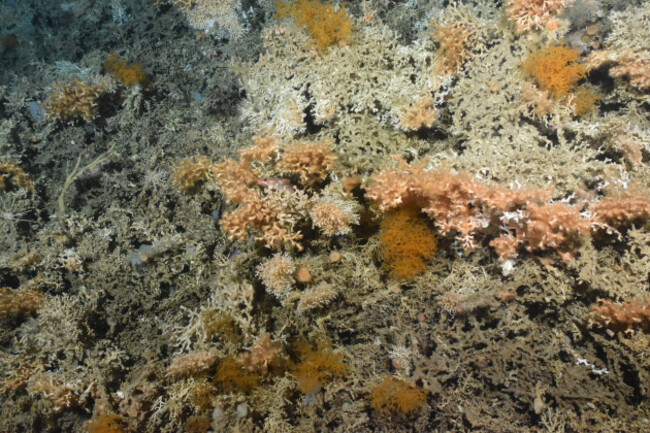
It’s part of a Horizon Europe project titled ‘REDRESS’, which is an acronym for “Restoration of deep-sea habitats to rebuild European Seas”.
The expedition to deploy the artificial reefs took place last month on board L’Atalante, a vessel of the French Oceanographic Fleet.
Reefs were placed at depths between 900 and 1,100m off the Porcupine Bank, and in the Guilvinec Canyon, Bay of Biscay – other reefs were installed here during an expedition last year too.
While cold-water coral reefs are less well-known than their tropical cousins, they provide important habitats for marine life and support biodiversity in the deep-sea, including fish.
The corals, however, are quite fragile and easily damaged by deep-sea trawling.
While recent fisheries and conservation regulations prohibit trawling in many areas where corals are found, the issue is now turning to how to return damaged areas to full health.
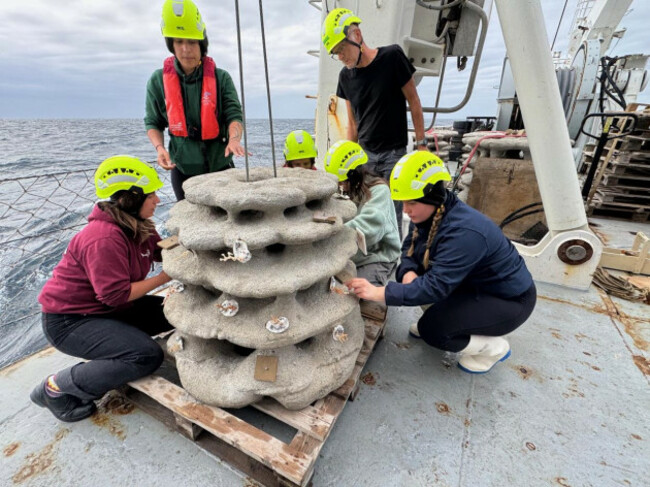
The artificial reefs are eco-designed cylinders made from low-carbon concrete incorporating volcanic material.
Each 3D-printed structure is around 80cm high and 100cm in diameter, weighing around 600kg.
They provide complex physical microhabitats including tunnels, ledges and overhangs, that offer shelter and provide surfaces for corals and other marine life to colonise.
The reefs are placed individually on the seabed, rather than together, to form a single connected structure covering an area of about half a hectare.
Researchers will monitor the sites over the coming years through photography, video and 3D mapping to assess how the coral and other marine life develop on and around the reefs.
Different approaches are also being tested as part of the research.
Some reefs were equipped with oyster shells, ceramic plates and tiles to encourage coral larvae to settle naturally, while others were fitted with fragments of living coral.
The aim is to see whether the coral can survive and establish new colonies or enhance the attractiveness of the artificial reefs for colonisation by coral larvae.
Encouragingly, researchers have found that the coral fragments, known as nubbins, which were placed on artificial reefs last year are still alive.
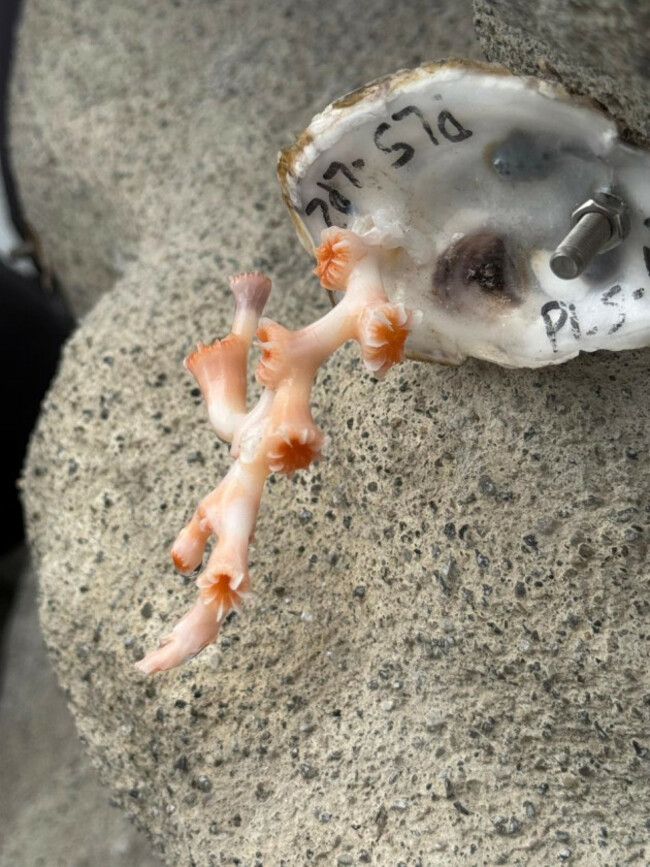
The reefs have also been colonised by a range of marine species, including sea urchins, fish, crabs and crinoids.
The research will also monitor seawater conditions, sediment and chemical contaminants.
This will help improve understanding of the conditions needed for healthy coral growth and assess the potential impact of climate change and ocean acidification on restoration efforts.
Both restoration sites, meanwhile, are now protected from further damage by bottom trawling.
Dr Anthony Grehan, a deep-sea ecologist at University of Galway and co-leader of the mission to the Porcupine Bank, said these “deep-sea coral reefs provide vital habitat for a diversity of marine life, but many have been damaged over many years”.
“Because these corals grow by only a few millimetres each year, natural recovery of lost reefs can take decades to centuries.
“With this project, we are testing whether we can actively accelerate that recovery by creating new starter structures for corals to grow on, which also mimic reef structure to help re-establish functioning reef habitats.”
Grehan said the “early results are very encouraging” and added: “If we can show that these approaches work, it could open up new possibilities to scale up the restoration of damaged coral reefs elsewhere in the Atlantic and beyond.”
Meanwhile, Marie-Claire Fabri, a research engineer in deep-sea benthic ecology and co-leader of the Bay of Biscay region expedition, remarked that “preserving these areas alone is not enough” and called for the “active restoration of cold-water corals”.
“The ban on bottom trawling has helped stop the direct pressure on these habitats, but to go further – given the slow growth of these corals in the Atlantic – just a few millimetres per year—we cannot simply wait for them to recover on their own.”

To embed this post, copy the code below on your site















have your say