Sign in. It’s quick, free and it’s up to you.
An account is an optional way to support the work we do. Find out more.
Sign in. It’s quick, free and it’s up to you.
An account is an optional way to support the work we do. Find out more.
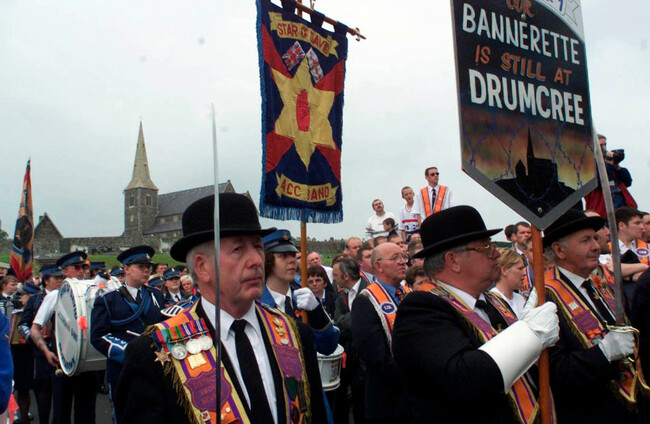
THE IRISH GOVERNMENT has said it is “very concerned” over a decision by Northern Ireland’s Parades Commission to allow the Orange Order to march down the Garvaghy Road for the first time in close to 30 years.
The Parades Commission blocked the order from marching along Portadown’s Garvaghy Road in July every year since 1998.
However, it today ruled that the Orange Order’s Drumcree return parade is to be permitted to proceed along the Garvaghy Road.
The stand-off at Drumcree made headlines in the 1990s, with nationalist residents of the Garvaghy Road resolutely opposed to the parade passing through the area.
This led to violent clashes for several summers and political tension necessitating a major security operation.
However, a procession will now be allowed this coming Sunday.
The Parades Commission placed a number of restrictions on the procession, including an 8am start time and limiting the number of participants to 35 people.
That is a reduction from the application from the Portadown District of the Orange Order, who proposed 60 Orange Order members take part in the procession on Sunday.
No supporters are to accompany the parade or congregate along the parade route or near homes on the Dungannon Road and Drumcree Road, and no bands may participate.
In a statement today, the Irish government said it is “conscious of the very difficult and traumatic history associated with parades on the Garvaghy Road”.
“The Government does not want to see a return to the divisions of the past,” added the statement. “That would be a retrograde step.”
The statement added that Irish government officials have been “liaising closely with residents in the area”.
The government also noted that an “appeal of the determination is now likely”.
“It is important that all parties continue to respect the legal process as they have done to date,” said the government spokesperson.
Last week, Taoiseach Micheál Martin said he would keep a request to meet with Garvaghy Road residents over the parading dispute “under review”.
In a statement today, Aontú leader Peadar Tóibín said that he had contacted Martin’s office, “urging the Taoiseach to use his influence to stop this march”.
“It is really important that the Taoiseach and the British prime minister (Andy Burnham) understand just how destabilising this is for community relations,” said Tóibín.
He added: “Mothers are in tears, in real fear for safety of their children. The community is devastated and terrified.”
Tóibín said that at the height of the Drumcree Parade in the 90s, “21 innocent people lost their lives”.
“It is beyond belief that this nightmare is about to revisit the residents,” he added.
Meanwhile, Sinn Féin vice president Michelle O’Neill remarked that there is “no reasonable or logical basis for the Parades Commission’s announcement”.
“For 28 years, the Garvaghy Road community has lived in peace, and the people of that community have been able to get on with their lives,” she added.
“Twenty-eight years of peace was not a problem that required a solution. It was a peace that needed to be protected.
“This march is steeped in a history of hate, sectarian violence, and murder. People right across the North are absolutely dismayed.”
Elsewhere, SDLP leader Claire Hanna said her party is “stunned” by the decision.
She added that “those who pushed for this outcome now have a particular responsibility to show restraint”.
“These will be challenging days and those of us shocked and dismayed by the decision must work harder to remain calm and keep order.”
However, DUP leader Gavin Robinson said the decision “demonstrates what unionism working together with persistence and legal scrutiny can achieve”.
He said the Parades Commission “has now explicitly recognised that the police have no information indicating that this peaceful parade will result in disorder or violence”.
Robinson meanwhile hit out at the “severe restrictions on numbers, timing and bands”.
“Those participating will walk peacefully and with dignity,” he added. “Others must respond in the same spirit.”
He said today “must now become the beginning of a genuine process to resolve Drumcree permanently, based on equal respect for the rights of everyone”.

To embed this post, copy the code below on your site













have your say