Sign in. It’s quick, free and it’s up to you.
An account is an optional way to support the work we do. Find out more.
Sign in. It’s quick, free and it’s up to you.
An account is an optional way to support the work we do. Find out more.
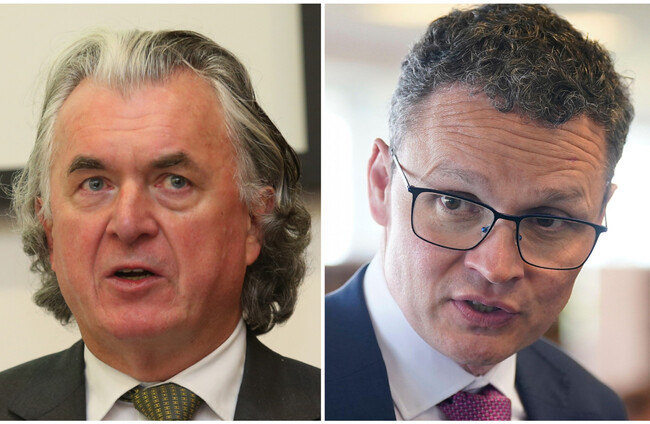
THE CHAIR OF RTÉ told the media minister that the cut to the broadcaster’s funding in Budget 2027 would potentially “damage” its relationship with the government.
Terence O’Rourke also warned Patrick O’Donovan that the decision could limit RTÉ’s ability to implement all the recommendations made by an expert committee established after the broadcaster’s payments controversy.
The comments were contained in a letter released to The Journal under the Freedom of Information Act.
The government’s decision to allocate RTÉ €240 million for 2027 – €20 million less than it had been promised under a three-year funding agreement – sparked a row between the broadcaster and O’Donovan last month.
The minister expressed dissatisfaction with the pace of reform at RTÉ, a claim that was subsequently rejected by director general Kevin Bakhurst.
The Taoiseach later said the government wanted to honour the funding agreement, while O’Donovan and RTÉ executives held talks aimed at resolving the dispute.
Acting media minister Peter Burke said last week that he hoped the funding issue could be resolved before the end of this year, but that he first wanted to be satisfied that RTÉ’s reform programme was progressing.
In a letter to O’Donovan dated 7 October, the day after the budget, O’Rourke expressed “significant disappointment” at the decision and described it as breaking an agreement.
He expressed worries about the possible implications for RTÉ’s relationships with the government and the media regulator as a result of the move.
“I am also concerned that your decision to break an agreement has the potential to undermine and damage the working relationships between RTÉ, government and the regulator, Coimisiún na Meán; relationships that I know you take seriously,” O’Rourke wrote.
O’Rourke said that when he agreed to become RTÉ chair, it had been on the “clear understanding” with the previous media minister Catherine Martin that the question of public funding would be addressed.
He said he had welcomed the delivery of the government’s funding commitment for 2025 and 2026, but that it was “very disappointing and frustrating” that the department had “apparently backtracked” on its commitment for 2027.
The chair also warned that the decision could have an “extremely negative impact” on RTÉ and its ability to fulfil its obligations as a public service broadcaster.
He said the board would have to consider the direct financial implications for audiences, content, staff and the objectives of RTÉ’s strategy.
The decision “may also constrain our ability to fully implement all the recommendations” of the Expert Advisory Committee, he wrote.
O’Rourke said RTÉ had committed to implementing those recommendations in the expectation that the funding arrangements would be as publicly announced by the government.
The committee was established to examine governance and culture at RTÉ following the 2023 controversy over undisclosed payments to former Late Late Show presenter Ryan Tubridy.
Its recommendations included putting the broadcaster’s funding on a more sustainable footing.
O’Rourke said he believed the government’s funding commitment had gone a long way towards fulfilling that recommendation, but that this was now “potentially seriously undermined” by the budget decision.
He asked to meet O’Donovan at the earliest opportunity and urged him to reconsider the decision and find a solution that would make RTÉ financially sustainable.
The following day, O’Rourke and Bakhurst met the minister for talks that the director-general described afterwards as “extremely constructive”.
O’Rourke attached a copy of an August 2024 letter from Catherine Martin to RTÉ’s chair and director general, setting out the government’s agreement to provide €225 million in public funding in 2025, €240 million in 2026 and €260 million in 2027.
The former media minister said the funding, made up of TV licence receipts and Exchequer support, would give RTÉ certainty and allow it to plan over a number of years for its five-year strategy.
At an Oireachtas committee hearing last week, RTÉ executives said they had been told of the €20 million shortfall just hours before the budget was announced.
The Department of Culture’s secretary general, Feargal Ó Coigligh, told the committee that the department’s overall allocation had fallen short of what O’Donovan had sought.
He said the department was working with RTÉ to make a case to the government for the additional funding.

To embed this post, copy the code below on your site











have your say