Sign in. It’s quick, free and it’s up to you.
An account is an optional way to support the work we do. Find out more.
Sign in. It’s quick, free and it’s up to you.
An account is an optional way to support the work we do. Find out more.
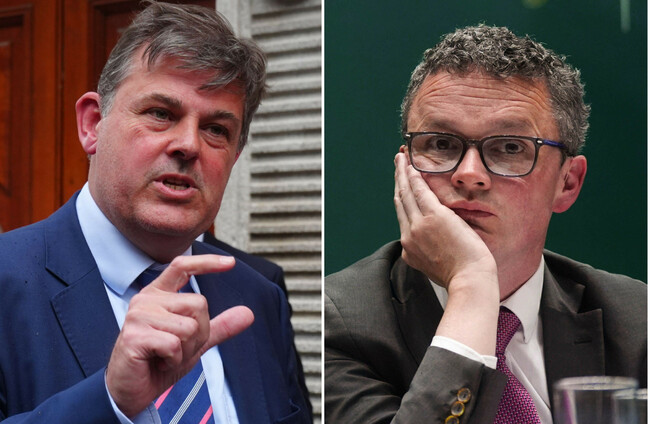
A ROW HAS erupted between RTÉ and the government after the national broadcaster was allocated €20 million less than expected in Budget 2027.
Minister for Media Patrick O’Donovan insists RTÉ’s funding has not been cut, while Director-General Kevin Bakhurst says the government has failed to honour a written agreement reached two years ago.
The dispute also prompted criticism from media regulator Coimisiún na Meán and the National Union of Journalists this week.
In July 2024, the government committed to providing RTÉ with €725 million in public funding over three years.
The funding deal was agreed a year after RTÉ became embroiled in controversy over €345,000 in payments to former Late Late Show presenter Ryan Tubridy that had not been publicly disclosed.
The controversy, which was followed by further revelations about spending at the broadcaster, led to a collapse in public confidence and a sharp drop in the number of people paying their TV licence.
With RTÉ facing a financial crisis, the government agreed to provide €725 million in public funding over three years, made up of TV licence revenue and additional State funding.
The money was intended to give RTÉ certainty over its finances while it carried out a five-year restructuring plan, including reducing its workforce by up to 400 people and investing more in programmes made by independent producers.
The agreement provided for €225 million in 2025, €240 million in 2026 and €260 million in 2027, made up primarily of television licence revenue and additional Exchequer funding.
However, Tuesday’s budget allocated RTÉ €240 million for next year, leaving it €20 million short of the amount previously agreed.
O’Donovan has rejected suggestions that this amounts to a funding cut, arguing that RTÉ will receive the same overall allocation as in 2026.
He has also expressed dissatisfaction with the pace of reform at the broadcaster, particularly its efforts to reduce staff numbers.
“It is also in the context of progress made by RTÉ in the delivery of their strategy,” O’Donovan said.
“While progress has been made across a number of issues, I am not happy that we have seen sufficient progress in delivering the smaller, more agile processes that we sought to be delivered under the strategy.”
While RTÉ had committed to reducing its workforce by up to 400 people under its five-year strategy, progress has been slower than the government had hoped.
According to RTÉ’s latest annual report, 67 employees left through its voluntary exit programme in 2025, despite more than 300 applying.
The broadcaster’s average employee numbers also rose from 1,962 in 2024 to 1,994 in 2025.
Bakhurst strongly pushed back on O’Donovan’s criticism of the broadcaster’s progress on reform.
“We completely reject the assertion that the pace of reform and transformation within RTÉ has been slow,” Bakhurst said.
He added that RTÉ had implemented around 90% of the recommendations of an expert advisory committee established following the controversies at the broadcaster.
“We have also already managed to exit almost 100 people from the organisation, despite the late approval of the Voluntary Exit Programme and a short window to enable people to leave,” he said.
Bakhurst said the three-year funding agreement had allowed RTÉ to plan ahead, including making commitments to produce more Irish drama and live sport, invest in its digital services and commission programmes from independent producers.
He warned that the government’s decision would “inevitably impact” RTÉ’s ability to deliver its five-year strategy.
“If the three-year multiannual agreement will no longer be honoured – we now have some important decisions to make,” he said.
RTÉ chair Terence O’Rourke is seeking a meeting with O’Donovan over the decision.
According to reporting in The Irish Times this morning, O’Donovan warned Minister for Public Expenditure Jack Chambers in a letter last week that the government would “renege” on the RTÉ funding agreement unless more money was provided to his department.
An additional €21 million was subsequently allocated to the department, but RTÉ’s funding remained at €240 million.
Speaking at a press briefing yesterday, O’Donovan acknowledged that RTÉ’s allocation was less than the government had envisaged in 2024, but said it reflected the funding available to his department.
He said RTÉ would receive an €11 million increase in funding, rather than the €31 million originally planned.
“We were simply not in that space to be able to do that,” O’Donovan told reporters.
Speaking on RTÉ’s Morning Ireland today, Minister of State Seán Canney said the funding agreement involved commitments from both sides, including targets for reform.
“An agreement is not just about money; it’s about performance, reaching targets, and it’s all coupled together,” Canney said.
Asked whether the government’s decision was linked to RTÉ failing to meet its targets on voluntary redundancies, Canney replied: “Absolutely.”
Fine Gael TD James Geoghegan has also questioned RTÉ’s progress, pointing to figures showing personnel costs increased from 49% to 50% of total operating costs between 2024 and 2025.
“Before RTÉ comes back looking for another major funding package, taxpayers and licence fee-holders are entitled to see much clearer evidence that the reforms promised alongside the existing deal are actually being delivered,” Geoghegan said.
Coimisiún na Meán said it was “disappointing” that the budget had not delivered the funding previously outlined by the government.
The regulator said public service broadcasters require adequate, sustainable and predictable funding under the European Media Freedom Act.
It said it will now engage with RTÉ to assess how the decision could affect its services and commitments to audiences.
The National Union of Journalists also condemned the decision, warning that the government’s ability to reduce previously agreed funding risks compromising the broadcaster’s independence.
Its general secretary, Laura Davison, said RTÉ should not be “looking over its shoulder at government fearful of future cuts in funding”.
Canney said further discussions between RTÉ and the government would take place, adding: “I’m sure the minister will sit down with RTÉ, and that solutions will be worked out.”
O’Donovan is also expected to bring proposals on the future of television licence funding to cabinet in the coming weeks.
For now, it remains unclear whether RTÉ will receive the outstanding €20 million or what changes the broadcaster may have to make if the funding is not restored.

To embed this post, copy the code below on your site












have your say