Sign in. It’s quick, free and it’s up to you.
An account is an optional way to support the work we do. Find out more.
Sign in. It’s quick, free and it’s up to you.
An account is an optional way to support the work we do. Find out more.
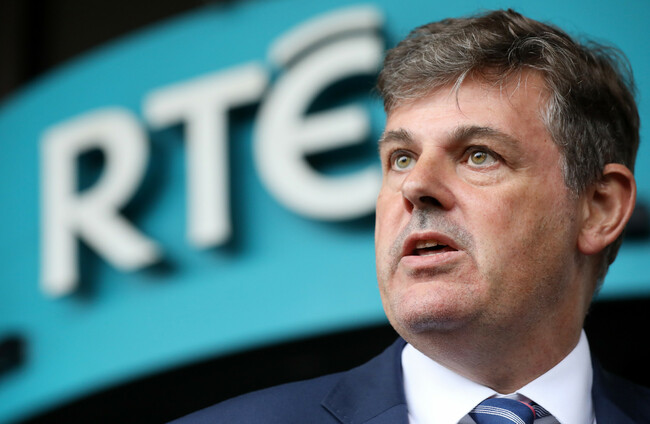
RTÉ DIRECTOR GENERAL Kevin Bakhurst has said he “completely rejects the assertion” that the pace of reform within the national broadcaster has been slow, after it was confirmed in Budget 2027 that it would receive €20 million less in funding.
In 2024, the government committed to providing public funding of €725 million to RTÉ from licence fee receipts and a direct top-up from the Exchequer over three years.
Of this, €260 million was allocated for 2027.
However, media minister Patrick O’Donovan today confirmed that the funding for next year would amount to €240 million. This is made up of €66 million in direct Exchequer support, and €174 million in projected licence fee collections.
Speaking at a post-budget briefing, he said the figure “is less than envisaged by the government in 2024″ but reflects “the overall funding available to my department”.
“It is also in the context of progress made by RTÉ in the delivery of their strategy,” O’Donovan said.
“While progress has been made across a number of issues, I am not happy that we have seen sufficient progress in delivering the smaller, more agile processes that we sought to be delivered under the strategy.”
He also said RTÉ will receive an €11 million “uplift” instead of a planned €31 million, adding that “we were simply not in that space to be able to do that”.
In a statement this afternoon, Bakhurst said the government’s decision “is one we had not anticipated and will inevitably impact on our ability to deliver our five-year strategy”.
“RTÉ welcomed and was grateful for the Government’s commitment in 2024 to provide public funding to RTÉ of €725 million over three years, from 2025 – 2027,” he said.
“In fact, the Taoiseach and the Tánaiste said at the time, that predictable multi-annual funding is key to RTÉ being able to deliver a strategy.”
Bakhurst said the decision to cut funding was coming at a “late stage”, when the organisation has “already made important commitments to our audiences, to the independent sector, to other important stakeholders and to RTÉ staff”.
He said the three-year funding commitment allowed RTÉ to plan ahead and, among other things, deliver independent news and analysis, commit to producing more public service programmes, invest in podcasts and the RTÉ Player, and stabilise its finances.
We completely reject the assertion that the pace of reform and transformation within RTÉ has been slow.
“The Leadership Team and I have delivered extensive reform since I took up the role of Director-General, including implementation of around 90% of the EAC report recommendations.
“We have also already managed to exit almost 100 people from the organisation, despite the late approval of the Voluntary Exit Programme and a short window to enable people to leave.”
Bakhurst said RTÉ board chair Terence O’Rourke was seeking a meeting with O’Donovan about the matter, “particularly given that RTÉ has committed to numerous agreements with its stakeholders based on this written and extensively publicised agreement.
He concluded by saying: “If the three-year multi-annual agreement will no longer be honoured – we now have some important decisions to make.”
When asked about Bakhurst’s statement at the briefing, O’Donovan said public service organisations across a number of sectors have had to demonstrate key efficiencies being delivered over the last 12 months.
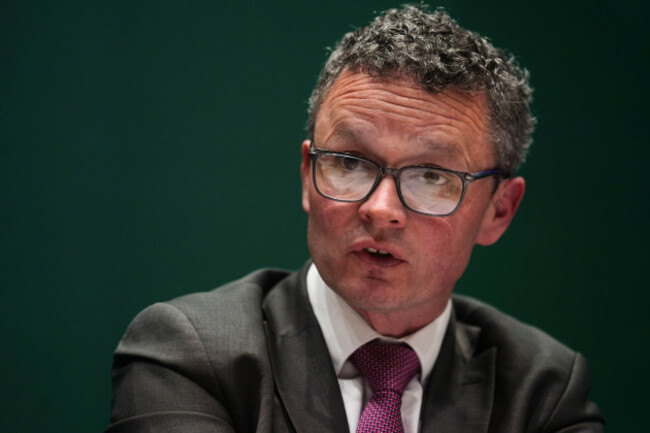
The Fine Gael minister said his department was “a very agency-dependent department” and had “very little scope, to be quite honest, about it in relation to where the resources that we had available to us needed to be assigned”.
He said it was “well-documented” that there were “issues” regarding RTÉ’s voluntary redundancy, something he said he hopes “would be able to be advanced and ameliorated”.
An internal analysis of the redundancy programme found that substantial work had been put into preparing early exit packages for staff, but only a relatively small number eventually received offers.
O’Donovan said his department would continue to engage with RTÉ on a weekly basis, and noted that €240 million “is not an insignificant amount of money”.
“It’s a quarter of a billion, and there are very few organisations across the state that can point to resource allocation of that order, and it certainly represents an enormous part of the current expenditure amount that is available to me as minister to be able to allocate.”
He concluded by saying he would update the government shortly on the delivery of the RTÉ reform programme, “including on progress made and what is yet to be achieved”.
The National Union of Journalists has condemned the government’s decision, calling it “alarming”.
NUJ general secretary Laura Davison said the cut exposed the government’s failure to meet its commitment to guarantee a well-funded and independent national broadcaster in Ireland.
“This decision raises serious questions about the government’s willingness to meet its pledges. It had agreed to a multi-annual programme of funding – now it is walking back its commitment to public service broadcasting,” she said.
“We urge the government to reconsider its decision and reform RTÉ’s funding model to secure the long-term future of Ireland’s national broadcaster.”
Meanwhile, media committee chair Alan Kelly has called on O’Donovan to explain the funding cut.
“This is a very worrying development. Government agreed funding with RTÉ, yet has now cut €20 million at a point when the broadcaster has already made significant commitments,” the Labour TD said.
“The Minister must explain why Government has changed course and what it expects RTÉ to sacrifice.”
Kelly noted that Bakhurst has made clear that RTÉ did not expect the cut and that it will affect its ability to deliver its five-year strategy, something which he said could impact “viewers and listeners, RTÉ workers and independent producers who depend on commissioning decisions”.
A head-on collision between RTÉ and Government is now looming. The Minister must engage immediately, explain this decision publicly and honour the funding commitment.
“Government needs to resolve this urgently before audiences, workers and programme makers pay the price.”
At the Public Accounts Committee in July, Bakhurst told TDs and senators that RTÉ was “tightening its belt” as it strengthened its financial position and “reversed the trend of reporting deficits” as a result of tighter cost controls supported by its new strategy, and the government’s €725 million multiannual funding commitment.
He said he would “appeal very strongly” for a similar multiannual commitment when it next comes for review.
When asked how much additional state funding RTÉ would be looking for from 2028, Bakhurst said discussions had not started.
He added: “We will need public funding. We will need funding from either the licence fee or a similar source of public funding.”
Separately, TG4 expressed “deep disappointment” at the level of funding announced in Budget 2027, which it said falls “significantly short of what is required”.
“At a time when interest in the Irish language is at a record high and demand for Irish-language content is stronger than ever, the decision not to increase TG4’s funding for 2027 is deeply disappointing,” ard-stiúrthóir Deirdre Ní Choistín said.
“TG4 is delivering growing audiences, significant public service value and economic, regional and Gaeltacht impact, while supporting the independent production sector across the country. Our funding should reflect the scale and ambition of that remit.
“This decision will inevitably have consequences for what TG4 can deliver in 2027. We will now assess the impact on our plans and strategic priorities for the year ahead.”

To embed this post, copy the code below on your site
















have your say