Sign in. It’s quick, free and it’s up to you.
An account is an optional way to support the work we do. Find out more.
Sign in. It’s quick, free and it’s up to you.
An account is an optional way to support the work we do. Find out more.
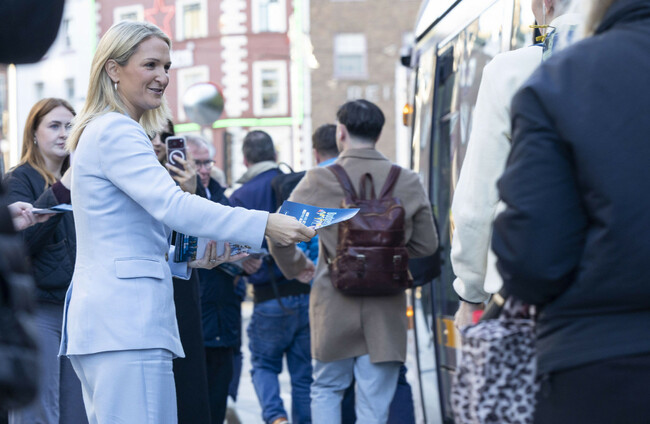
FINE GAEL MINISTERS made the brave choice to canvass public transport commuters this morning – a group some say were abandoned in the budget.
The government announced an extension to cuts in excise duty on petrol and diesel on Tuesday, which is sure to have left people who commute by car happy. But public transport commuters can look forward to an average 15% increase on fares next year.
On the bright side, the National Transport Authority expects that the price hikes will reduce the number of people using public transport – so commuters might have a bit more legroom (at a cost – and that’s without even getting into the implications for climate action).
Unsurprisingly, the distant prospect of extra legroom didn’t seem to be of great solace to the workers leaving packed Luas Green Line trams this morning at the Stephen’s Green stop in Dublin city centre.
The vibe was as chilly as the weather, and the army of Fine Gael TDs and parliamentary party members who showed up weren’t enough to thaw it out.
The majority of commuters completely ignored the canvassers eagerly thrusting pamphlets about the budget at them, while others outright declined.
To be fair, commuters probably didn’t expect to see a pack of elected officials and photographers waiting at the tram doors before they had even had their first cup of coffee.
The arrival of Minister for Foreign Affairs Helen McEntee led to a bit more engagement, and more commuters took the pamphlets, but they still weren’t eager to stop and chat.
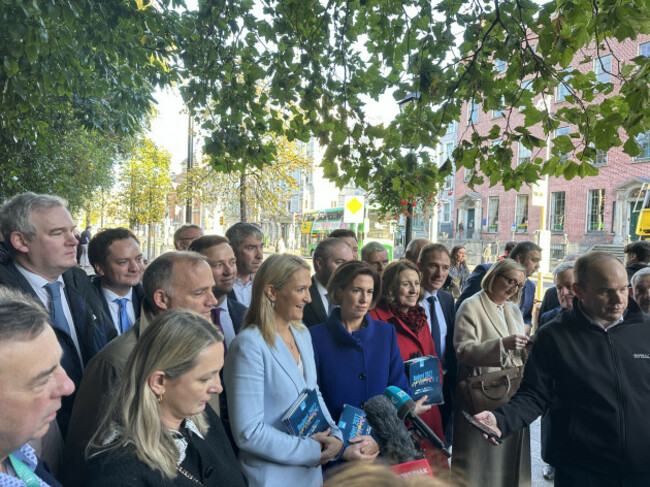
At least they didn’t have anything bad to say – unlike the many campaigners who criticised the government’s approach to public transport before and after the budget.
Just this morning, as the politicians were likely making their way to Stephen’s Green, the Dublin Commuter Coalition released a statement saying that the government is “going in the wrong direction”.
“With its second budget now delivered, Government have clearly shown us their priorities, and it’s certainly not people who get up early in the morning and commute to work, it’s the cars they drive and the roads they drive them on,” they said.
The government said the overall transport budget has increased, with over €1 billion secured for State-subsidised public transport services alone.
But the Dublin Commuter Coalition highlighted that in real terms, the budget for public transport has reduced in comparison to last year’s budget. They said the overall commitment is “barely enough to cover increased operational costs and rising fuel prices”.
The coalition pointed to the 2027 Expenditure Report which shows that €1,441 million was allocated to current expenditure for transport in 2026, compared with €1,376 million for 2027 – a decrease of 4.5%.
The Department of Transport said the reduction in the Department’s overall allocation compared with 2026 is “primarily due to a number of one-off measures that were included in the 2026 Revised Estimates”.
“Excluding these one-off items, the Department’s current funding allocation for 2027 has increased by €105 million,” it said.
Labour’s transport spokesperson Ciarán Ahern went as far as to say that public transport users are being abandoned and “punished for doing the right thing”.
The TD was critical of the budget’s failure to provide funding to stop the upcoming public transport fare hikes, as well as the lack of investment in the active travel budget.
But when McEntee was asked by a reporter this morning if she felt the choice to canvass public transport commuters was a bit brazen, she wheeled out the famously vague phrase and said the budget had to be looked at “in the round”.
The minister said many of this morning’s commuters will benefit from other measures, highlighting the increase in the top rate of tax and investments in education.
“What you have in the budget are a number of measures to try and support people, whether it’s commuters, people getting public transport, people who are in their cars,” she said.
“What we’re trying to do is firstly make sure that we’re continuing to invest in critical infrastructure, whether it’s the MetroLink, bus routes or public transport, but also making sure that people who are in their cars, that the reduce in excise that we’ve expanded to November now goes out to next year, and that people have certainty.”
Oh well, at least people have the promised MetroLink to look forward to – although seeing as it won’t be ready for passengers for at least a decade, some of this morning’s commuters may be retired.

To embed this post, copy the code below on your site











have your say