Sign in. It’s quick, free and it’s up to you.
An account is an optional way to support the work we do. Find out more.
Sign in. It’s quick, free and it’s up to you.
An account is an optional way to support the work we do. Find out more.
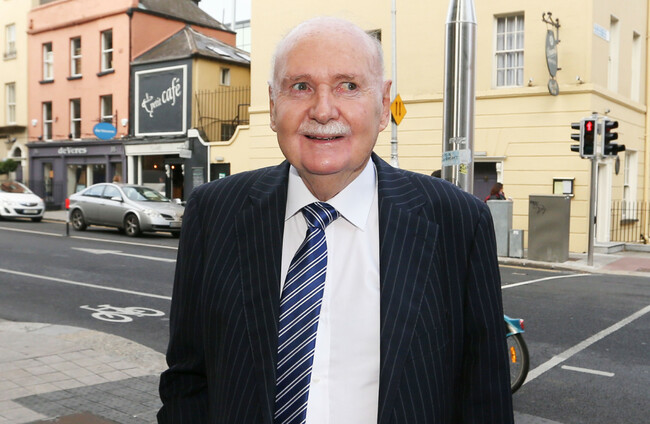
THERE ARE “BLACK holes after black holes” in the €250 million damages case against the former head of Irish Nationwide Building Society boss Michael Fingleton, his lawyer has told the High Court.
The civil case against the former INBS chief is in its fourth day before the High Court, where it is alleged that he negligently mismanaged the building society and engaged in property “gambles” with high-net-worth individuals in an informal and speculative manner in the mid-2000s.
Fingleton (87), who cannot give evidence due to ill-health, ran the building lender from 1971 to 2009 as managing director and chief executive. At its height in 2007, INBS had reported assets of €16 billion but was a high-profile casualty of the financial crisis of 2008.
Liquidators for Irish Banking Resolution Corporation (IBRC) have taken the case against Fingleton, who denies the allegation of negligent mismanagement.
The losses, relating to five specific property loans between 2006 and 2008, had been estimated by the IBRC at €6 billion.
However, only €250 million in damages is now being pursued by IBRC, relating to the five loans, allegedly approved by Fingleton. The court has been told that Fingleton was “nodding through” top-ups and extensions to certain clients without the knowledge of the society’s board.
At the High Court today, solicitor Niall Clerkin, for Fingleton, said there were “black holes” in the case in terms of documents and witness evidence against his client.
Clerkin said a senior staff member has said that “substantial tracts of documents” are missing in the case.
Clerkin said that a former UK branch manager based in the Belfast office of INBS, Gary McCollum, had told a court in Northern Ireland that documents before the courts were incomplete.
Clerkin said that, in addition to the incomplete paperwork in the case, none of INBS’ borrowers had been called by IBRC in the case currently before the High Court.
“It is an enormous black hole,” said the solicitor, who said there was no other witness in the case who could give evidence to the level of McCollum regarding the integrity of the five loan files subject to proceedings.
Clerkin said that it is IBRC’s case that there was a “critical triangle” at the top of INBS during the 2006 and 2009 period, namely: Fingleton, McCollum and Tom McMenamin, who the court heard was the head of commercial lending in INBS’ Dublin office from 2002.
Clerkin said that Fingleton was “incapacitated” and could not give evidence, that McCollum had given evidence that “there were substantial tracts of paperwork missing from our files” and that no reason had been put forward by the plaintiff regarding McMenamin not being a witness in the case.
Clerkin said there were “black holes after black holes” in the case against Mr Fingleton.
“This leaves us with one person [McCollum] left in the critical triangle, and he is too confused by the absence of documents to give certain evidence,” said Clerkin.
The solicitor said the court was being asked to make a determination in the civil case without a “settled” set of “binary, factual documents” available.
He said the court could not decide what “alarm bells” did or did not go off for Fingleton regarding caution and due diligence during the period of the issuing of the five loans. He said it was “too easy to portray him [Fingleton] as a man out of control”.
In opening the case on Tuesday, Lyndon MacCann SC, for IBRC, said Fingelton “gambled” with the society’s money when he allegedly approved “speculative, risky” commercial loans, which sometimes had already been greenlit by him before they were taken before the board of directors, on which he also sat.
The five loans allegedly approved by Fingleton relate to property land development projects between 2006 and 2008 in the UK and France despite them having no zoning or planning permission, counsel said.
It is further alleged that there were no securities in place on the loans and no personal guarantee sought for or provided by the borrowers.
Fingleton was a prominent presence in Irish business during the Celtic Tiger and was reported to have been worth around €75 million in 2006.
However, his son has told the courts that his father is reduced to €25,000 in two personal bank accounts and has outstanding judgment debts of more than €10.7 million.
The case continues at the High Court.
To embed this post, copy the code below on your site













have your say