Sign in. It’s quick, free and it’s up to you.
An account is an optional way to support the work we do. Find out more.
Sign in. It’s quick, free and it’s up to you.
An account is an optional way to support the work we do. Find out more.
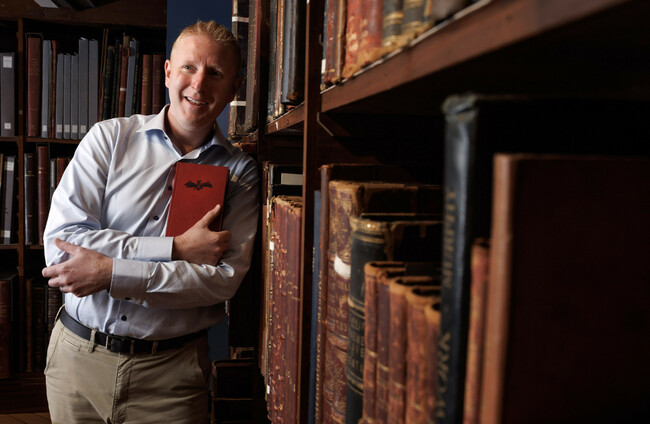
IT WAS A quiet, Covid Christmas when 41-year-old Brian Cleary went to bed with hearing in both his ears. When he woke up on St Stephen’s Day, that was no longer the case.
Cleary had lost all hearing in his left ear. There were no warning signs.
Cleary, the Chief Pharmacist at Dublin’s Rotunda Hospital, struggled with tinnitus and adapting his life to deal with his sudden hearing loss. Things he previously enjoyed, like going to gigs and listening to audiobooks and podcasts, seemed out of reach.
In 2023, he took time off work and travelled to Berlin to receive a cochlear implant under the HSE’s Treatment Abroad Scheme. At home while recovering, he spent time in the National Library, where he spent time reading historical literature and the works of Bram Stoker, an author he has been a life-long fan of.
On 12 October, 2023, Cleary was in the National Library combing through works of Stoker when he uncovered a lost short story by the famed author.
The story, titled Gibbet Hill, was found in a Christmas supplement of the Dublin Daily Express in 1890 and remained undocumented for over 130 years. It had never been referenced in any Stoker bibliography or biography.
Speaking around the time of the discovery, Cleary said he had sat in the library, “holding my breath while I gazed at what I had just found: a long lost ghost story from Bram Stoker.
“As I read this gem of a story, the thought struck me that unless someone had found it and had not shared it, I was possibly the only living person who had read it, followed by “What on earth do I do with it?”.
With the help “an amazing collection of people” the work was published with a foreword by Roddy Doyle, accompanied by a reproduction of an 1862 paper by Stoker’s mother Charlotte Stoker, which advocated for the education of hearing loss.
Original artwork by Paul McKinley, an account of how Cleary found the piece, and an analysis of the work by Stoker biographer Paul Murray are all included in the book, which is available to purchase here.
This year’s Macnas Halloween parade is inspired by Gibbet Hill. It takes place in Dublin at 7pm on 2 November. The City Council’s annual Bram Stoker festival begins tomorrow and runs until Monday 3 November.
In tandem with the book’s release, Cleary helped establish the Charlotte Stoker Fund, administered by the Rotunda Foundation, which funds research into preventable hearing loss in vulnerable newborns.
A year on from the book’s publication, the fund has helped establish a testing system in the Rotunda Hospital that allows for the testing of vulnerable newborns.
In place since April, the testing is, in essence, a cheek swab that is placed into a machine that can present results in 26 minutes. The test can tell staff whether the child has a gene that places them at risk of receiving a certain antibiotic.
The antibiotic is important and used to treat sepsis, but for some babies, it can lead to hearing loss. This is rare and affects around 2-4 of 1,000 babies. The gene testing enables doctors to opt for a different antibiotic that won’t place the baby at risk.
So far, around 130 babies in the Rotunda’s neonatal unit have been tested.
“We’re lucky that so far, we’ve received enough funds through the Charlotte Stoker Fund to get lift-off for this study,” Cleary said. It is also receiving support from the hospital.
“It’s very exciting – it’s what I had in mind for the Charlotte Stoker Fund when we pitched it to the hospital,” he said. The team are hoping to raise awareness of the book, so the sales can flow into the fund and continue to support the testing.
In the long-term, Cleary hopes the fund will grow enough to explore other avenues, such as supporting small children with cochlear implants and studies into Irish sign language.
Cleary’s personal story of hearing loss and Charlotte Stoker’s advocacy over 160 years ago intertwine today.
Speaking to The Journal, Cleary said his cochlear implant has completely changed his life, and he continues to advocate for children and adults who face hearing loss.
“It’s hard to realise the impact [of sudden hearing loss] without experiencing it,” he said, “but it completely changes your ability to communicate in noisy environments and in lots of different settings.
“So overnight, my perfect hearing was gone, and everything was changed, and I didn’t get the treatment I needed immediately. I was unfortunately treated for a middle ear infection. I didn’t get the steroids I needed until day seven.”
Each year, a thousand people in Ireland will develop sudden sensorineural hearing loss. Of these, “some people will get better, but some people won’t. Their lives will be forever changed.”
Cleary urged anyone who experiences this to go to hospital urgently and receive treatment immediately.
Although Cleary’s hearing in his left ear was not salvageable due to the delay in starting the required treatment, he has used his situation to advocate for others.
“Getting the opportunity to advocate is absolutely incredible, and then to be able to get better accessibility for disabled people at things like gigs, like getting plugged into the sound desk – CMAT was one of the first people who helped me with that in the Olympia a couple of years back.
“And it was just magic to get a really good gig experience again, when I really thought I’d attended my last gig.”
For people like Cleary who have a cochlear implant, there’s a system that allows for the implant to be wirelessly connected to the sound desk at a concert that enables the sound desk mix to be transmitted to their implant.
Cleary has now been to over ten concerts since he received his cochlear implant and is working to convey the possibility to parents of children with cochlear implants so that they can similarly enjoy the arts.
Of Charlotte Stoker and the fund established in her name, he said, “I think she’d be happy with what’s happened since.”
The book is available here and donations can be made directly to the fund here. Prints by Paul McKinley are available here. All proceeds go directly to the fund.

To embed this post, copy the code below on your site














have your say