Sign in. It’s quick, free and it’s up to you.
An account is an optional way to support the work we do. Find out more.
Sign in. It’s quick, free and it’s up to you.
An account is an optional way to support the work we do. Find out more.
LAST UPDATE | 12 Jul 2023
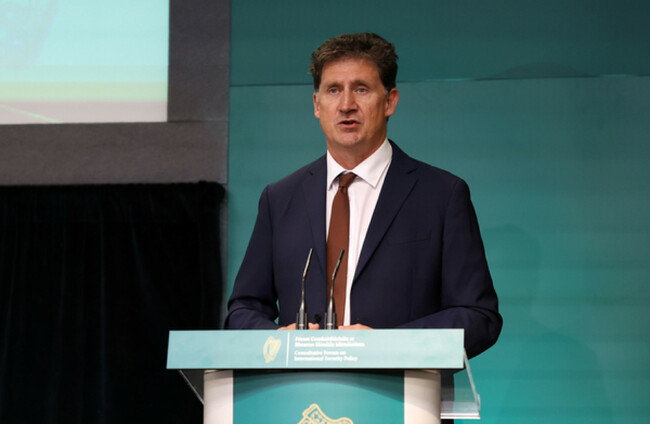
MINISTER FOR TRANSPORT Eamon Ryan said the Irish Government is willing activate mechanisms if needed to prevent the US military from transporting cluster bombs through Shannon Airport and in Irish airspace.
The Biden administration’s recent decision to supply Ukraine with cluster bombs has brought the possibility of their transfer though Ireland into focus as the US military regularly uses Shannon Airport as a stopover.
The minister insisted that the Irish government takes “a strong position” on the use of cluster munitions and that mechanisms are in place that can be used to block their transport through Ireland.
Ryan raised concerns about the transport of cluster bombs through Ireland and its airspace and when pressed by The Journal about whether the government would block flights if needed, Ryan said they would.
“Yes is my answer, because clearly in my mind, talking to the Taoiseach and Tánaiste about this, we’re all of a similar view. We’ve taken a strong position on the use of cluster munitions and we maintain that position.”
He also said that diplomatic and political courses of action would be the government’s first choice when it comes to dealing with the potential transit of cluster bombs, which are banned by over 100 countries including Ireland.
“We are opposed to the use of cluster munitions,” he said.
“We do have a role where we have to review, if there are any flights going through Shannon or over our airspace, which munitions are carried. So we have some mechanisms to monitor that but it’s the use in the first place (that) is our primary concern.”
Under the UN treaty banning cluster munitions, Ireland is not only prohibited from producing and using such weaponry but from transferring it directly or indirectly as well.
Cluster munitions consist of small bombs encased in a shell which is opened in the air above a targeted area. The bomblets rain down and explode on impact with the ground – in most cases.
The reason they are banned in many countries is that they pose a significant risk to civilians due to their inaccuracy and because they tend to leave unexploded ordnance on the ground, often contaminating the landscape long after a conflict has ended.
The UN treaty was first signed in Dublin in 2008. Other notable signatories include France, Canada, the UK and Germany, all of whom are NATO members.
Last week, following the announcement from Washington, the Department of Foreign Affairs issued a statement clarifying the government position on the issue, saying:
“Ireland has held a strong and unwavering commitment to the Convention on Cluster Munitions (CCM) since its adoption in Dublin in 2008.
“Along with the over 100 States Parties to the CCM, we maintain our position that these weapons are by nature, indiscriminate and imprecise.
“The documented use of cluster munitions in armed conflicts underscores the continuing threat that these weapons present to civilians.”
With reporting by Christina Finn

To embed this post, copy the code below on your site












have your say