Sign in. It’s quick, free and it’s up to you.
An account is an optional way to support the work we do. Find out more.
Sign in. It’s quick, free and it’s up to you.
An account is an optional way to support the work we do. Find out more.
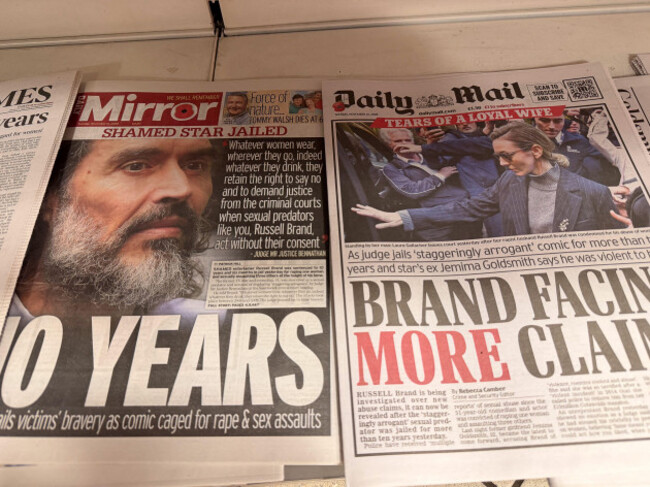
IT WOULD BE wonderful to think that the sentencing of rapist Russell Brand heralds a new era for celebrity behaviour, and by extension predatory behaviour across society.
Wouldn’t it be great to believe that, nearly a decade on from #MeToo, Brand being jailed for 10 years would send out a strong message to abusers: your actions will not be countenanced.
Brand’s sentencing and the widespread horror over his actions teach us several things:
That celebrity can be, and is, used as a shield to hide predators and the public from the true scale of their abuse.
That the power wielded by a famous man can be used to commit the most heinous of crimes.
And that a predator might not recognise he is a predator at all.
Celebrities hold a distinct form of power that can be fused with the male power fostered by a patriarchal society.
It’s the kind of power that acts as a magnet, attracting others into their orbit, eager for a taste of their fame. The kind of power that means such people get used to their whims being catered for.
The kind of power that means abusers can get away with seeing themselves as benign figures when their manipulative behaviour is in fact malignant.
They might know that certain crimes – grooming, sexual abuse, rape – are wrong. But their status can foment a destructive form of cognitive dissonance when they are the ones committing those very crimes.
They’re not used to analysing what it means to want what they want, and get what they reach for.
This means that their victims can be gaslit into believing what they feel is not real, or worth acting on.
Russell Brand claimed not to recognise his own behaviour as rape or sexual assault - but, crucially, a court did.
It will take much more time, soul-searching and societal change for us to get to a point where behaviour like Brand’s is an egregious exception to the norm.
We are still only at the point where allegations about high-profile celebrities are being made public after years of speculation.
On Tuesday, accusations about the behaviour of David Walliams were published in The Guardian and on ITV. Walliams had unsuccessfully attempted to seek a court injunction preventing the outlets from publishing articles alleging he had used his celebrity status to prey on young women and girls for sex.
Walliams denies the accusations contained in the reporting. The article details several instances of him messaging female fans in their late teens, inviting some to his house and others to his hotel room.
Walliams, through his lawyers, denies targeting teenagers and women and using his celebrity status to manipulate them into having sex with him.
There is a clear distinction in the two stories, in that Brand has been convicted by a court of law and no criminal findings have been made against Walliams.
On Friday afternoon, London’s Met Police confirmed they had launched an investigation into the former Little Britain star in the wake of receiving claims against him.
In the cases of the two men, the fact that accusations emerged at all is thanks to dogged reporting by journalists and the utter bravery of women coming forward to tell their story.
It’s well overdue for us all to reflect on how the society we live in, coupled with the mores of the entertainment industry, helps to create the fertile ground for such behaviour.
In Brand’s case, you would be hard-pressed to find a woman who does not recognise the conditions that could lead to a high-profile entertainer being able to take advantage of or manipulate women, and for it to take time for his victims to recognise what was done to them.
The fact that Brand was brought to justice at all was due in large part to the MeToo movement, which was founded in 2006 by Tamara Burke but found new life and vigour on Twitter.
Spurred on by the 2017 New York Times reporting about producer Harvey Weinstein, ordinary women shared their own stories of abuse and harassment via the hashtag #MeToo.
This was a time when people speaking out about such issues online could be called ‘snowflakes’ and ‘social justice warriors’. But while it’s easy to dismiss one person, there is huge power in numbers. #MeToo forced the world to acknowledge that gender-based abuse is not experienced by a tiny minority of people.
In fact, the fear of such abuse is stitched into the reality of every woman’s life. #MeToo laid bare the rancid power that abusers can have to silence and destabilise a person.
This global moment of reckoning showed the scale of abuse, and tilted the world towards justice.
At least for a while.
#MeToo did mean that the door leading towards justice for celebrity sexual crimes could be pushed open. But in 2026, there has been a feeling that the door is in danger of being shut completely.
On X (formerly Twitter), where #MeToo blossomed, right-leaning figures now hold more sway. Misinformation abounds, diluting the power of users’ voices. AI is being used to deliberately sow contempt and confusion.
Meanwhile, equality is being treated by some powerful politicians and corporations as a disposable, optional commodity, rather than an essential part of living in a fair and just world.
Because of this, the openness that was fostered online towards speaking out about injustice and abuse had started to disperse in recent years. Mercifully, in the past few weeks there’s a sense that things have shifted again, and it feels like survivors have been given new voice.
But what a journey it can take for allegations to be made public. And the question still stands: will we actually learn from the continued revelations and allegations surfacing about powerful male celebrities?
It’s not a surprise that someone who holds a high level of power and who is gifted celebrity status could use this combination to abuse. But this abuse can be enabled by an entertainment industry that prizes money and success above the wellbeing of individuals.
Plus, a society that doesn’t acknowledge its inherent blind spots when it comes to gender inequality creates the conditions that lead to survivors of abuse being ignored, dismissed or questioned in court about their sexual history.
If there is something to be learned from allegations about celebrities, it is that such behaviour does not happen in a vacuum. To pretend otherwise is to ignore that the entertainment world, and society at large, hold the tools that can dismantle this damaging system.
There are surely many barely-concealed ‘open secrets’ about celebrities currently festering. In 10 years’ time, we’re likely to see allegations about a currently beloved celebrity emerge.
But how much will society have changed in the interim? If nothing is learned, we’re condemned to go through this cycle to infinity.

To embed this post, copy the code below on your site













have your say