Sign in. It’s quick, free and it’s up to you.
An account is an optional way to support the work we do. Find out more.
Sign in. It’s quick, free and it’s up to you.
An account is an optional way to support the work we do. Find out more.
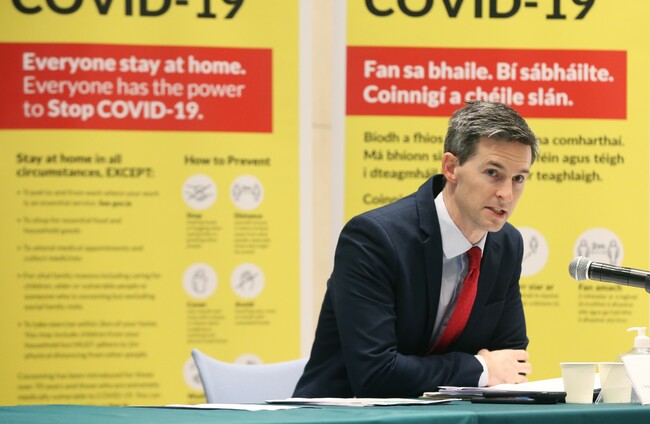
PUBLIC HEALTH OFFICIALS confirmed a further 1,372 new cases of Covid-19 and seven deaths in Ireland as Deputy Chief Medical Officer Dr Ronan Glynn led this evening’s press briefing of the National Public Health Emergency Team (NPHET) addressing the Covid-19 crisis.
This evening’s figures mean that there have now been a total of 188,923 cases of Covid-19 in Ireland, along with 2,977 deaths.
Here’s what was discussed at this evening’s briefing:
“From NPHET’s perspective, any measure that reduces the risk of someone who is infected or infectious coming into this country is welcome,” Dr Glynn said.
“There are a number of ways in which travel can be disincentivised and a number of those measures are already in place. Okay, we have significant or reasonably significant levels of travel into and out of the country, but they are a shadow of what we would have seen in pre-pandemic times,” he said, adding that the most useful measure has been public willingness to forego non-essential travel.
Any measures that reduce passengers from entering the country are helpful, but the most useful tool has been public compliance, says Dr Ronan Glynn. People should still restrict their movements on entry - even with a negative test. | Read more: https://t.co/yW9N08ihLJ pic.twitter.com/am5JBN10w5
— RTÉ News (@rtenews) January 25, 2021
Those travelling into the country without a negative PCR test are set to face quarantine under the new rules, with passengers from “high risk areas” such as South Africa and Brazil also likely to be subject to mandatory quarantine.
Dr Glynn said a negative test prior to travel “simply tells us that they were not infected or didn’t have a viral load sufficient to produce a positive test at the time they were tested”.
“But it doesn’t tell us that they’re not potentially infectious,” he said.
“So, our perspective, we do want people to quarantine, restrict movements for a period of time. And depending on the precise circumstances of the individual, it may be appropriate for them to take a further test five days after arrival in the country.”
When questioned about the reopening of schools, Dr Glynn said that “right now is not the time to see mobility of over a million people that would be associated with a full reopening of education”.
“We’re still at a level of disease that is way, way higher than where we want to be or need to be, in general terms,” he said.
Dr Glynn said there needs to be a “continued improvement” in case numbers and ensure that figures “don’t plateau”.
Deputy CMO Dr Ronan Glynn says he can’t see the movement of a million people - as would be happening if schools reopened - happening in the next fortnight. | Read more: https://t.co/yW9N08ihLJ pic.twitter.com/vZP1qibFM5
— RTÉ News (@rtenews) January 25, 2021
“The number of admissions per say may be starting to decline, that may be beginnings of a slow decrease in numbers in intensive care. But as I mentioned … we expect those numbers to remain very high for weeks to come,” the chair of NPHET’s Irish Epidemiological Modelling Advisory Group Professor Philip Nolan said.
In the US, White House advisor Dr Anthony Fauci has said wearing two face masks “likely does” provide more protection than wearing just one.
“We constantly look at the emergency evidence around masks and other infection prevention control mechanisms that people can use in the community, but then obviously, in healthcare settings,” Dr Glynn said.
“From our perspective, in the first instance, we’re keen that any change in terms of [guidance on] masks would ensure that supply is sufficient for people working in healthcare settings,” he said.
Dr Ronan Glynn says they are keen that any change in terms of masks would ensure sufficient supply for people working in healthcare. NPHET will look at the issue of wearing medical masks, but the most important thing is to wear a mask. | Read more: https://t.co/yW9N08ihLJ pic.twitter.com/bGSBn151N7
— RTÉ News (@rtenews) January 25, 2021
Dr Glynn said they have been looking at the measures put in place in Austria and will make such recommendations “if we feel they are appropriate”.
“The first point for the general public is not to get overly concerned about the type of mask and to focus in the first instance on wearing a mask, wearing that mask appropriately and cleaning your hands before and afterwards, disposing of the mask appropriately, rather than focusing on the type of mask,” he said.
You can sign up to TheJournal.ie’s coronavirus newsletter below. Tomorrow’s edition will include further details from the briefing.

To embed this post, copy the code below on your site














have your say